Redford architectural fabrics: Braided Journey
Annaberg-Buchholz

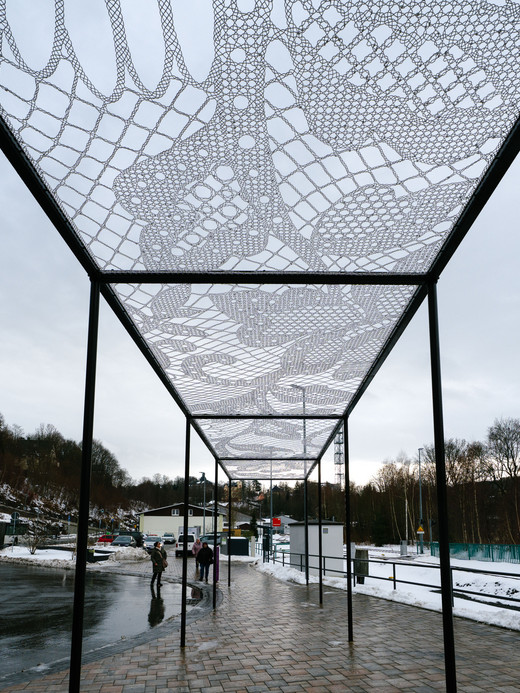
Although created specifically for the location, the large-format sculpture Braided Journey stands at the Lower Station in Annaberg-Buchholz as if unintentionally and perhaps not recognisable as a work of art at first glance. The work, created by the Dutch artist and designer group Redfort architectural fabrics, plays with the idea of a sculptural drawing in space, but also with the idea of a platform roofing that is typical of a railway station. Four 3.90 x 2.90 metre meshes, each made of steel wire coated with white plastic, are stretched between eight steel columns, each four metres high.
Rhythmically arranged floral elements are reminiscent of lace and braids and are associated with the craft of lace-making, which is particularly relevant in Annaberg-Buchholz, thus taking the viewer on a journey that begins with the 16th century mining entrepreneur Barbara Uthmann. After the early death of her husband, Uthmann took over the management of the silver mines and ran the Saigerhütte in Grünthal (until her de facto expropriation by Elector August of Saxony in 1567). From 1560, she was a driving force in the production of braids, lace and trimmings and at times employed up to 900 women in domestic labour. The Frohnauer Hammer, a silversmith and ore hammer mill established in 1621, is the oldest industrial monument in Saxony and is located in the immediate vicinity of the Lower Railway Station. The lower railway station was opened in 1866 as part of the then economically important railway line between Zwickau and Chemnitz. In GDR times, the line was also used by the uranium-producing SDAG Wismut. Rail transport between Annaberg-Buchholz and Schwarzenberg was discontinued in 1997, and in 2021 Chemnitz University of Technology opened the Smart Rail Connectivity Campus (SRCC), where research is being conducted into the future of the railway. Braided Journey could also give the public a glimpse of a journey through the economy of the Ore Mountains spanning more than 460 years.
(Text: Alexander Ochs)
Redfort architectural fabrics
Braided Journey
Material: powder-coated steel
Erected with the support of the city of Annaberg-Buchholz.
Address:
Lower railway station
09456 Annaberg-Buchholz
to the location on Google Maps


Annaberg-Buchholz - Ingenuity above and below ground
Annaberg-Buchholz, the first planned mining town to be built directly above the silver mines, is architecturally diverse. Its urban geography and architectural monuments range from the Renaissance to the Wilhelminian era, as visitors let their gaze wander around the old town centre. In the 16th century, Annaberg (Duchy of Saxony - Albertine line) developed into one of the centres of silver mining and was the second largest mining town after Freiberg. At that time, Buchholz was still an independent town and belonged to the Electorate of Saxony (Ernestine line).
The town is a great experience both above ground and underground: in the silver mine "Im Gößner", directly below the old town, you can take a trip back to the early 16th century. At that time, the mining official and scribe Adam Ries published the first arithmetic book here in German and with Arabic numerals. This made bookkeeping and administration much easier and set a precedent throughout Europe.
The story of the entrepreneur and benefactress Barbara Uthmann, who continued to run the family mines and a smelting works after the death of her husband in 1553, is extraordinary. She used the financial profits to establish a new branch of the textile industry in the Erzgebirge with the production of braids and lace. Over 900 women were able to supplement their income by working at home. The artwork "Braided Journey" by Redfort architectural fabrics at Bahnhofsplatz 1 is a reminder of this tradition.
St Annen Church, named after the patron saint of miners, can be seen from afar. The late Gothic hall church (consecrated in 1519) with its graceful ribbed vault is the symbol of mining culture par excellence. On the mountain altar, visitors can see the oldest artistic depiction of Saxon mining from the Reformation period. At that time, the "Annaberger Kät", one of the oldest folk festivals in Germany since 1520, also originated from a church festival after Whitsun.
You can find more information at the Annaberg-Buchholz World Heritage Visitor Centre
Ore mining landscapes: silver, tin, cobalt, uranium, iron
Silver, tin, cobalt, uranium and iron represent the five ore mining landscapes that characterise the Erzgebirge/Krušnohoří Mining Region UNESCO World Heritage Site. Each gives visitors an insight into mining and processing in individual eras and illustrates the significance from a global perspective.
Markus-Röhling-Stolln visitor mine: silver, cobalt and uranium mining
Thanks to the "Altbergbau Markus-Röhling-Stolln e.V." association, visitors to Annaberg-Buchholz can experience a large mining area. the ride on the mine railway is 600 metres long. Impressive evidence of silver and cobalt mining (1733 to 1857) and uranium mining by SAG Wismut (after 1945) can be seen. The nine metre tall "Kunstrad", a reconstructed hydroelectric power plant, demonstrates the technical innovations used to extract ore at great depths. Since 6 July 2019, the "Markus-Röhling-Stolln" has been part of the UNESCO World Heritage Erzgebirge/Krušnohoří Mining Region.
Frohnauer Hammer Museum: Germany's 1st technical monument
The intelligent utilisation of hydropower not only improved the extraction of ore from great depths, but also the efficient processing of metal materials and products. Forge hammer mills can still be seen in operation in some places in the Ore Mountains, such as the "Frohnauer Hammer" (17th century) near Annaberg-Buchholz. It is the oldest protected technical monument in Saxony (since 1907) and the oldest forging museum in Germany (since 1910).
Altars to kneel down to: The mountain altar in St Annen by Hans Hesse (1521/22)
On the back of the mountain altar of St Annen (consecrated in 1519) in the mining town of Annaberg-Buchholz, visitors can see the oldest artistic depiction of Saxon mining from the Reformation period. The painting was created by Hans Hesse and is the symbol of mining culture par excellence.
It tells the legend of Daniel Knappe, who found the first silver in Annaberg. At night, he dreamt of an angel who showed him a place at the foot of the Schreckenberg where he would find silver. And so it happened, according to legend. From then on, the legend continues, all working miners were called miners in honour of Daniel.
The depiction of the miners' working world in a religious context was new in art history at the time, as was the use of folk tales as motifs. The differentiation of the pictorial areas according to work processes and occupational groups is remarkable, as is the first depiction of women as miners. Women are depicted twice in the Hesse painting in the role of ore washers.
The mining altar is therefore a unique testimony to both social history and a new piety: it was commissioned by miners, financed by miners themselves with the so-called "weekly penny" and created for the community of miners. The front of the carved mountain altar depicts traditional scenes from the life of Mary. It is hinged and shows depictions corresponding to the church year.
Another depiction of a miner can be found on the back of the pulpit: a miner can be seen sitting on his arse leather at the pulpit entrance, working the rock in the mine with iron and mallet in search of silver ore. In this context, it may also symbolise the search for the spiritual treasure, the Word of God.
"Beautiful door" by Hans Witten in St Annen Church
The "Beautiful Door", which is attributed to the master Hans Witten, is labelled with the initials "HW". God the Father, Jesus and the Holy Spirit are depicted above the door, adored by a choir of angels. The work of art dates back to 1512 and originally came from a monastery in Annaberg, which was dissolved during the Reformation. the "Beautiful Door" was moved to St Anne's Church in 1577. The Annaberg baptismal font was also made by Hans Witten (1521) and comes from the former Chemnitz monastery.
Church of the miners: St Mary's
In 1502, the Annaberg miners built their mining church of St Mary on the market square. Financed from the "weekly pennies" of the miners, only mining devotions were held here from 1511 to 1863. The church was converted into an event centre in 2004 and 2005 after being renovated in line with its listed status.
Mining services are still held here on the 2nd Saturday in January. The large carved figures of the miners' nativity scene are well worth seeing. As a unique witness to centuries of Erzgebirge piety, St. Mary's has also been a UNESCO World Heritage Site in the Erzgebirge/Krušnohoří Mining Region since 2019.
Innovations in the Ore Mountains mining region: Learning to calculate anew. Giving new work.
Mining has always been both a blessing and a curse for people over the centuries. If the ore veins offered rich quantities of silver, people were able to earn a living. The mining towns grew and the wealthy bourgeoisie promoted culture and education. If the yield declined, creative rethinking was required to secure a livelihood. The biographies of an Annaberg mining official and an entrepreneur reflect these developments.
Master calculator secures bread prices: Adam Ries (1492-1553)
Soon after the founding of the free mining town of Annaberg (1497), an efficient school system was established. The up-and-coming mining industry and its processing industry needed - today we would say - skilled labour. Attracted by the "mountain clamour", Adam Ries from Staffelstein in Franconia came to Annaberg in 1522. His youth and education are not recorded in historical sources. What is known is that he had a talent for maths and therefore found employment in the Annaberg mining administration.
There he was responsible for supplying the town with food. At that time, almost everything had to be imported from nearer and further afield in the foothills of the Ore Mountains. In order to maintain social peace and balance among the townspeople, he devised the "Annaberg Bread Order" (1533), in which prices were regulated. Standardised bread sizes and prices helped to cushion the impact of fluctuating grain prices. This was imitated in the towns of Hof, Joachimsthal (today: Jachymov), Leipzig and Zwickau.
His experience in mining administration had a lasting effect on the school system. Ries used a new system of arithmetic based on Arabic numerals in the classroom for the first time. He also published three arithmetic books in German, which were widely distributed. The first book (1518) dealt specifically with teaching children how to use the abacus. In the second book (1522), he explained arithmetic with Arabic numerals, a bestseller that went through 120 editions. He demonstrated applied arithmetic in the third book (1550) with many examples, e.g. calculating the contents of barrels.
in 1525, Adam Ries bought a house at Johannisgasse 23. Today, the Adam Ries House is a museum and documents this exciting history of the new arithmetic - which you can also take part in. The listed museum building is part of the Annaberg-Frohnau Mining Landscape and is a UNESCO World Heritage Site in the Ore Mountains/Krušnohoří Mining Region.
Entrepreneur of European standing: Barbara Uthmann (1514-1575)
Few names are more synonymous with the economic prosperity of Annaberg-Buchholz in the 16th century than that of Barbara Uthmann. She was a wealthy "Fundgrübnerin", i.e. mine owner in Annaberg, Buchholz, Schneeberg (copper) and Ehrenfriedersdorf, Marienberg (silver). She also very successfully ran the Saigerhütte in Grünthal, now Olbernhau, a smelting operation that extracted large quantities of copper and silver. Probably never before had a woman presided over such a large mining empire.
She had inherited the company from her husband, who had died in 1553. Together with her sons, this extraordinary woman managed to fend off the intrigues of her male competitors. All these years, she was under the male guardianship of the town clerk Georg Kraus (until 1567) and councillor Johann Kluge, in accordance with the town law of the time. The Saxon Elector August exploited the intrigues in the fierce competition for his own interests and revoked Barbara Uthmann's copper privilege in 1553. In 1567, she was forced to sell the Saigerhütte to the Elector.
New craft: lace-making as an acquisition for miners' wives
As a clever businesswoman, Uthmann increasingly invested her fortune in the 1570s in a new production and distribution concept for textile goods, the so-called publishing system. According to one source, she employed 900 women who produced textile braids, lace and elaborate bobbin lace at home. This offered new social security, not least for some miners' widows. For Barbara Uthmann, the small-scale publishing business minimised the entrepreneurial risk as a woman. Her business skills must have been excellent. As a child, she is said to have enthusiastically attended Adam Ries' school of arithmetic.
Lace-making as a craft probably originally came to Germany from Brabant (Belgium), Venice and Switzerland. Around 1550, sources speak of production in Annaberg by the Uthmann family and other families. Fine trimmings for the decoration of clothing were already being produced around 1530, with Scottish merchants having a monopoly on the trade. The Uthmanns attained the status of purveyors to the electoral court.
Annaberg - the centre of lace-making
Barbara Uthmann epitomises the Erzgebirge mentality of tenacity and ingenuity, business acumen and social responsibility, regional roots and international networking in an exemplary manner. Annaberg remained the Erzgebirge centre for lace-making for over 300 years. In honour of Barbara Uthmann, a fountain with a bronze sculpture by Dresden sculptor Robert Henze (1886) stands on Annaberg's market square. She remains a central figure in the cultural memory of the region to this day. The artwork "Braided Journey" by Redfort architectural fabrics at Bahnhofsplatz 1 is also a reminder of this tradition.
Making the future: A typical mentality in the Ore Mountains
Innovation and a sense of tradition, openness and immigration have always ensured the survival of the Erzgebirge mining region. All of this bears witness to many transformations that reach far back into history and in some cases continue to this day. The region has always been on the move. People came and went with the economic ups and downs, reinvented themselves culturally and further developed crafts and technology. This is still the case today.
Mobility of the future: Sören Claus conducts research at the Smart Rail Connectivity Campus
Annaberg-Buchholz was connected to the Saxon railway network in the middle of the 19th century. This gave the industrialisation of the region a huge boost. The transformation to metal processing and the textile industry compensated for the decline in mining. Even today, in times of climate change, innovations are in demand. New mobility concepts play a central role in this.
The "Smart Rail Connectivity Campus" project at the Lower Railway Station in Annaberg-Buchholz is developing intelligent solutions for rail transport: automated driving and intelligently networked systems in railway technology and drives. The line between Annaberg-Buchholz and Schwarzenberg is used for test runs. The joint project is being led by the city of Annaberg-Buchholz and Chemnitz University of Technology. It is supported by the Free State of Saxony and DB RegioNetz Verkehrs GmbH/Infrastruktur GmbH Erzgebirgsbahn. The Purple Path artwork "Braided Journey" by Redfort architectural fabrics is also located here at Bahnhofsplatz 1.
Inclusion hotel: Enabling participation with Anna und Sascha e.V.
Association chairwoman Katja Seifert and her colleagues have been committed to the realisation of a social project in Annaberg-Buchholz since 2016: the inclusion hotel. In future, people with and without disabilities will be able to develop ideas, work and live together there. in 2017, the association bought and renovated an old house at the "Buchholzer Tor". The inclusion hotel opened in August 2025.
The project was inspired by the life story of a boy from St. Petersburg. Sascha was born there in 1995. The doctors diagnosed him with Down's syndrome. The boy was placed in a children's home. There he met Katja Seifert, whose brother was involved in social work in Russia through the "Perspektiven" e.V. association. They couldn't let go of the boy's fate. After persevering with the Russian and German bureaucracy, they succeeded in bringing Sascha to Germany. Here he was able to receive better medical care and grow up in a family environment.
Every person is valuable
This maxim is one of the core values of the Capital of Culture Chemnitz 2025 and also characterises the commitment of Anna und Sascha e.V. In 2022, the Berlin-based sculptor Christina Doll took up this theme. She reinterpreted the well-known Erzgebirge figure motif "Angel and Miner" for the PURPLE PATH. Her angel represents a young woman with trisomy 21. The group of figures presents the mining tradition of angels and miners with the idea of inclusion.
The artist's study room: avant-garde writer and sound artist Carlfriedrich Claus (1930-1998)
Carlfriedrich Claus was born in Annaberg and is today regarded as one of the most important artists of the GDR. His artistic work is considered avant-garde and includes graphic art, visual and concrete poetry as well as sound poetry. Early on, he became interested in languages from all over the world, which inspired his experimental use of typography and sound. His oeuvre - now a protected cultural asset of the state of Saxony - comprises several hundred audio cassettes with articulations, language sheets, hand drawings, books, prints and thousands of letters and photos.
in 1977, together with Michael Morgner, Thomas Ranft, Dagmar Ranft-Schinke and Gregor-Torsten Schade, he founded the artists' group and producers' gallery CLARA MOSCH (1977-1982) in Adelsberg, a district of Karl-Marx-Stadt/Chemnitz. Their art received no attention and had no place in the official art scene of the GDR. Their actions not only attracted attention from the art scene, but also from the State Security. They were spied on, but all the threats and intimidation could not stop their endless and sometimes subversive creativity.
Study room in the Gloria Filmpalast Annaberg-Buchholz
The Förderverein Carlfriedrich Claus - Lebens- und Arbeitsort in Annaberg-Buchholz e.V. renovated his flat in Johannisgasse and opened a study room and meeting centre there. The rooms are located in the rear building under the Annaberg Gloria Filmpalast.
Kunstkeller Annaberg e.V.: The artist Jörg Seifert (*1968)
The association, led by its chairman Jörg Seifert, sees itself as a mediator and promoter of contemporary art and culture. However, the exhibitions, readings and talks in the Kunstkeller are not focussed solely on Annaberg or Erzgebirge artists, but are deliberately oriented towards Germany and internationally.
Jörg Seifert was born in Annaberg in 1968. From 1991 to 1993, he studied stage design at the Dresden University of Fine Arts. He started his career as a clerk, but remained involved in painting, graphics and sculpture on the side. He has run the Kunstkeller on a voluntary basis since 1998. Since 2004, he has also been a member of the board of the Carlfriedrich Claus Association - Lebens- und Arbeitsort in Annaberg Buchholz e.V. He has worked as a freelance artist and in the art trade since 2006.
As part of the Capital of Culture Chemnitz 2025, Jörg Seifert is one of the initiators of the art project "Annaberger Impuls" at the PURPLE PATH.
Manufactory of Dreams: the collector Erika Pohl-Ströher (1919-2016)
The "Manufactory of Dreams" in Annaberg-Buchholz is the experience museum for historical toys in the region. Over 1,500 exhibits from the heyday of wooden toy production in the Ore Mountains (1890-1930) are on display.
The exhibition "Young Art at the PURPLE PATH" was held here from 26 April to 3 August 2025. Using the collection in the Manufactory of Dreams as an example, the students of the advanced course grade 12 of the Protestant School Community Erzgebirge dealt with traditional models of Erzgebirge culture. They presented refreshingly new perspectives on traditional patterns and icons of Erzgebirge folk art
Collecting for posterity
The unique collection was put together by Erika Pohl-Ströher. Her great passion for collecting developed out of love for her homeland and in memory of her grandparents Franz and Marie Ströher. They founded the Wella company in Rothenkrichen/Vogtland in 1880, which is now one of the world's leading cosmetics companies. The family immigrated from Bohemia to Saxony as early as the 17th century. in 1945, the family had to leave their home in the Vogtland Ore Mountains because some of their factories produced armaments and employed forced labourers.
Erika Pohl-Ströher lived in the Federal Republic of Germany and Switzerland. Until 2003, she held 23% of the shares in Wella AG in Darmstadt, which she then sold for 818 million euros. She donated her collections, which include wooden toys, folk art and 80,000 minerals from all over the world, on permanent loan to the "Manufaktur der Träume" and the "Terra mineralia" exhibition in Freiberg.