Hoda Tawakol: Delicious Monster
Limbach-Oberfrohna

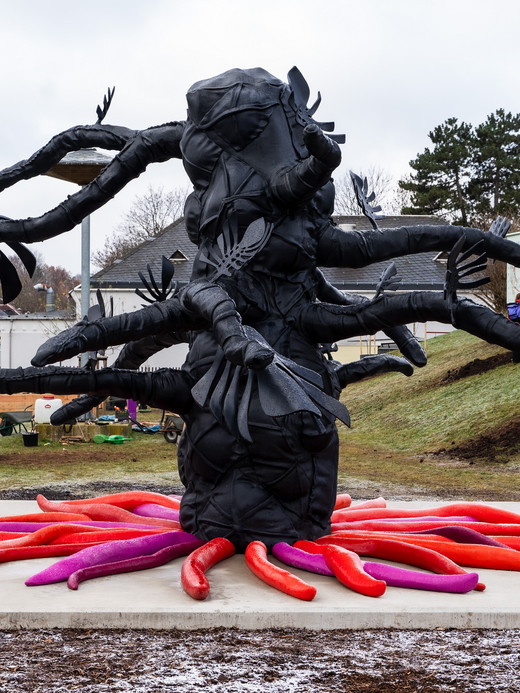
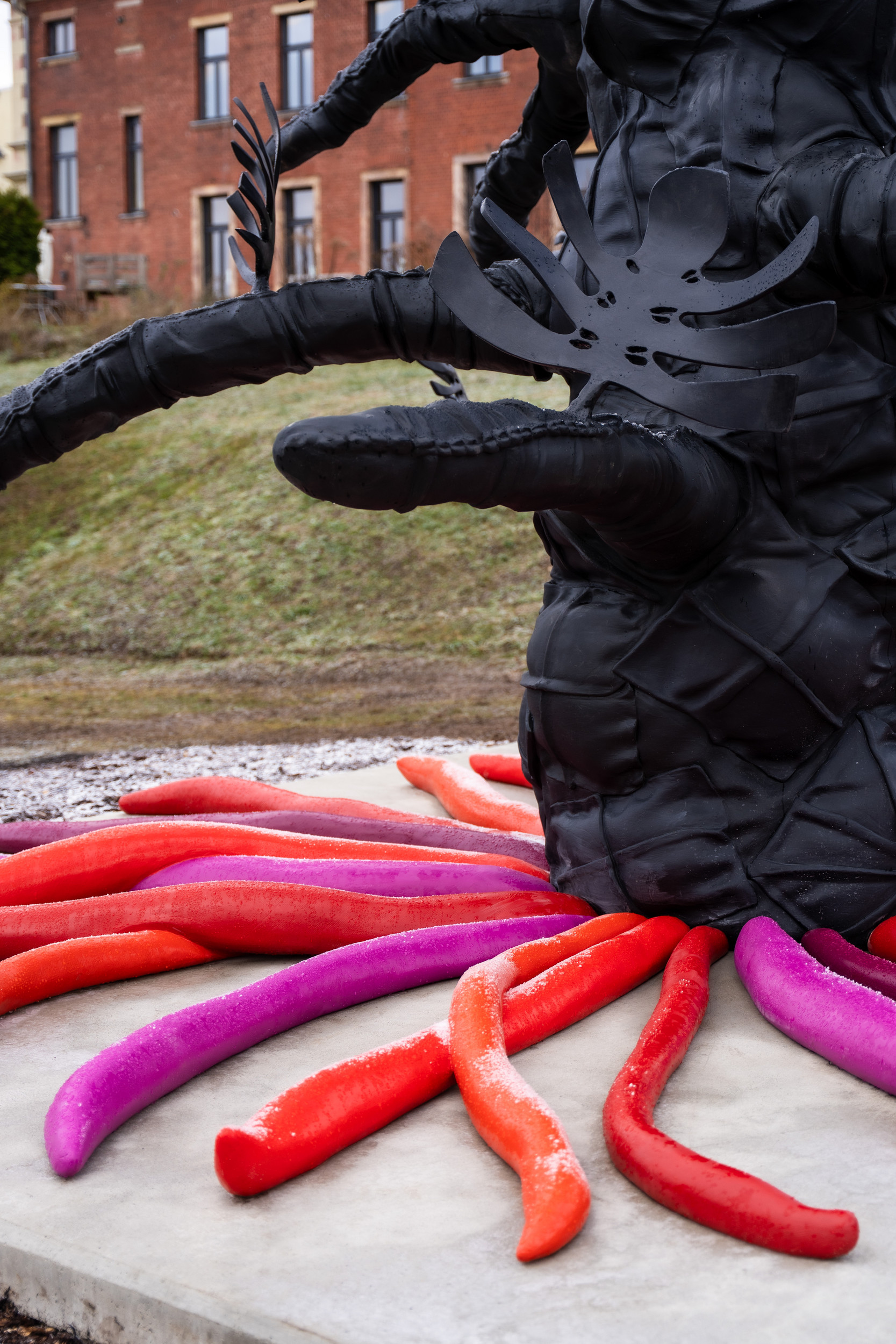
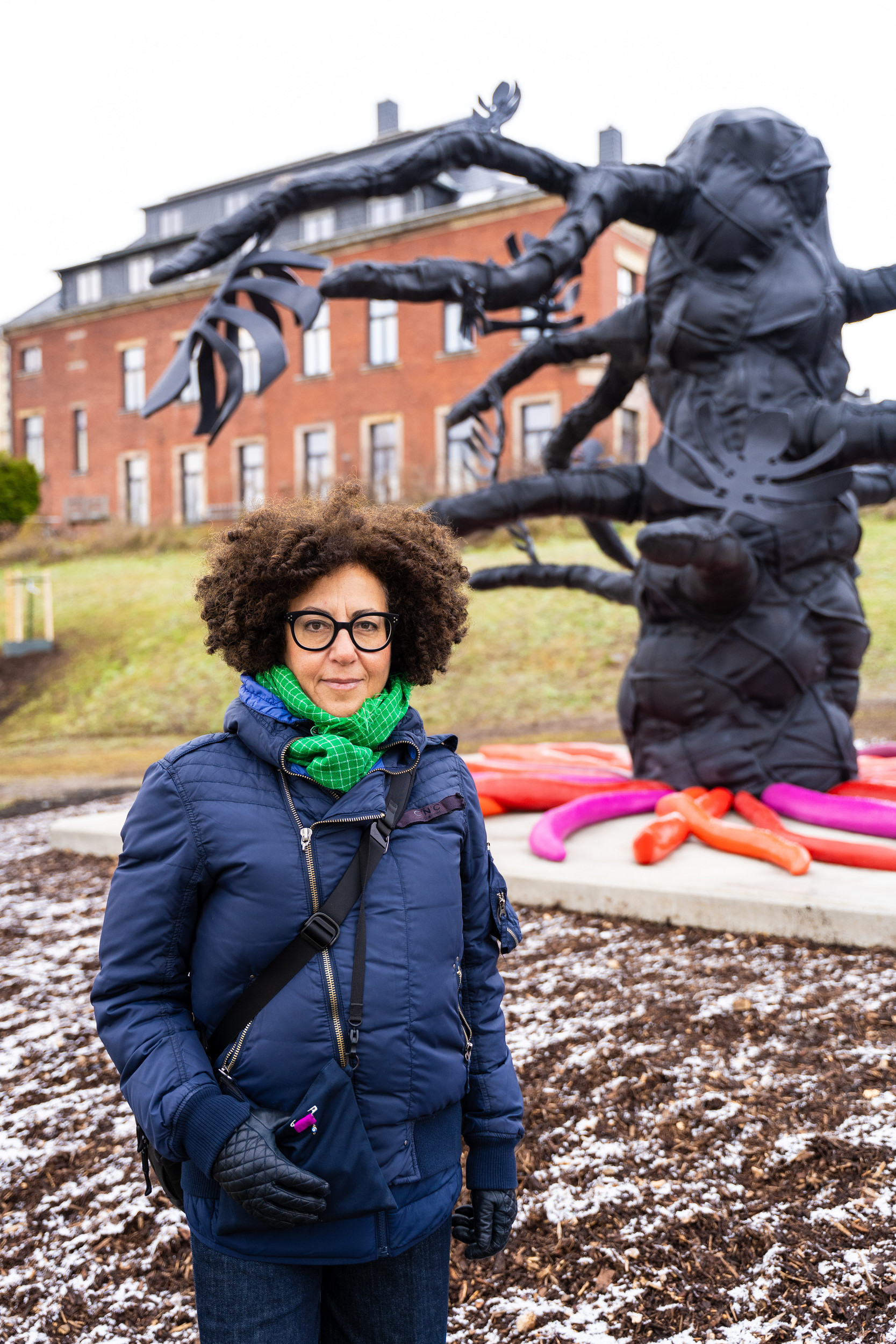
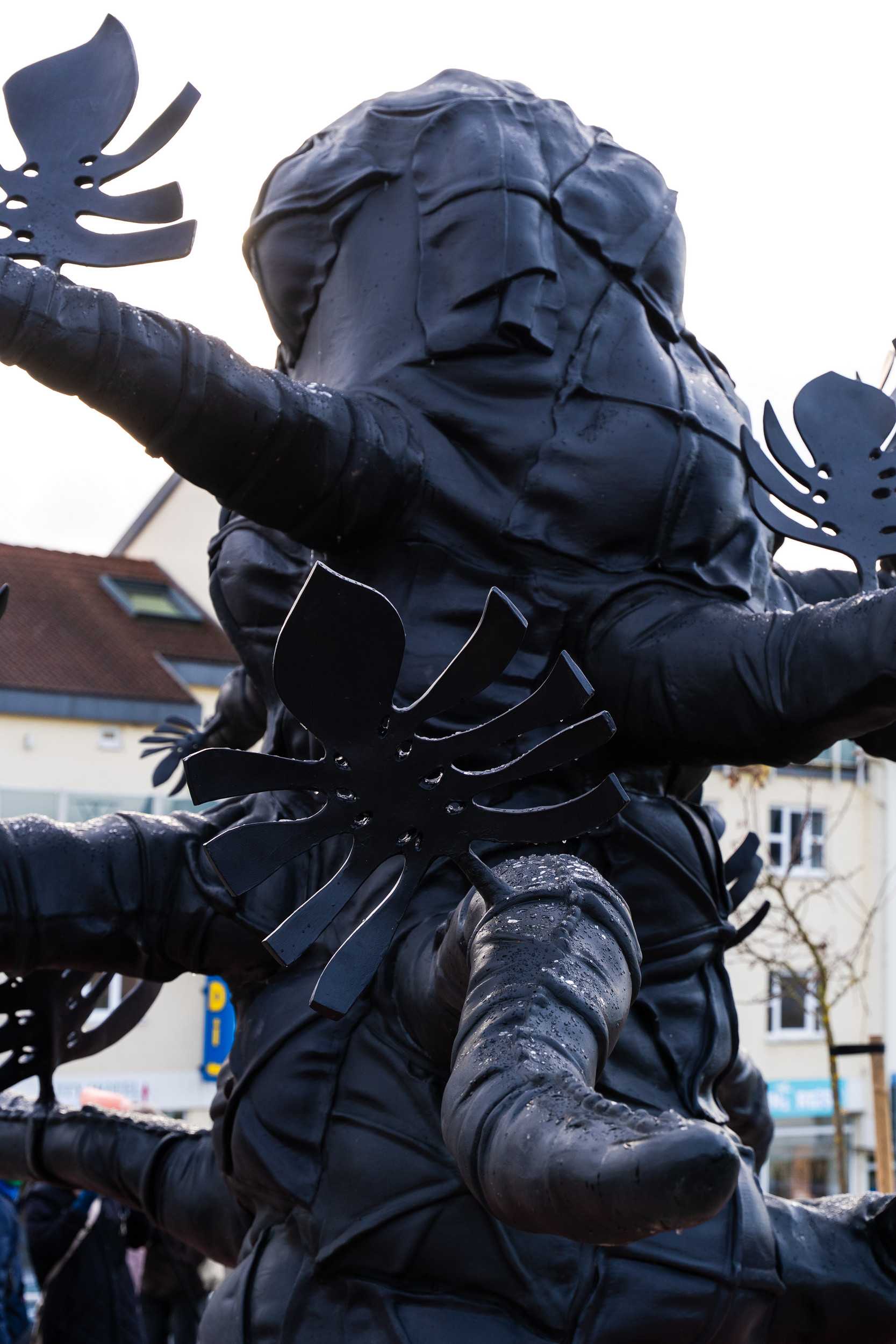
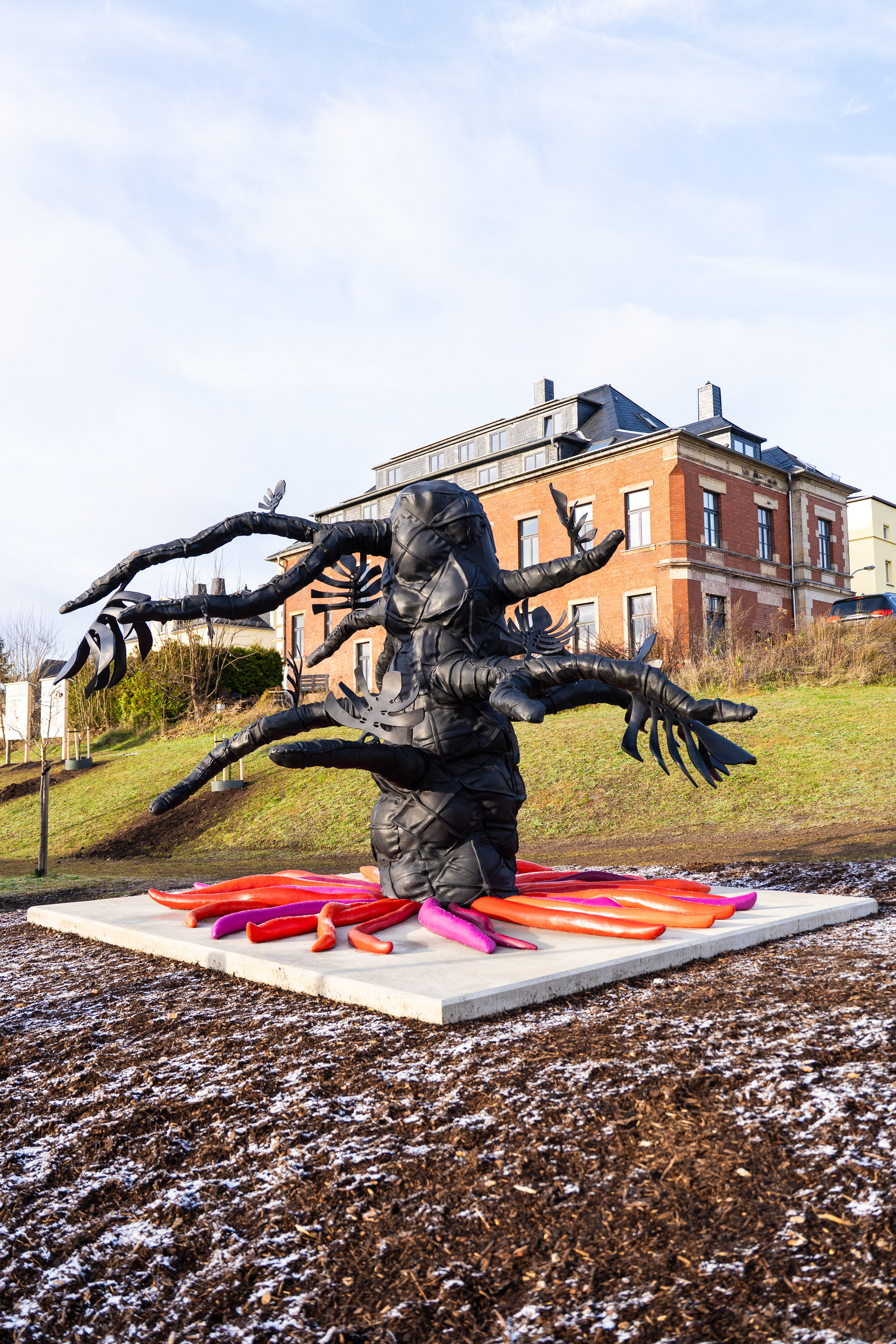
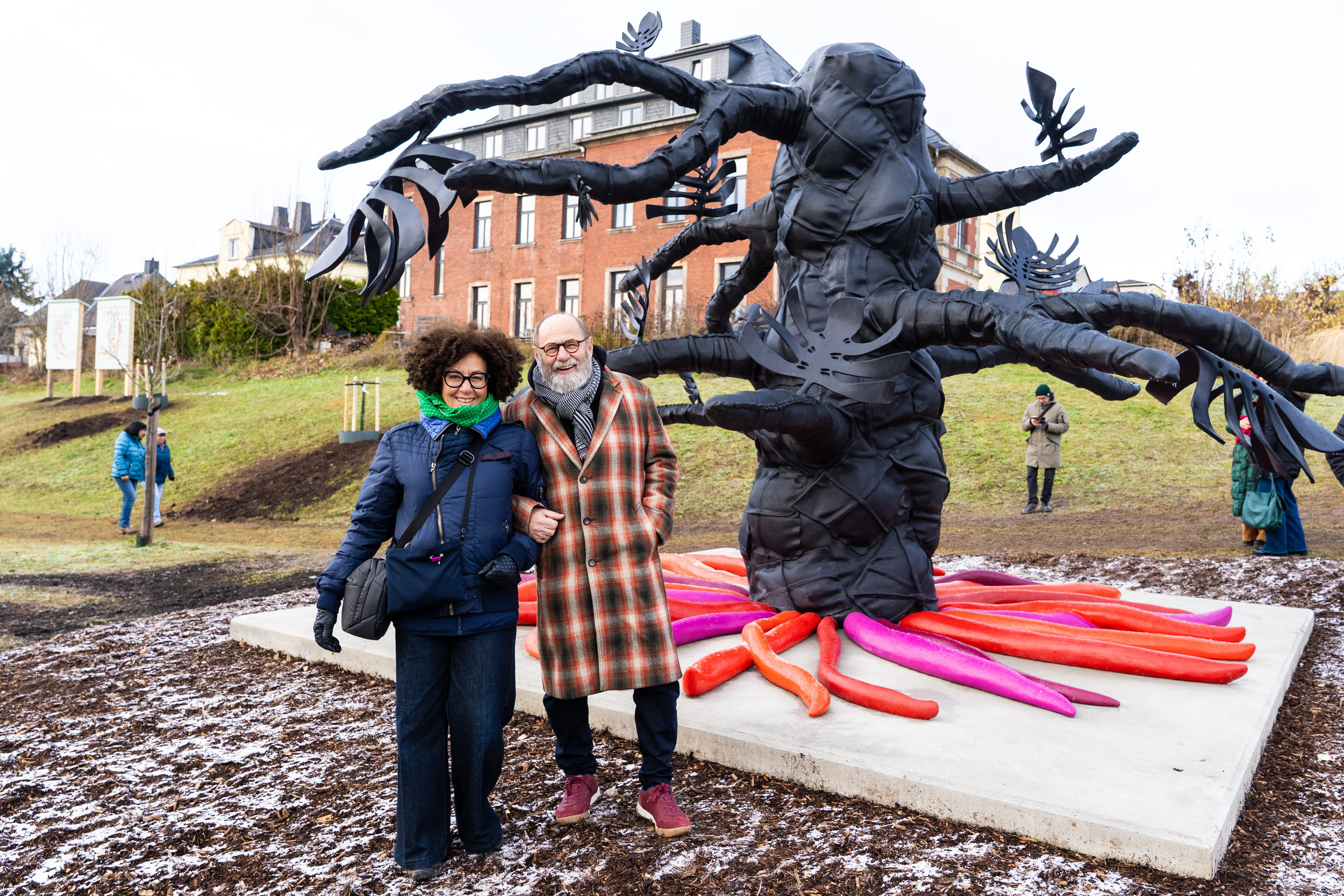
For the series Delicious Monsters, Franco-Egyptian artist Hoda Tawakol, who was born in London, Great Britain, in 1968, grew up in Paris, France, and now lives in Hamburg, combines her fabric sculptures reminiscent of dolls, wigs and masks with tree and leaf shapes made of fibreglass-reinforced plastic. With the shape of the window leaf (Monstera deliciosa), the artist references a botanical plant genus that seems to be at home in the living and working spaces of Central Europeans. However, its ancestors were once taken from their tropical home in Central America to Europe by colonial plant hunters and cultivated in botanical collections as easy-care houseplants.
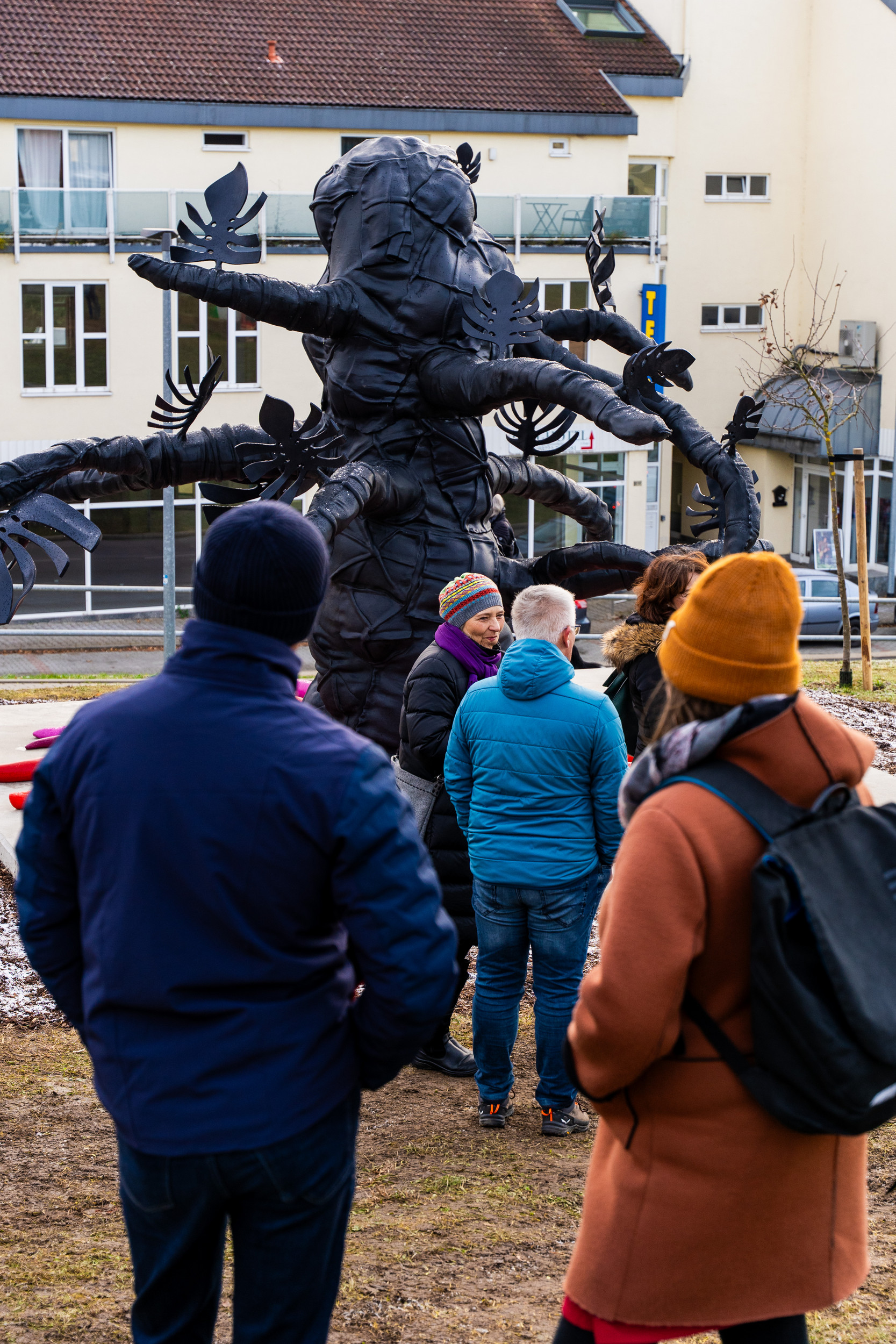
However, Tawakol's ‘delicious monster’ does not torment itself in a narrow flowerpot. Starting from a thick trunk, branches bound as if from textiles stretch far into their surroundings. Black-coloured foliage appears grafted on, red and purple roots spread across the floor like blood vessels or fragments of bodies. Through its form and colour, the work develops a high symbolic power in the mental space it initiates. It plays with the viewer's associations, evoking longing and effort, power structures and their options, as well as growth and decay, giving and taking.
Tawakol's Delicious Monster links the eventful history and identity of its location in Limbach-Oberfrohna, where historical, physical and mental situations converge. In one of Saxony's oldest mining areas, the remains of pits and spoil heaps can still be seen today, tracing an inverted network of roots on the Ulrichsberg and bearing witness to the mining history of the Wolkenburg district since the 13th century. In the 18th and 19th centuries, Detlef Carl Graf von Einsiedel furnished the garden of Wolkenburg Castle with a sculpture ensemble cast from Lauchhammer black iron based on ancient models. Although constructed from ‘light’ material, Tawakol's work seems to absorb the heaviness of iron as well as its colour. In the early 18th century, the Limbach entrepreneur, black printer and inventor Johann Georg Esche found a stocking knitting machine at the home of a Huguenot living in Dresden, which he further developed based on a French model. Supported by his sovereigns of Schönberg, Esche laid the foundation for the region's successful textile industry. In 1870, his descendants moved the Limbach hosiery factory to Chemnitz, turning not only their company but also the city into an international industrial and cultural centre of Europe.
(Text: Alexander Ochs / Ulrike Pennewitz)
Hoda Tawakol
Delicious Monster
In Limbach-Oberfrohna
Material: GRP-glass fibre reinforced plastic
Set up with the support of the town of Limbach-Oberfrohna
Address:
Markt 14
09573 Augustusburg
Location on Google Maps
Limbach-Oberfrohna: Effective. Brand new. Artful.
Gabriela Oberdorfer's laboratory of a meadow orchard is a work of art that actively addresses the issue of revitalising fallow land. The artist also involves a class from the Goethe primary school. The pupils are helping to create the art area, which consists of a large mural, a meadow orchard and raised beds. The site is located next to the Apollo film theatrewhich has been around since 1910. It became known to a wide literary audience in the 1990s through the novel "Der Kinoerzähler" by Gert Hofmann, who was born in Limbach-Oberfrohna.
Revitalisation - this term has become a trademark of the once proud textile industry town of Limbach-Oberfrohna. After German reunification, the town underwent profound structural change. Almost all the factories closed and thousands of textile workers lost their jobs. In the meantime, many modern companies have established themselves in and around the town. The heritage of the textile tradition lives on in the city's cultural memory. Many committed people in the Esche Museum and its support association preserve material evidence and memories, develop a new textile networking and competence centre or create new usage concepts for old textile factories.
Effective: Esche Museum Limbach-Oberfrohna
At the Esche Museum Limbach-Oberfrohna you can visit an entire era. The building once housed the second oldest textile factory in the town and is one of the oldest surviving factory buildings in Saxony. The complex was built in the mid-19th century by Traugott Reinhold Esche as a hosiery factory. His ancestor, the entrepreneur Johann Esche, constructed the first wooden warp knitting machines in the town in the 18th century. The English and French were still the leaders at the time.
But the technology of warping continued to develop in the city and quickly caught up. This was also thanks to the resourceful Esche family, who attracted other entrepreneurs. The main products were knitwear: knitted and crocheted garments such as stockings, underwear and gloves. By 1900, Limbach-Oberfrohna had risen to become the world capital of glove production. the local companies exported 90 per cent of their gloves all over the world.
As part of the European Capital of Culture Chemnitz 2025, the ESCHE LAB a new centre of excellence for research, development, industry, design and production.
Tip: Villa Esche in Chemnitz
Herbert Eugen Esche (1874-1962), who had an Art Nouveau villa built in Chemnitz in 1902/3 by Belgian architect and designer Henry van de Velde (1863-1957), also came from this Limbach family of entrepreneurs. This was van de Velde's first architectural commission in Germany and was of great importance for his artistic work. Villa Esche with its park-like garden is considered a very early synthesis of the arts of modernism and today serves as a museum, conference centre and event venue.
New factory: ARTISEDA textile factory becomes Protestant school centre
In the centre of Limbach-Oberfrohna, right next to the town hall, the ARTISEDA textile factory stood empty for over 20 years. No, or rather: it stood still. Because the large factory building with the expressionist clinker brick façade and the high tower from the 1920s was not empty. The interior was still there: sewing machines, patterns and vast quantities of brand-new, undelivered textiles.
Underwear was produced here from 1854 to 1998: Underwear, baby rompers and pyjamas. The Limbach-Oberfrohna entrepreneurial family Silke and Rico Wrzal, together with many committed members of their parish, have changed a great deal here and brought it back to life with the FELS - Freies Evangelisches Limbacher Schulzentrum.
Artful: iron art casting at Wolkenburg Castle
On the outskirts of Limbach-Oberfrohna, just outside the valley of the Zwickauer Mulde, stands Wolkenburg Castle Wolkenburg Castle. Its history dates back to a castle in the 12th century. It has also undergone major transformations through revitalisation. The current building with its English landscape park dates back to the classicist period (1780-1820). It is thanks to an art-loving count in the 18th century, Carl Detlev Graf von Einsiedel, that Wolkenburg Castle is home to a collection of iron art castings of European standing.
Tip: Wolkenburg Castle is a memorial site
A satellite camp of the Flossenbürg concentration camp was located in the municipality of Wolkenburg, which belongs to the castle. From August 1944 to April 1945, over 350 women were imprisoned here for forced labour in a former weaving mill. Since 2000, a memorial stone has commemorated the fate of the women who were deported here from Germany, Italy, Yugoslavia, the Netherlands, Poland and Russia.
Between 1943 and 1945, the Flossenbürg concentration camp in the Upper Palatinate/Bavaria Flossenbürg concentration camp operated a total of 77 satellite camps. Twelve of them were located in places near today's PURPLE PATH: in Auechemnitz, Flöha, Freiberg, Hainichen, Hohenstein-Ernstthal, Mittweida, Oederan, Amtsberg, Zschopau and Zwickau.
The art-loving count: Detlef Carl Graf von Einsiedel (1737-1810)
At Wolkenberg Castle on the Zwickauer Mulde, which is part of the Limbach-Oberfrohna municipal area, there is a unique collection of sculptures from Lauchhammer Eisenkunstguss. The works of art can be discovered both in the castle and freely accessible in the park. Through an inheritance, Detlef Carl Graf von Einsiedel, who lived at Wolkenburg Castle, came into possession of the Lauch-Hammer ironworks in the manor of Mückenberg (today: Lauchhammer in Brandenburg) in 1776.
With the expertise of leading scientists and engineers from the Freiberg Mining Academy, he succeeded in modernising the hammer mill into an early industrial enterprise. He was also inspired by artists in the development of industrial products. Works of art were also created in the foundry. The sculptors Thaddäus Ignatius Wiskotschill (1753-1795) and Joseph Mattersberger (1754-1825) produced usable moulds from plaster casts of antique sculptures for replicas in iron. These were particularly sought after by the neo-classical architects and garden designers of the time.
In 1782, Count Einsiedel, the technicians and artists further developed the technology of iron casting with a special wax-out melting process. Larger and more complex machine components and bridge parts could now be precisely produced using iron casting, which had previously only been possible in England and France. In the historic Foundry in Lauchhammer sculptures by renowned artists are still being cast today.
Linguistic genius and writer: Gert Hofmann (1931-1993)
Gert Hofmann was born in 1931 in the Limbach district. The house where he was born was on Kreuzstraße in Limbach, now Paul-Seydel-Straße. Opposite is still a confectionery where his uncle ran one of Limbach's first silent film cinemas before opening the Apollo film theatre in Jägerstraße, just 400 metres away. the family moved to Leipzig in 1948. Here, Hofmann completed an interpreting and translation exam for English and Russian at a language school. Throughout his life, he utilised his talent for languages academically and ingeniously in his literary work.
After graduating from high school in 1950, he began studying Romance, German, Slavic and English language and literature at the University of Leipzig, continuing his studies in Freiburg im Breisgau from 1951. in 1957, he completed his doctorate with a thesis on the American-British author Henry James, and from then on worked as a research assistant at the University of Freiburg, taking up teaching positions in Toulouse, Paris, Bristol, Edinburgh, New Haven, Berkley and Austin. From 1971 to 1980, Hofmann lived in Klagenfurt/Austria and taught at the University of Ljubljana/Yugoslavia. From 1980 until his death, he lived in Erding near Munich.
His literary work is extraordinarily diverse and has been translated into many languages. His work began in the 1960s with radio plays and theatre plays, in which he also focused on linguistic and socially critical themes. From 1979, he also published short stories and novels. He became known to a wider audience with his novel "Der Kinoerzähler" (1990), which was made into a film in 1993 by Bernhard Sinkel with Armin Mueller-Stahl in the title role.
"Der Kinoerzähler" is a work of fiction in which Hofmann tells the story from the grandson's perspective that his grandfather Karl was the silent film narrator at the Apollo cinema in Limbach. But in 1931, the year of Hofmann's birth, the Apollo cinema was already showing sound films. There was also no cinema narrator named Karl Hofmann. He was "an artist without bread and art", said Karl to his grandson. The story of a fragile life of economic hardship, political crises and technological upheaval in the first half of the 20th century unfolds along this leitmotif. "I am superfluous", confesses the grandfather one day when he became unemployed after the introduction of the sound film. A sentiment that many people in Limbach-Oberfrohna who experienced the collapse of the textile industry from 1990 onwards can easily empathise with.
In honour of the writer, the Limbach-Oberfrohna municipal library has been named "Gert Hofmann" since 2021.
Book tip:
Gert Hofmann: The cinema narrator. Novel, Munich/Vienna: Carl Hanser Verlag 1990
Border crosser and playwright: Heiner Müller (1929-1995)
The playwright Heiner Müller also belongs to Gert Hofmann's generation (*1931). Born in Eppendorf/Middle Saxony in 1929, he spent some of his childhood and school years in Bräunsdorf, which is now a district of Limbach-Oberfrohna. Bräunsdorf was also the birthplace of his father Kurt Müller (1903-1977). His parents were social democrats, for which his father was imprisoned in Sachsenburg concentration camp near Frankenberg in 1933. From 1939 to 1947, the family lived in Waren an der Müritz/Mecklenburg.
After the end of the war, Heiner Müller completed his A-levels in Frankenberg, where his father became mayor in 1947. Although he was a member of the SED, which was forcibly united from the SPD and KPD, he left the GDR for the West in 1951. Heiner Müller remained in the GDR, working as a research assistant in the German Writers' Association's drama department from 1957. At this time, he published his first plays as a freelance author and was engaged by various theatres.
The critical play "Die Umsiedlerin" was cancelled in 1961 and Müller was expelled from the Writers' Association. Despite ongoing critical disputes with the SED, other of his plays continued to be performed. He managed to walk the line between social criticism and a certain degree of conformity, so that he was given a permanent position as a dramaturge at the famous Berliner Ensemble in 1970.
After signing a protest petition against the expatriation of singer-songwriter Wolf Biermann from the GDR in 1976, he was dismissed and then worked at the Berlin Volksbühne until 1982. By this time, he had already made a name for himself in West Germany with his plays, especially those that were not allowed to be performed in the GDR. After the fall of the Berlin Wall, he returned to the Berliner Ensemble (1992).
What remains of Heiner Müller are his poetic-dramaturgical border crossings and an internationally acclaimed oeuvre. What will also remain is the memory of an ambivalent biography, in which the history of the 20th century was reflected in broken form. Müller repeatedly clashed with the cultural policies of the GDR and was himself the victim of publication and performance bans. And yet he worked from 1979 to 1990 as an "informal collaborator" for the MfS - Ministry for State Security of the GDR.
A typical mentality in the Chemnitz region
Innovation and a sense of tradition, openness and immigration have always ensured the survival of the Erzgebirge mining region. All of this bears witness to many transformations that reach far back into history and in some cases continue to this day. The region has always been on the move. People came and went with the economic ups and downs, developing technically, socially and culturally. This is still the case today. In the textile town of Limbach-Oberfrohna, a whole host of new threads are being spun between the past, present and future.
ESCHE LAB in the Esche Museum: Dr Barbara Wiegand-Stempel and Gabriele Pabstmann
With the ESCHE LAB, a competence centre for textiles with a focus on knitting and ready-to-wear is to be created in the Esche Museum. It is intended to form an interface between research, development, industry, design and production. The "Textile Hub" is aimed at textile professionals, designers, developers, students, researchers, start-ups and companies and offers opportunities for prototyping, the production of small series, artistic production, networking and exchange as well as presentation.
The project was initiated by Dr Barbara Wiegand-Stempel, Director of the Esche Museum, and Gabriele Pabstmann, Museum Educator. Their approach will make it even easier to experience the rich textile heritage in the region in future. They are encouraging strong networking with other textile locations in the region in order to develop European appeal and combine traditional techniques with the latest technologies.
The chroniclers: Marvin Müller and Daniel Polster
Since its opening in 2011, the Esche Museum has become a nucleus for activities relating to industrial culture. Young people like Marvin Müller are involved in the Esche Museum's support organisation. Even as a child, he was impressed by the architectural jewellery of an old factory building near where he lived. One day, he went to the town archives to find out more about the industrial history of Limbach-Oberfrohna. While intensively researching documents, he uncovered a lot of interesting facts from the past. For example, he reconstructed the chronicle of the Carl Götze glove factory.
Since then, the subject has stayed with him. Marvin Müller was particularly fascinated by the fact that Limbach-Oberfrohna was considered the world capital of glove production around 1900. The development from a village of craftsmen to an industrial town was rapid, he reports on his tour of the museum. In just a few decades, manufactories grew into large factories. His search for clues leads him down ever new paths, e.g. to the disappeared graves of factory owners in the cemetery. Only plans, photos and a few structural remains have survived.
Fellow club member Daniel Polster studied mechanical engineering. When he was a child and teenager in the 1990s and wandered through the town's empty factory buildings, he asked himself the question: "Why did so many people once work here and no longer do?" He wanted to find answers to this question. Daniel Polster discovered not only the industrial history, but also the architecture of the factories and villas. In some cases, there are very rich sources. Many contemporary witnesses who used to work in the factories still provide information. The human wounds of the upheaval of 1989/90 are also becoming visible.
There is a growing circle of young people interested in industrial history and industrial culture in Saxony, says Daniel Polster. They exchange ideas via the Internet, at the regulars' table in the association or at exhibitions in the museum. In this network, the many threads of the past are brought together to form a living bond of memory and identity. "Even if these old factories have long since lost their economic value," summarises Daniel Polster, "we should preserve them as cultural heritage. Just as we do with old castles or churches, many of which have lost their political or religious use."
The brave ones: Silke and Rico Wrzal
Where people once worked, they now learn. Since 2019, Silke and Rico Wrzal have been working with other members of the church community to initiate a school project: the FELS - Freie Evangelische Limbacher Schulzentrum, consisting of a secondary school and a grammar school. The landmark ARTISEDA factory owned by industrialist Louis Schaarschmidt in the 1920s has been renovated. The Wrzals know their way around the building trade, as they successfully run an installation company for building and energy technology.
"The industrial buildings are so typical, so characteristic of our city, that they should be preserved," says Silke Wrzal. She herself trained in the textile industry from 1989 to 1991. "There was a huge response in the city when it became known that we had bought the ARTISEDA factory at auction for our school project. Former employees were particularly enthusiastic about it," says Silke Wrzal, describing the days following the auction.
In memory of these people, there is a small museum in the new school. "It is important to preserve the textile history that has characterised us over so many decades," explains Silke Wrzal. When clearing out the factory, the Wrzals saved old documents, objects from everyday working life and machines. Rico Wrzal has special memories of a cutting machine for sample sheets: "I installed this machine as a young electrician over 30 years ago."
Rico Wrzal has researched the construction history of the factory: "The factory consists of three building complexes that were built after 1870 with each expansion of the company. It wasn't until 1920 that everything was walled in with clinker bricks to create a cohesive architectural ensemble." The architecture represented the economic success of the time, the proud entrepreneurial self-confidence.
But that is a thing of the past, says Rico Wrzal: "People's needs have changed. We should respect history, but also react to the changes and develop something new." Industry in the city centre is no longer possible today, so there have to be new utilisation concepts for the defining architecture. Silke and Rico Wrzal have always been aware of the challenge and the responsibility. They had the entrepreneurial courage and, as Christians, the joyful certainty that they were following a calling and would succeed in their endeavour.
With the kind support of eins, Sparkassen-Finanzgruppe and Volksbank eG