Axel Anklam: Inside
Augustus Castle

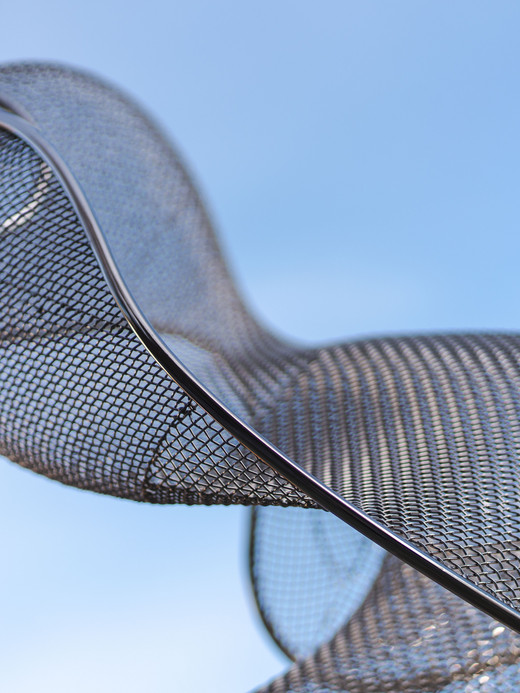
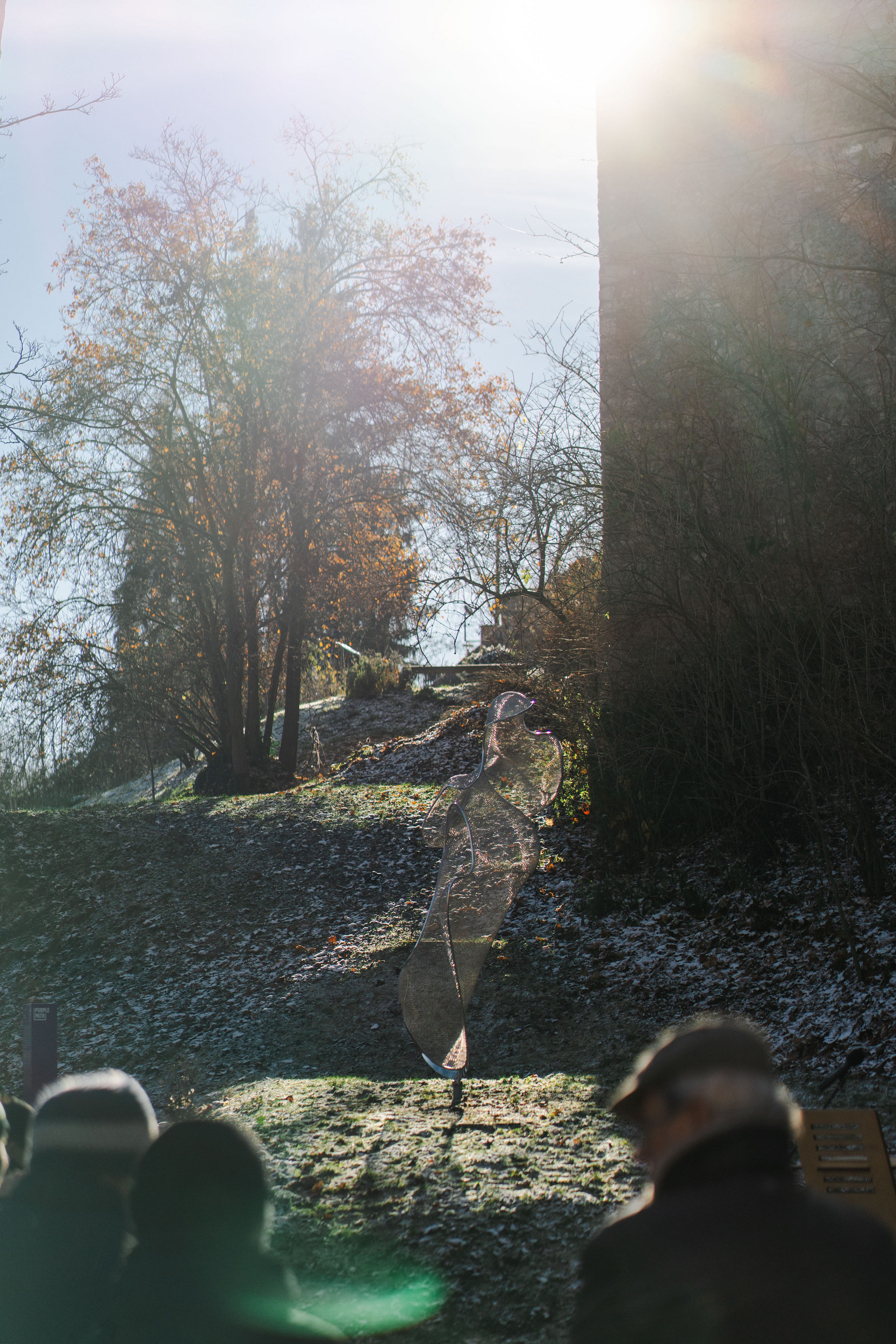
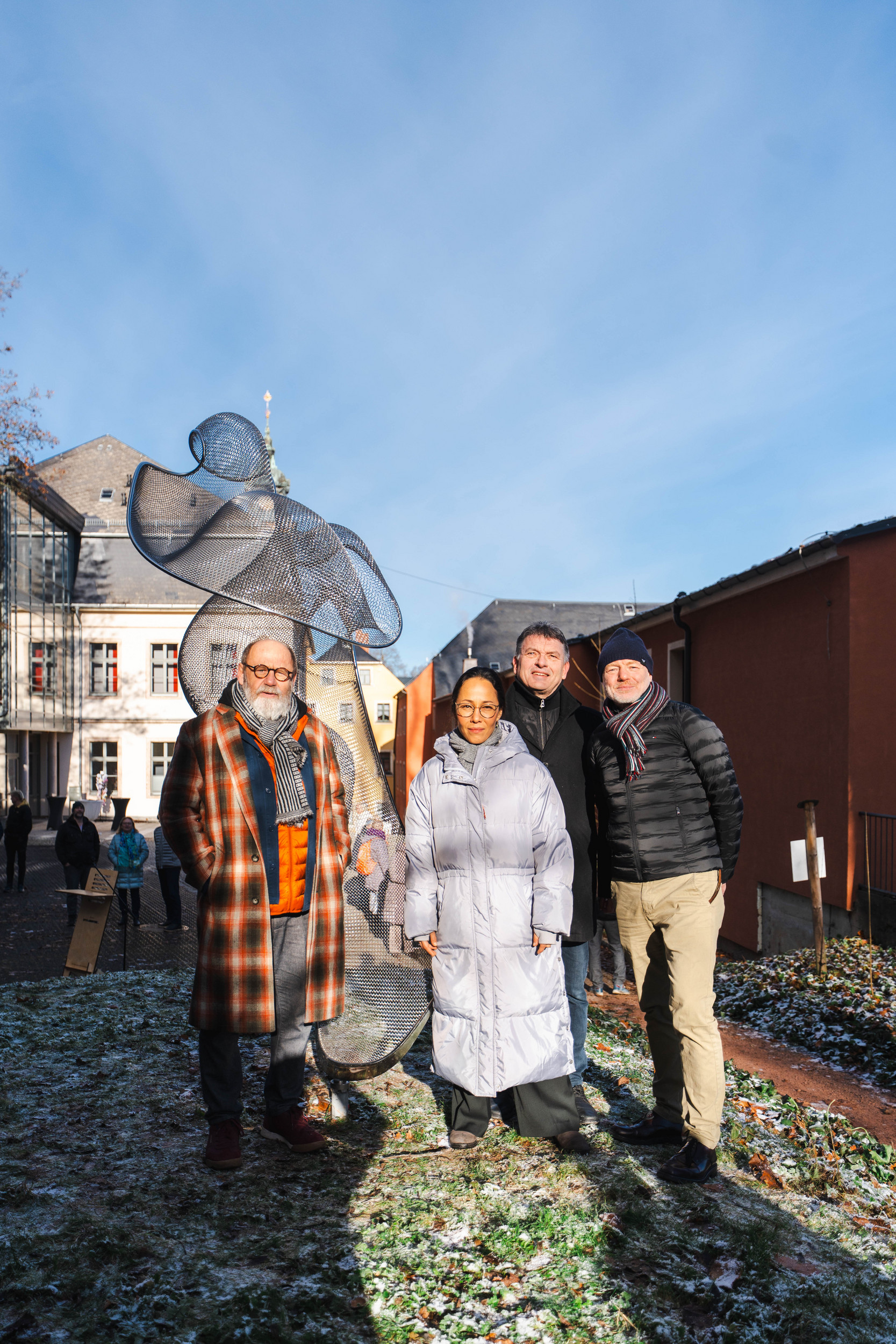
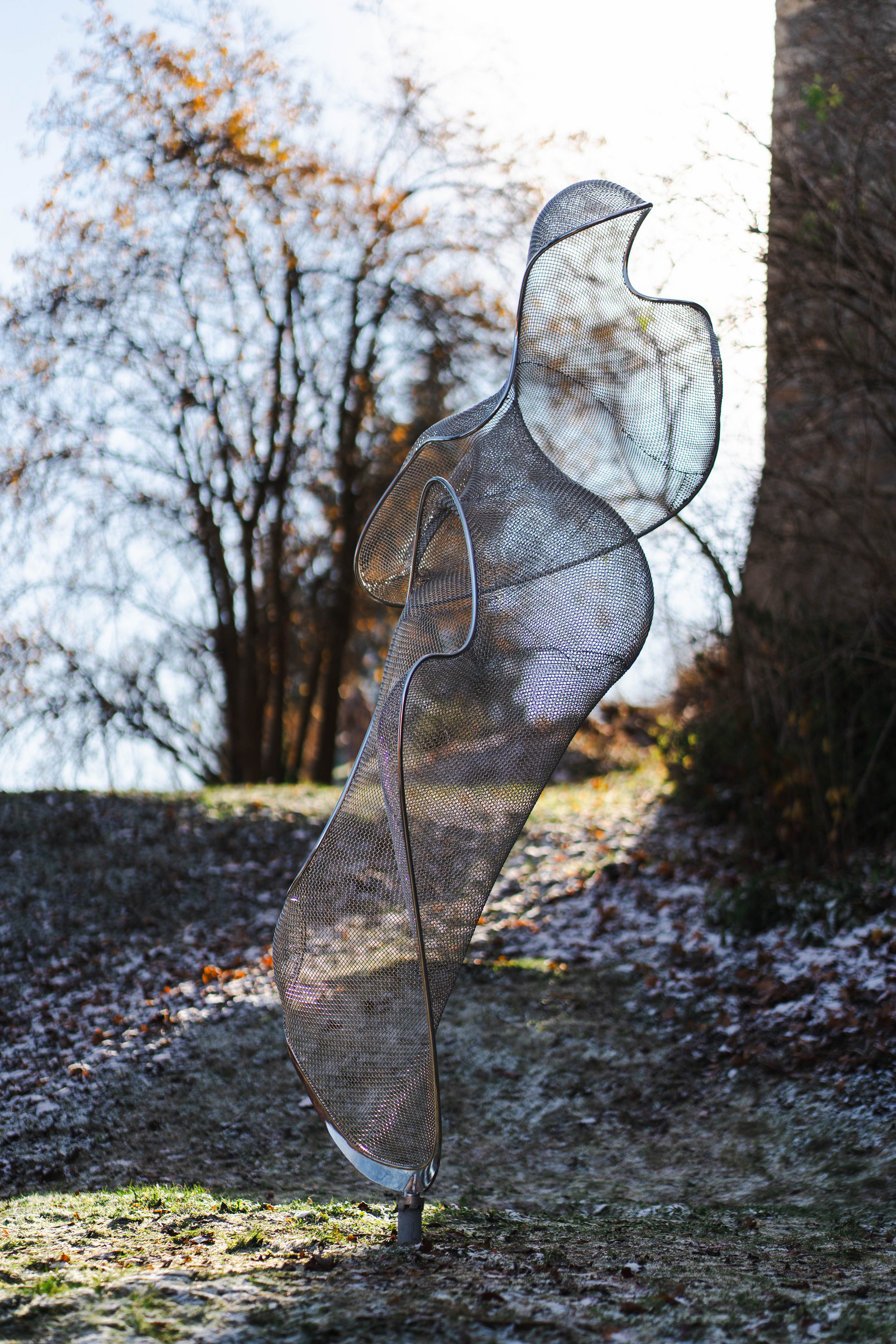
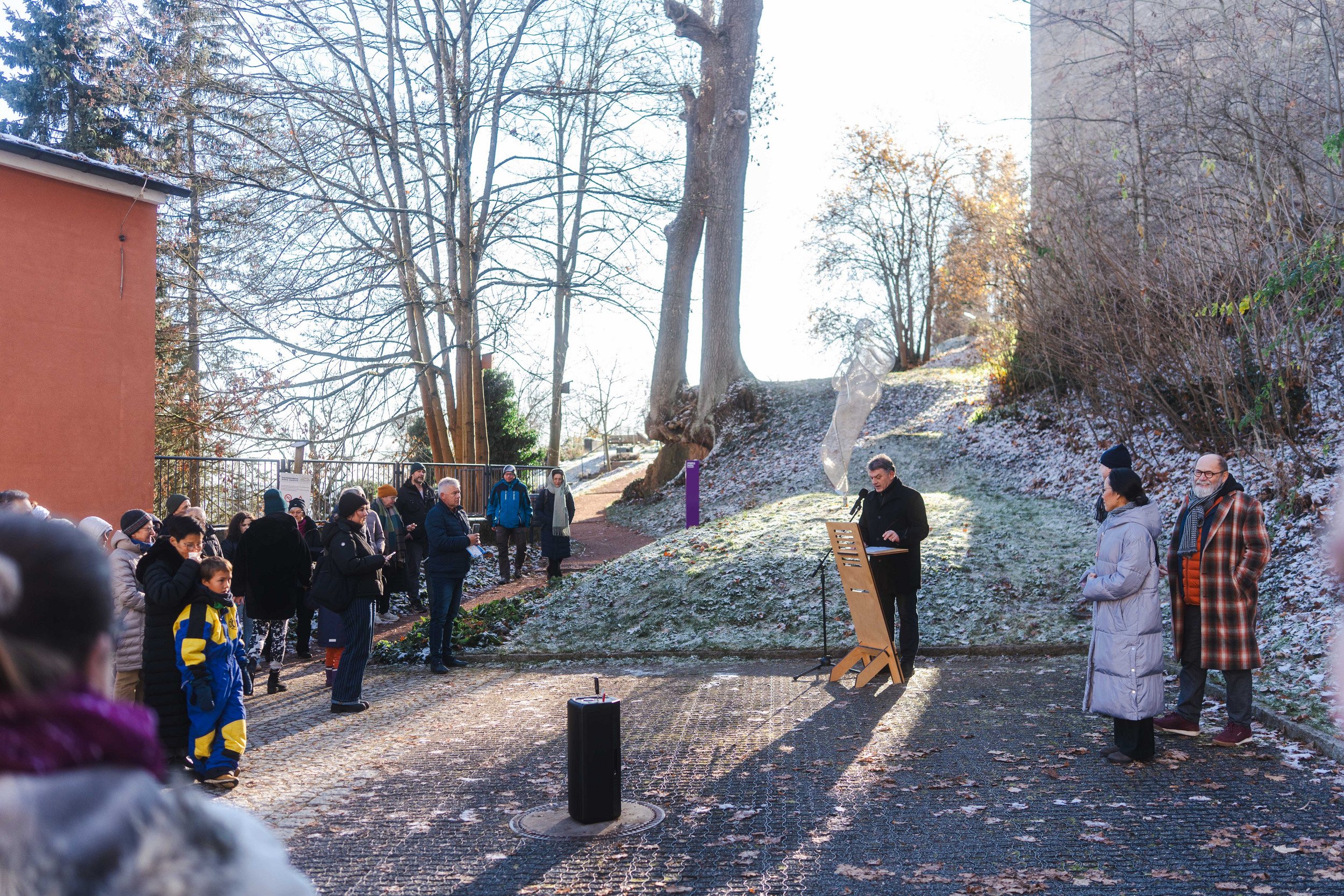
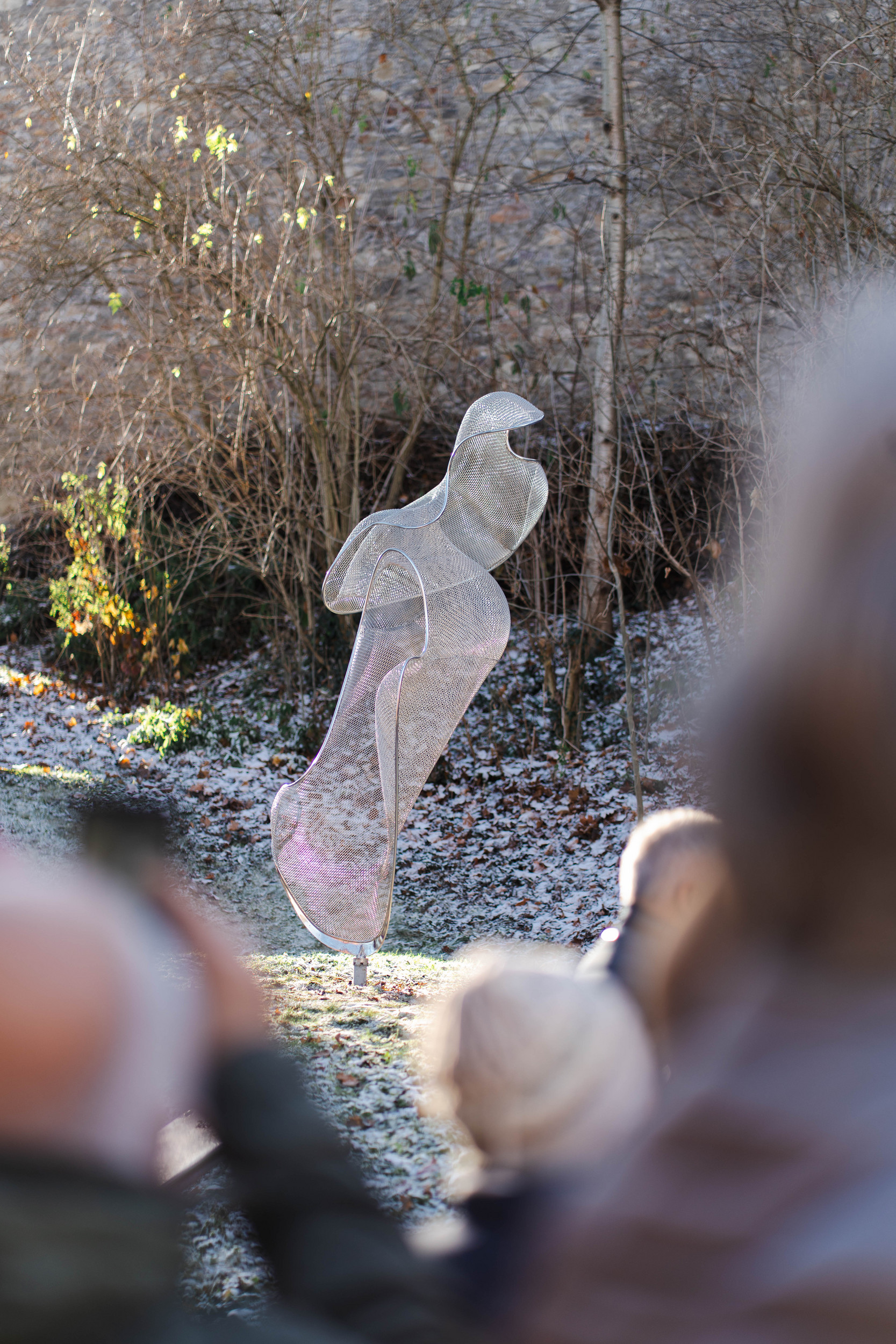
A delicate-looking stainless steel net stretches across a winding round tube frame, reaching upwards. Lines intersect or drift apart, the surfaces appear tense and relaxed at the same time. They create a vague, almost directionless shape of utmost lightness. The translucent sculpture ‘Inside’ by sculptor Axel Anklam, who was born in Wriezen in 1971 and died in Berlin in 2022, is a complex geometry in space that translates harmonies and dissonances into a new formal language. Anklam observes art forms in nature – such as landscapes, mountain formations, wing beats, wind currents or musical sequences – and transforms them into abstract, synthetic structures. In his work ‘Inside’, the boundaries between form and space, which shines through the fine mesh, become blurred. The sculpture is an exploration of nature that does not imitate it, but rather reflects its innermost principles.
The work selected for Augustusburg comes from the artist's estate. Its hybrid form, reminiscent of a column of smoke, oscillates between mineral, animal, plant and human states. Located at the entrance to the Electress Anna Garden with its perennial plants and historic herb beds, the work refers to the work of the first German pharmacist, Electress Anna of Saxony. Throughout her life, she was intensively involved in agriculture, medicine and pharmacy. She had extensive knowledge, developed medicines, ointments and aquavits, as well as early laboratory and process techniques. In close contact with doctors, she also trained young girls in herbalism and cared for her fellow human beings with utmost devotion.
(Text: Alexander Ochs / Ulrike Pennewitz)
Axel Anklam
Inside
Material: Stainless steel
Set up with the support of the town of Augustusburg.
Address:
Schlosstraße 1
09573 Augustusburg
Location on Google Maps
Augustusburg - Renaissance, engines and visions
Augustusburg Castle sits prominently on a 516 metre high quartz porphyry cone on the northern edge of the Ore Mountains. Located to the east of Chemnitz, it is a landmark that can be seen from afar and is also known as the "Crown of the Ore Mountains" due to its exposed location. The hunting and pleasure palace Augustusburg was built between 1568 and 1572 on the orders of Elector Augustus of Saxony.
The building replaced the medieval castle of Schellenberg (11th century), which was also the name of the village at the foot of the castle until 1899. The symmetrical shape of the four-winged Renaissance building of Augustusburg Castle with its square courtyard and four tower houses is reminiscent of a crown - a symbol of the Saxon elector's claim to power.
The Electress Anna Garden: sculpture Inside by Axel Anklam
Below Augustusburg Castle, in a terraced area between the castle and the old town, lies the Electress Anna Garden. It is home to the sculpture Inside by Axel Anklam (1971-2022). This garden was inaugurated in 2019 as a tribute to Electress Anna of Saxony, the wife of Augustus of Saxony (1526-1586).
Medicinal herbs and culinary herbs grow in beds, the selection of which is based on historical records by Anne of Saxony. Old fruit trees have also been planted, a tribute to Elector Augustus, who was intensively involved in fruit growing and grafting. The garden is thus a kind of living museum for botany and Anna's passion for herbalism.
Electress Anne of Saxony (1532-1585) - her work and significance
Anne of Denmark, later Electress of Saxony, was a fascinating personality: interested in medicine, socially committed and socially influential. She was the daughter of King Christian III of Denmark and Dorothea of Saxe-Lauenburg. in 1548, she married Elector Augustus of Saxony. The couple had a very stable marriage for 37 years, from which 15 children were born, 11 of whom died at an early age. They were survived by the future Elector Christian (1560-91) and his three sisters Elisabeth (1552-90), Dorothea (1563-87) and Anna (1567-1613). The family is depicted on the panel of the Lucas Cranach Altarpiece in the castle church.
Anna devoted herself intensively to herbalism and pharmacy. She developed her own recipes and produced remedies such as ointments, eye lotions and so-called "distilled waters". To this end, she set up gardens at the Saxon residences and ran laboratories and distillation facilities. Historians suspect that this interest was inspired by her mother. In letters that have survived, the two regularly exchanged views on medical topics. She was also in contact with doctors of her time and was a supporter of the ideas of the famous physician Paracelsus.
In political terms, Anna was not only the elector's wife: in the 1560s and 1570s, she took on functions in the elector's household administration and eventually even the economic management of the electoral domains, which gave her considerable influence in Saxon state affairs. She used her knowledge and position to become socially involved: She trained young girls in herbalism, cared for pregnant women and the sick, and established classes for midwives - hence she was popularly known as "Mother Anne".
Every year, the Free State of Saxony awards the Annen Medal for voluntary social commitment. Electress Anna died of the plague in Dresden in 1585 and was buried in the Freiberg Cathedral cathedral.
The motorbike museum at Augustusburg Castle
The motorbike museum, founded in 1961, sets a modern accent in the historic castle complex. 170 exhibits documenting the history of motorisation of the two-wheeler - from the beginnings to the present day - are on display over an area of around 1,200 m². Important brands from Saxon production, such as DKW and MZ from Zschopau, are represented. Interactive elements turn the visit into a sensory experience: sound simulator, video clips, unique historical artefacts. There are also regular biker meetings and classic car events, such as the Biker Castle Open Air. Guests then come from all over Europe.
The dark past: concentration camp at Augustusburg Castle
Immediately after the National Socialists seized power, the castle became a satellite camp of the Sachsenburg concentration camp from March 1933 to December 1935 Sachsenburg concentration camp. The castle prison initially housed 200 so-called "protective custody prisoners", mainly political opponents of the Nazi regime. From June 1933, these prisoners used forced labour to set up the "Gauführerschule Sachsen" of the NSDAP, a place for the ideological orientation of Nazi officials.
in 1943 and 1944 - due to the advance of the Allies - furniture from Adolf Hitler's Reich Chancellery was stored in rooms of the castle restaurant and the Gauführerschule. There are numerous stories and myths surrounding this furniture storage. The historical memory is kept alive today with lectures and commemorative work, also as part of events organised by the Capital of Culture 2025 together with Auf weiter Flur e.V. - Association for Citizen Participation and Urban Development.
Altars to kneel down to: Lucas Cranach altar in the castle chapel
At the heart of the castle is the castle chapel, which houses an outstanding work of art: an altar by Lucas Cranach the Younger (1515-1586). The impressive altarpiece (1571) shows a detailed, painterly crucifixion scene with the praying electoral family in the foreground - a rare depiction of contemporary families in Renaissance dress. Elector Augustus had commissioned the altar and the accompanying pulpit from the Cranach workshop in Wittenberg.
A typical mentality in the Ore Mountains
Innovation and a sense of tradition, openness and immigration have always ensured the survival of the Erzgebirge mining region. All of this bears witness to many transformations that reach far back into history and in some cases continue to this day. The region has always been on the move. People came and went with the economic ups and downs, developing crafts, technology and culture. This is still the case today.
Makerhub in the Altes Lehngericht: craftsmanship meets technology
In the historic old town of Augustusburg, you will find the Altes Lehngericht , which now functions as the Makerhub of the Capital of Culture 2025. It is one of the oldest buildings in the town and is located directly on Schlossstraße, the northern footpath to the castle. The Makerhub with its textile, wood and digital workshop is a creative meeting place: new ideas are developed in workshops, exhibitions and cultural programmes are held here. The Makerhub will remain after the Capital of Culture year and thus become part of Augustusburg's cultural programme. It contributes to the lively connection between past and present.
Soundtrack on the Purple Path: Pascal Kaufmann
An innovative player in the cultural life of Augustusburg is Pascal Kaufmann . He is a church musician, conductor, festival organiser and organist at the town church of St. Petri. in 2019, he founded the Augustusburg Summer of Music and has since directed the Augustusburg Youth Philharmonic Orchestra.
Visionary: 360° world of sound
His visionary project is the "360° World of Sound"a unique work of organ art in Europe: six organs in different locations (gallery, behind the altar, bass pipes under the pews) are to be controlled simultaneously via a central general console. In future, listeners will be able to experience a spherical sound experience from 4,194 pipes. Pascal Kaufmann provides regular updates on the progress of the project in the church.
Heavenwards: Composition for the PURPLE PATH
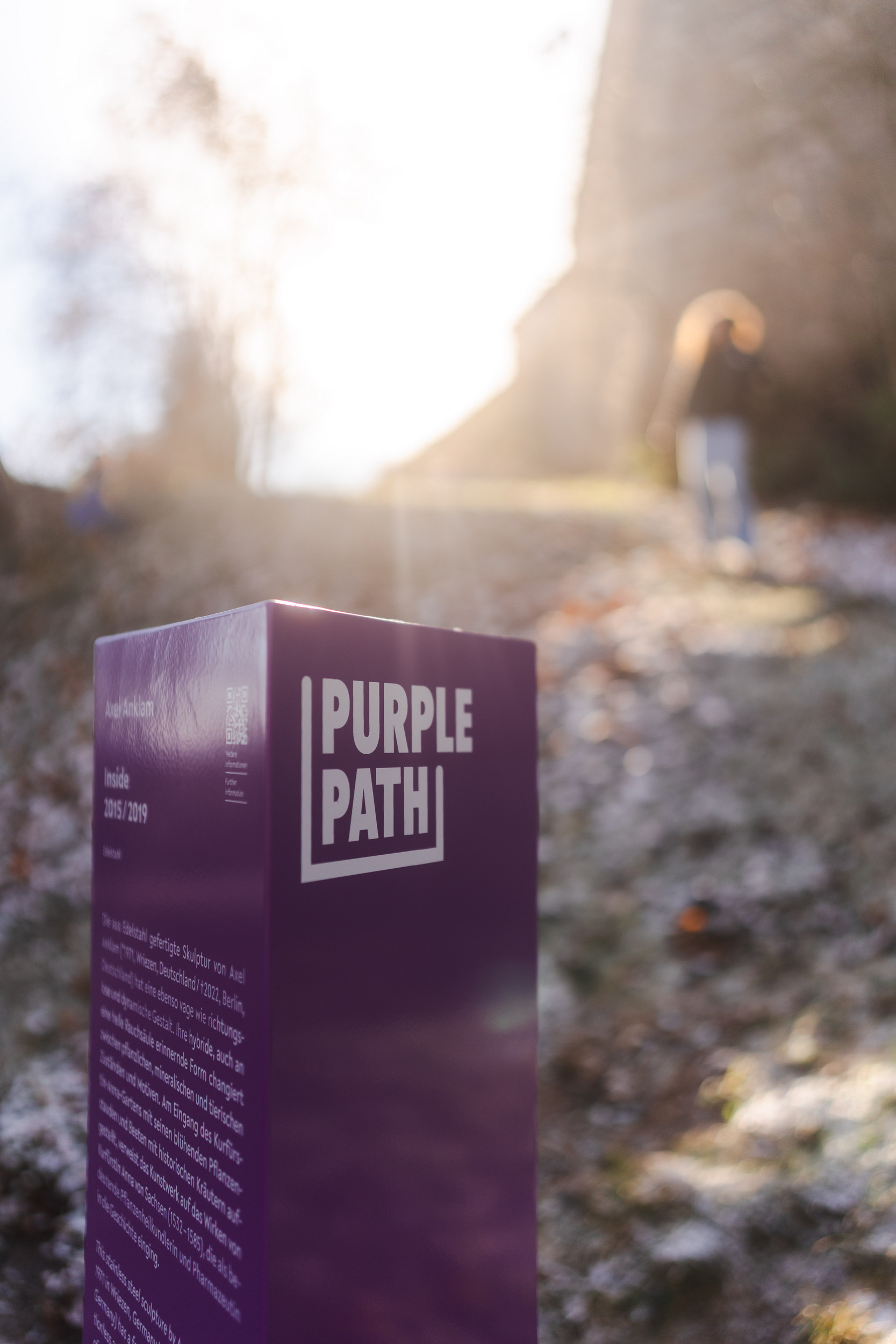
Pascal Kaufmann composed the classical piece "Himmelwärts" especially for the Purple Path "Heavenwards". The 1:19-minute work is played every 20 minutes in the two carriages of the historic Augustusburg cable car (since 1911) when they meet halfway during the eight-minute journey over 1.2 km and 168 metres in altitude. The composition was recorded by 54 members of the Augustusburg Youth Philharmonic Orchestra.
The sound installation will initially be heard on all journeys in the two carriages of the cable car until the end of 2026, making it an integral part of the works at the PURPLE PATH.