Anja Schwörer: Mapping Patterns - Industrial Flora
Niederwiesa

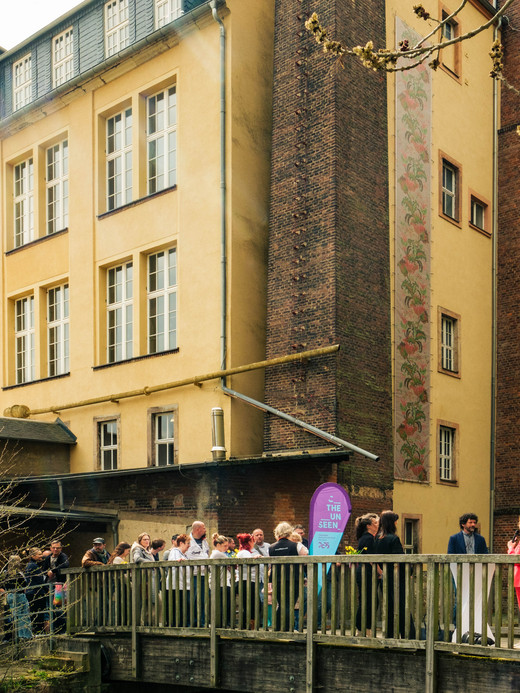
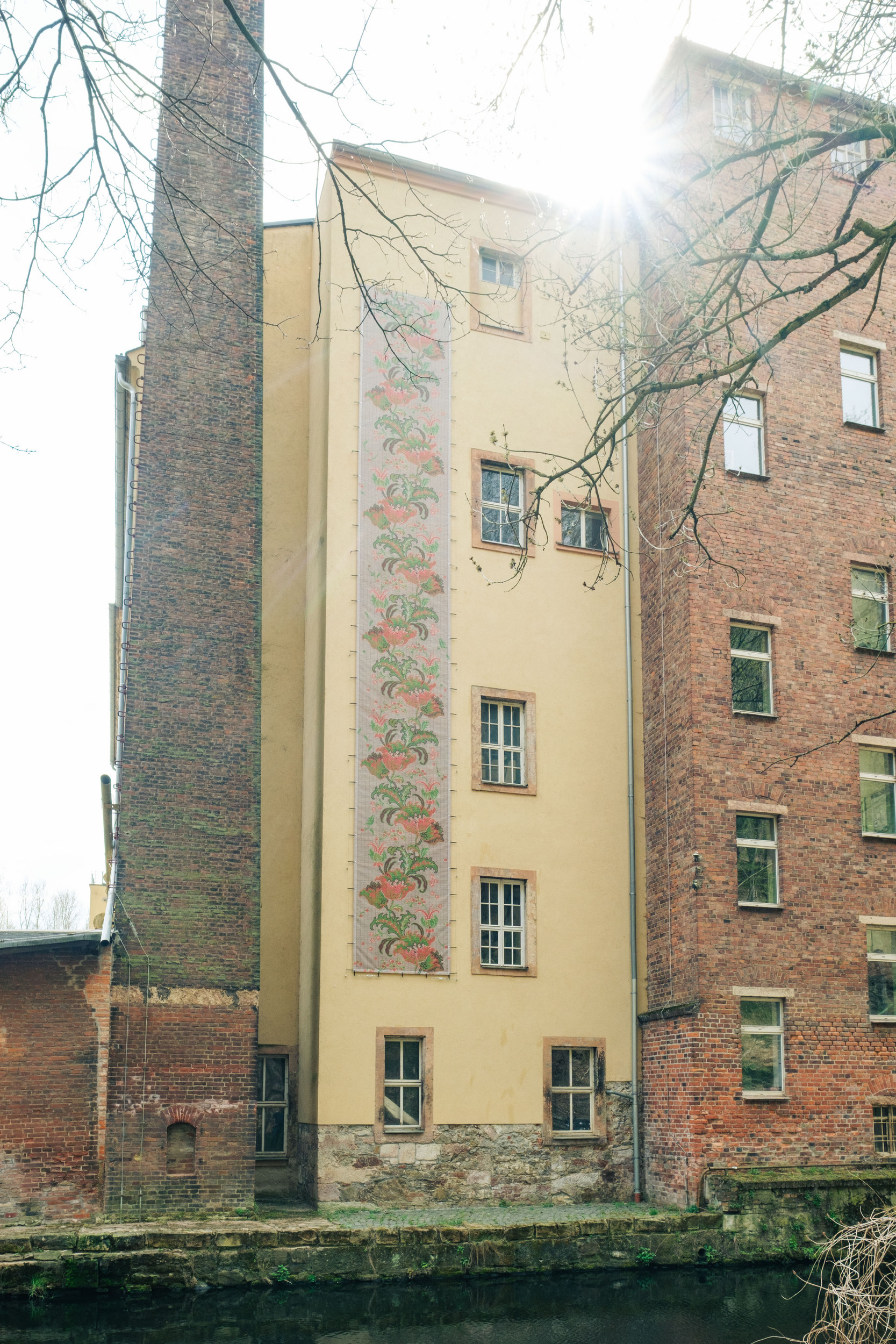
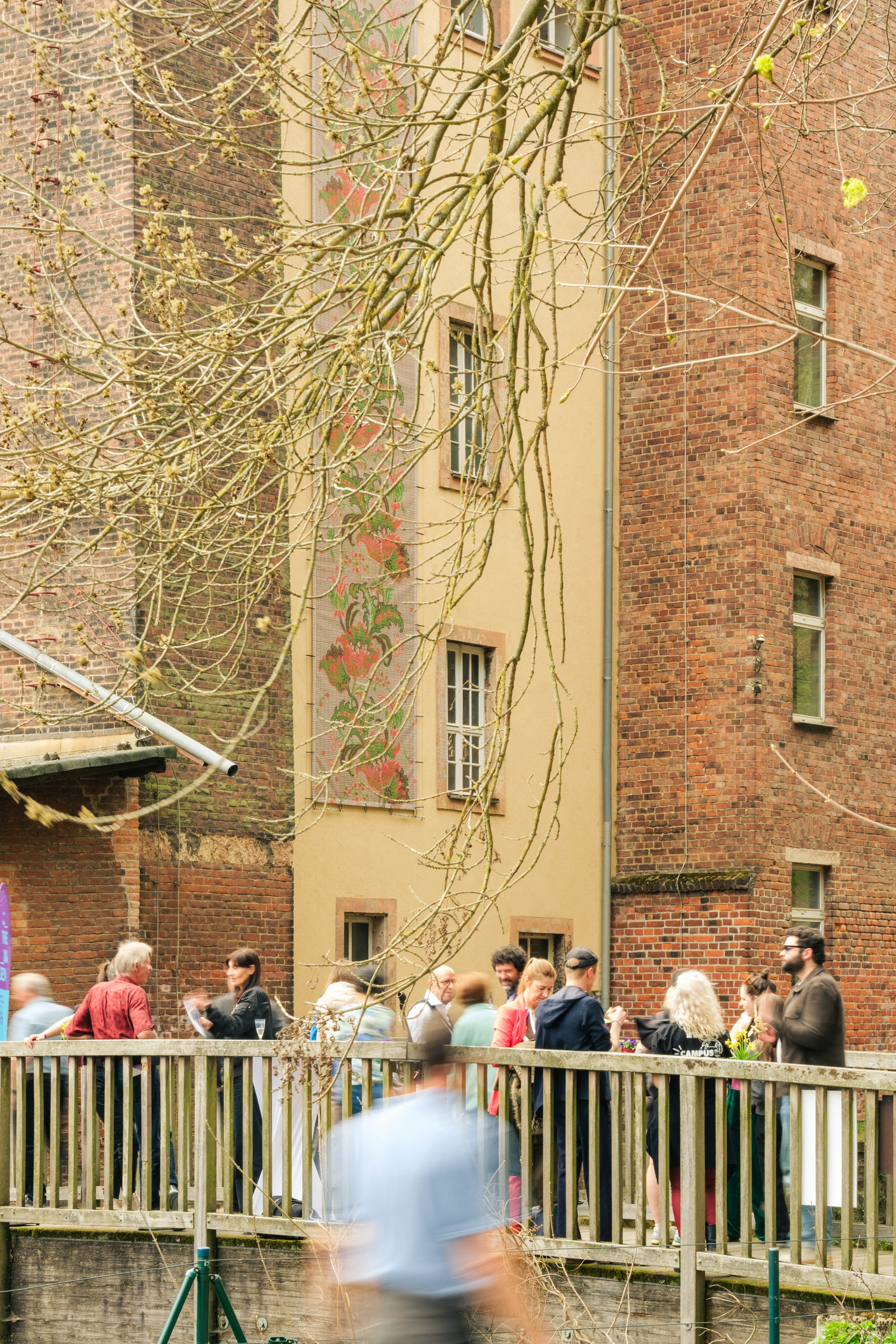
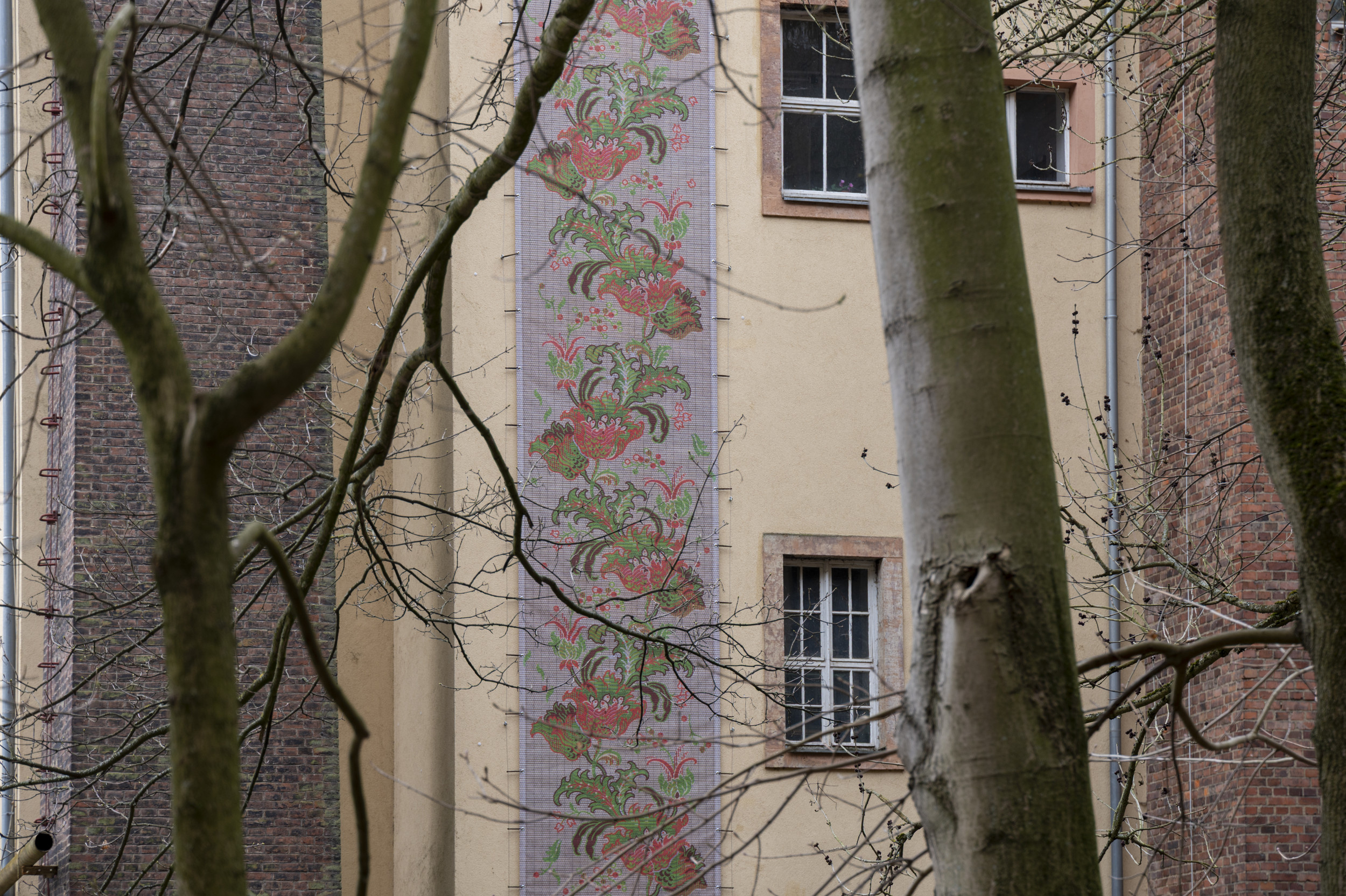
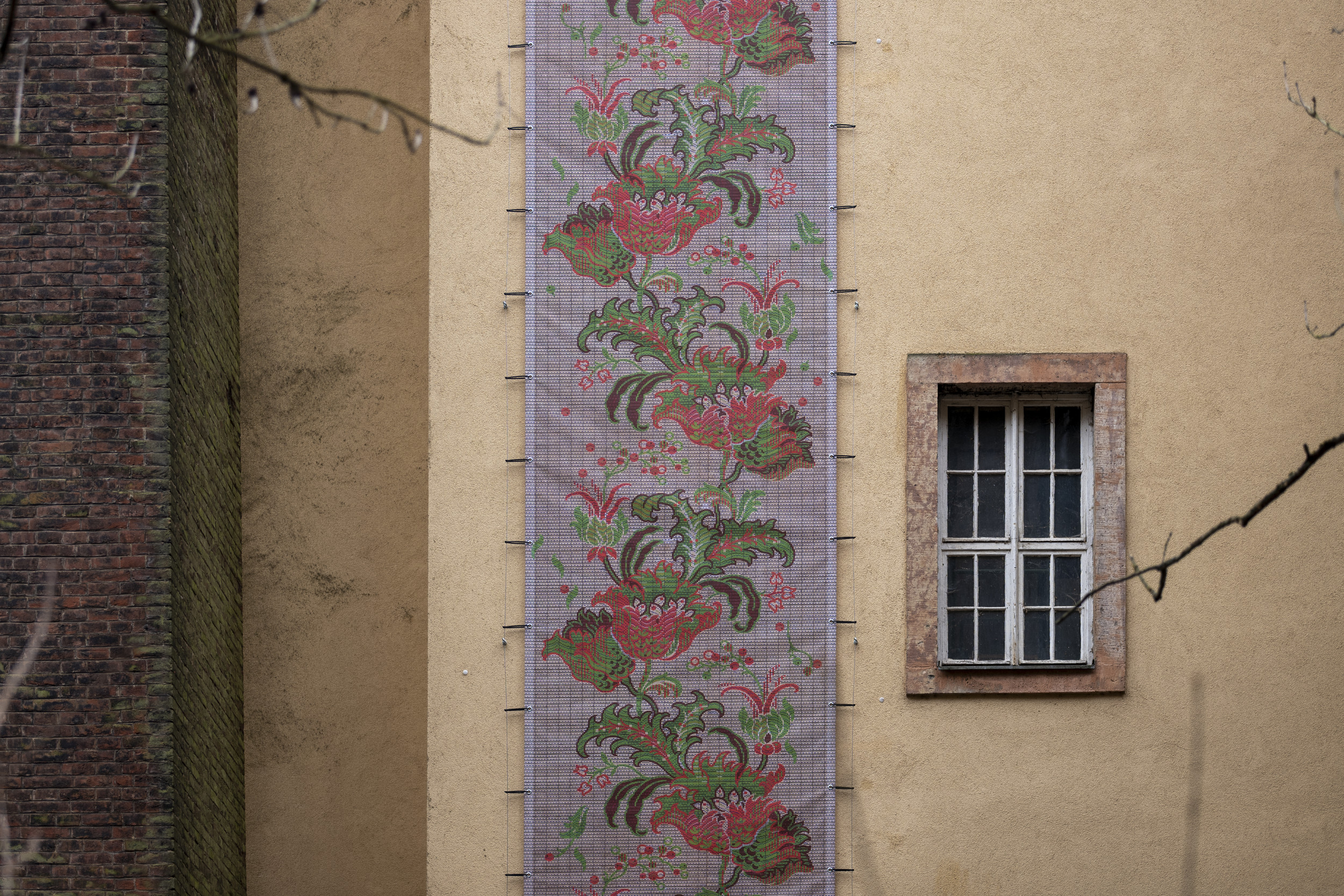
A vertically elongated mural by the artist Anja Schwörer, who was born in Kandel in 1971 and now lives in Berlin, has been installed on the rear façade of the small industrial museum Schauweberei Braunsdorf in Niederwiesa. Coloured squares arranged in a row create a geometric image when viewed from the opposite bank of the Mühlbach stream. It is reminiscent of plant tendrils and flowers made up of pixels on a computer screen. The artist has isolated individual elements and removed them from the uniformity of the grid drawing. They shift the perfection into a lively, almost organic composition. The pixel dots printed in a green-violet colour spectrum on PVC mesh blend in with the colourfulness of the wall, which shimmers through the net-like texture of the fabric. The grid and basic shapes of Schwörer's mural Mapping Patterns: Industrial Flora refer to fabric structures, woven ornaments and the functioning of looms, which are documented, researched and demonstrated on historical machines in the show weaving mill.
The artist chose a cartridge drawing from 1897 as her motif, which was used in the textile industry as a schematic representation of a textile weave for the production of borders, ornaments, jacquard fabrics or tapestries. Until the 1950s, these patterns were designed by artists and pattern draughtsmen, translated into a kind of early programming language and punched into punched cards, which were used to control the looms. Schwörer's mural is thus a poetic, playful and site-specific reminder of the origins of computational linguistics, which obviously has its origins in the control of looms and is therefore not in fact a 20th century invention.
(Text: Alexander Ochs / Ulrike Pennewitz)
Anja Schwörer
Mapping Patterns: Industrial Flora (2025)
In Niederwiesa
Material: Digital print on mesh banner
Set up with the support of the municipality of Niederwiesa.
Address:
Schauweberei Braunsdorf
Inselsteig 16
09577 Niederwiesa OT Braunsdorf
to the location on Google Maps
Niederwiesa - The energy of water
In the Zschopau valley, the power of water has fuelled economic development for centuries. It provided energy for mills and textile factories. Along the course of the river, man-made millraces branched off again and again, bringing the water to the mill wheels. This is also the case in Niederwiesa, in the Braunsdorf district.
Karolin Schwab's art installation My Floating Home is located in the centre of the millrace of the Braunsdorf weaving mill. The fluid nature of the water of the Zschopau, which flows through the artwork, symbolises the passage of time. The mill site has existed since the 16th century. Today, the Braunsdorf weaving mill is a 4th generation family business.
The millrace also connects the weaving mill with the historical Braunsdorf show weaving mill. This technical museum and monument documents almost 200 years of history of the Saxon textile industry. Special features include the originally preserved production halls and functioning machines, which are also demonstrated. Many of the machines originate from Chemnitz mechanical engineering.
Since 1999, the building of the show weaving mill has also been home to a textile company with a big name: the Cammann Gobelin Manufaktur. It is the successor company to the world-famous Chemnitz upholstery fabric weaving mill Cammann & Co. Anna Schwörer's textile installation can be seen on the rear façade of the museum. Visitors will find themselves at kilometre 84 of the charming Zschopautal cycle path.
From thread to fine fabric: the historic Braunsdorf show weaving mill
"Experience the magic of the old art of weaving" - the Braunsdorf historical weaving mill doesn't promise too much. It is one of the most important technical museums and monuments to the textile tradition in Saxony. On display are completely preserved textile production facilities, which are also demonstrated in operation.
The historical roots of the site go back to around 1800. From 1827, a spinning mill produced yarns here, the machines of which were driven by the water power of the Zschopau. In the course of the 19th century, there is also evidence of a sheep's wool laundry and dye works as well as a felt factory.
1910 was an important milestone in the history of the factory. The Chemnitz weaving entrepreneur Paul Martin Adolf Tannenhauer (1857-1926) bought the site, rebuilt it and set up an upholstery fabric weaving mill with new mechanical looms. His production in Chemnitz was completely relocated to Braunsdorf. in 1912, his son Kurt Tannenhauer (1890-1971), who had previously spent time in South America, joined the company.
When his father died in 1926, Kurt Tannenhauer continued to run the weaving mill alone. From 1936, it operated under the name Weberei Kurt Tannenhauer - Möbel- und Dekorationsstoffe. The entrepreneur came into conflict with the Nazi regime when he refused to weave uniform fabrics during the Second World War. As a result, he received hardly any other orders and had to save the factory and the workforce with small orders during the war.
After the war, Kurt Tannenhauer succeeded in making a new start with the production of fine Biedermeier fabrics. Their high quality was in demand on the international market, so that they were sold to Australia, the Arab world, Scandinavia and West Germany. The gradual forced nationalisation during the GDR era in 1961 and 1972 did not bypass the Tannenhauer family business. Despite this, his daughter Eva worked as a textile designer in the company from 1950 to 1990, and his son Werner as commercial manager.
As a so-called Volkseigener Webereibetrieb (VEB), the company continued to produce upholstery and decorative fabrics until 1990. in 1991, the family business was returned to the siblings. Together with the Friends of the Chemnitz Industrial Museum , a concept was developed to preserve the building and machinery. in 1994, the building was declared a technical monument and museum, which has been run by the municipality of Niederwiesa since 1996.
The historic Tannanhauerfabrik building itself is privately owned by Berlin architect Ulrich Ferger, who runs a guest house and event location here. The freelance sculptor and creative stonemason Frank Heim also has his workshop "Heimstein" on the site.
Zschopautal cycle path: the royal road of the Ore Mountains
The Zschopau Valley is a 136 km long valley with many faces: steep rocky gorges, green meadows and dense forests, picturesque villages, proud castles and palaces, historic bridges, industrial monuments and evidence of mining. There is probably no other valley in Saxony where cyclists can gather so many different and varied impressions in just a few kilometres.
A cycle tour through the Zschopau valley shows cyclists many sides of the federal state of Saxony, which the locals themselves would say are typically Saxon: from the Ore Mountains to the lowlands, from unspoilt nature to the centuries-long influence of mining, the metal and textile industries, from architectural and cultural-historical treasures to lively customs.
From the source area on the Fichtelberg to the Freiberg Mulde
The Zschopautal cycle route is recommended as a 2-day tour (136 km). It makes sense to start the day before in Oberwiesenthal/Erzgebirge. At the end of the 1st day, an overnight stay in Augustusburg is recommended (after 73 km). This makes the first stage 10 km longer than the second stage (63 km), but the first section, up to around KM 40, is almost all downhill. Cyclists with a particular interest in culture and history should plan 3 days to allow more time for sightseeing along the route.
Although the route tends to be downhill along the course of the river, the tour is still classified as moderately difficult due to several climbs (approx. 1,500 metres of positive elevation gain). As the Zschopau valley is a very rocky and steep valley in places, the trail occasionally leads away from the course of the river to the heights above the valley. Although this is strenuous on the one hand, it rewards you with charming views of the landscape of the Erzgebirge and Central Saxony on the other.
The Zschopau valley cycle path leads from the source of the Zschopau at Fichtelberg, the highest mountain in Saxony (1218 m), to its confluence with the Freiberger Mulde near Döbeln. There it merges seamlessly into the Mulde cycle path.
Cultural treasure trove in a baroque ensemble: Lichtenwalde Castle and Park
Lichtenwalde Castle is located just two kilometres from the Niederwiesa art installations on the Purple Path. There was probably a medieval fortification here as early as the 12th century. Today there is a magnificent baroque castle and park complex here, which was built in the first half of the 18th century.
The imposing building complex with three wings houses a large and varied collection of cultural artefacts and art from all over the world in the Treasury Museum. On display are art and everyday artefacts from Nepal and Tibet (Himalayas), precious porcelain and furniture from China and Japan as well as wooden sculptures of the ancestral cult from West Africa.
Also worth seeing are the restored historical rooms from the 18th century, such as the prestigious King's Room, the ornate Red and Green Parlour, the magnificent Chinese Room and the library, which today also hosts wedding ceremonies.
Especially in the warmer months, a stroll through the palace park with its magnificent flowers and water features is a real cultural and historical delight. Laid out in the style of a French baroque garden, it incorporates various rococo elements in a surprising way, in some cases with a romantic touch. Around 1800, an English landscape park was created as an extension. Lovers of European garden culture can give free rein to their joys of discovery here in the pleasantly cool climate of the Zschopau valley.
Making the future: A typical mentality in the Ore Mountains
Innovation and a sense of tradition, openness and immigration have always ensured the survival of the Erzgebirge mining region. All of this bears witness to the many transformation processes that reach far back into history and in some cases continue to this day. The region has always been on the move. People came and went with the economic ups and downs, reinvented themselves culturally and further developed crafts and technology. This is still the case today.
Quality flour from regional grain: Braunsdorf weaving mill
A mill in Braunsorf on the Zschopau is already mentioned in a document from the 16th century. The people here are well aware of this long history and rely on the tradition of regional products. Wheat and rye come from the neighbouring growing areas of the region as far as Lommatzscher Pflege (Saxony) and Altenburger Land (Thuringia), which are among the best in Germany in terms of grain quality. The water of the Zschopau is also used to generate energy, effectively supplemented by powerful photovoltaic systems.
Regional quality suppliers, sustainable energy production and gentle milling processes with modern technology - this is what the Webermühle family business, now run by the 5th generation, is built on. The company is proud to preserve and further develop the diversity of German bread culture with its high-quality regional flours and together with the bakery trade.
Peggy Wunderlich and Torsten Bäz: Cammann Gobelin Manufaktur
High-quality fabrics for classic furniture and exquisite rooms - that is the hallmark of Cammann Gobelin Manufaktur Braunsdorf. In August 2014, Peggy Wunderlich and Torsten Bäz took over the company as external successors. There had been several changes of ownership after the fall of communism in 1989/90. It was not easy to restart the company with its great history in luxury textiles after reunification, which had been forcibly nationalised in the planned economy of the GDR between 1972 and 1990.
But now the course has been set for the future. Fine fabrics from manufactory production are still in demand on the world market, especially if they have a traditional name. Furniture factories, interior decorators and restorers of historical fabrics rely on the expertise of Cammann. The company's treasure is its countless original historical fabric samples. Anyone wishing to be inspired by tradition and creativity can take a look at the online sample book.
The company founder: Franz Paul Cammann
Today's manufactory goes back to the upholstery fabric weaving mill Cammann & Co. in Chemnitz. This was founded in 1886 by Franz Paul Cammann and was one of the world's leading producers of luxury fabrics for upholstered furniture, wall coverings for state rooms, salons, theatres, railway carriages and ships. Deliveries were made to England, India, North America and the Arab world.
In the 1920s, the company moved to Blankenauer Strasse 74, where the imposing eight-storey administration building (built in 1923-26) with its spire still rises 40 metres into the sky today. At the time, it was the first high-rise building in Chemnitz and the tallest building in the city. Its reinforced concrete construction, designed by Chemnitz architect Willy Schönefeld, was already modern at the time.
Indoor art 2025
In 2025, a major exhibition on the history of graffiti art will take place on the Cammann site in Chemnitz. Hallenkunst 20 25" documents the worldwide development with a comprehensive review of art and cultural history. Works by more than 70 artists and 30 galleries from the USA, Germany, Austria, Switzerland, France, Italy, Spain, Poland, the Czech Republic, Denmark, Sweden, the Baltic states, Slovakia, Ukraine and Hungary will be on display.