Christina Doll: Engel + Bergmann
Hohndorf

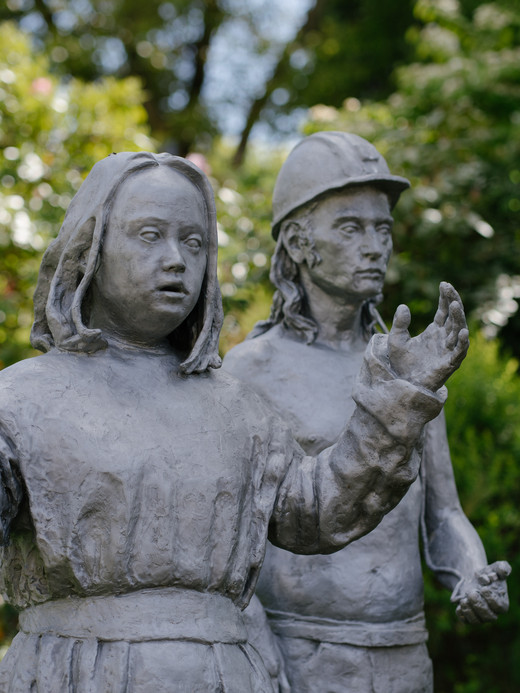
A young girl with outstretched arms and a wide robe stands next to a slender man with a pit helmet, who appears to be offering the viewer a piece of ore. The two figures by Christina Doll are reminiscent of the traditional Erzgebirge motif of angel and miner, which the artist, who was born in Cologne in 1972 and now lives in Berlin, translates into a contemporary visual language. Doll's figures, cast from a variety of materials, refer less to the traditional design methods of Erzgebirge iconography that have been handed down over the centuries. Her angel and miner appear to have been taken from life in terms of their facial features, their furnishings and their form. The artist approaches people through a process of observation, not portraying them, but empathising with their nature, observing their gestures and facial expressions, finding special features and similarities. It is not celebrities or social media identities, but marginalised groups and suppressed narratives that she gives a face and a form in her lifelike, immediate and truthful sculptures, the forcefulness of which breaks through any surface.
"Feelings are stronger than consciousness," is how Doll describes her experience of meeting a group of children with physical and cognitive disabilities. The artist observed them rehearsing the nativity play and translated their gestures, facial features and shape into the figure of an angel. For the miner, the artist researched the history of one of the installation sites, St Wolfgang in Schneeberg, where rich silver deposits were mined alongside tin, iron and copper in the 15th century. Labelled as pitchblende and considered unusable, the ore that shaped Schneeberg between 1946 and 1956 was thrown onto heaps over the centuries: uranium. Operated by the Soviet-German AG Wismut, the ore was mined in the pits of Object 03 in the strictest secrecy, initially also under forced labour and with dramatic consequences for workers, the population and nature, in order to produce fuel rods and nuclear weapons in the Soviet Union. Doll gave the miner's figure the facial features of a Wismut worker based on an old photograph; its figure is reminiscent of Lucas Cranach's depiction of Adam on the Reformation altar in St Wolfgang. With the pair of figures, angel and miner , the artist does not create an idealised depiction, but rather creates a monument to real life, the people, their work and their suffering in a sensitive, almost humble manner.
(Text: Ulrike Pennewitz / Alexander Ochs)
Christina Doll
Engel + Bergmann, 2025
In Hohndorf, at square Bergmannsplatz
Material: Aluminium
Set up with the support of the municipality of Hohndorf.
Address:
Bergmannsplatz
u. Angerstraße 2,
09394 Hohndorf
to the location on Google Maps


Hohndorf - mining tradition, art and a lively community
Nestled on the northern edge of the Ore Mountains, between Oelsnitz and Lugau, lies Hohndorf - a town that has its roots deeply embedded in the history of coal mining and at the same time has developed into a modern, open community. Hohndorf was part of the Lugau-Oelsnitz coalfield, which lies to the east of the Zwickau coalfield. It is the mixture of mining tradition, scenic beauty and a lively village community that makes Hohndorf so special.
From village to mining community
First mentioned in documents in the 15th century, the people of Hohndorf initially lived from agriculture, crafts and small businesses. Change came with the 19th century: coal mining fundamentally changed life and dominated the working world and local culture. Conveyor systems, miners' housing estates and pits characterised the townscape. The population grew from 400 (1838) to 7,000 (1927). At around 1,200 metres, the Vereinigtfeldschacht was one of the deepest coal shafts in Europe around 1940. This made coal mining increasingly unprofitable.
VEB Steinkohlenwerk "Deutschland" was the most important employer in Hohndorf until the 1960s. Then the mines were finally closed until 1963. Most of the buildings and facilities were demolished over the years to make way for new buildings for living and working. Today, display boards and lovingly maintained traditions are reminders of this era.
In the 1990s, the population declined due to structural change. Today, Hohndorf has around 3,500 inhabitants. In recent decades, the "miners' village" has developed into a modern, family-friendly residential community with good connections to Chemnitz and Zwickau.
Bergmannsplatz: miners' memorial and new work of art for inclusion
The heart of mining remembrance beats at Bergmannsplatz. Here stands the striking miners' monument, which honours the diligence and pride of the miners. The sculpture shows a miner in work clothes with a mine cart - an earthy testimony to the local labour tradition. Since May 2025, the artwork Engel + Bergmann by artist Christina Doll has stood in the immediate vicinity: a contemporary interpretation of Erzgebirge Christmas symbolism and mining tradition with a direct link to the present day.
The angel figure is inspired by children with physical or cognitive disabilities. She stands there with open arms. Christina Doll is consciously setting an example for inclusion. Inclusion also plays a major role elsewhere in Hohndorf: at the Hohndorf residential centre run by the Theodor Fliedner Foundation.
The Coal Trail - experience history
This 18 km long Themed circular hiking trail connects Oelsnitz, Hohndorf, Gersdorf and Lugau. There are over 80 information boards along the route, reminding visitors of former shafts, spoil tips and historic roadways - an impressive journey through time into the region's mining past.
Hike through historic Hohndorf
On the approx. 12 km long circular tour of medium difficulty, you can explore old farms, traditional inns and craft businesses in Hohndorf and the history of the village.
A typical mentality in the Ore Mountains
Innovation and a sense of tradition, openness and immigration have always ensured the survival of the Erzgebirge mining region. All of this bears witness to many transformations that reach far back into history and in some cases continue to this day. The region has always been on the move. People came and went with the economic ups and downs, reinventing themselves culturally and socially and developing crafts and technology. This is still the case today.
Hohndorf residential centre: a living model of inclusion
In Hohndorf, inclusion is not only expressed artistically with the Engel + Bergmann sculpture on Bergmannsplatz, but is also realised in a socially effective way. With the Hohndorf residential centre of the Theodor Fliedner Foundation, a new "village within a village" was created after German reunification in the 1990s.
In the middle of the old village centre, where there are now many new homes and small shops, there is a lively, inclusive form of living for people with mental or multiple disabilities. In residential groups, accompanied by an outpatient care service, 50 people can live together in the centre of community life - an impressive example of inclusion in action. The foundation also maintains 30 rental flats in the neighbourhood for families who care for relatives with disabilities or senior citizens.
The Hohndorf residential home shows how inclusion works in practice in everyday life: People with disabilities live in the heart of the community, not isolated, but embedded in a functioning neighbourhood and an open community. It is the mixture of mining tradition, scenic beauty and a lively village community that makes Hohndorf so special.
Background: The foundation
The Theodor Fliedner Foundation operates nationwide with care, therapy, residential and educational programmes. 50 facilities in five federal states are primarily aimed at people in need of care, people suffering from addiction or mental illness and people with disabilities. 2.every day, 600 employees act in accordance with the diaconal principles of Theodor Fliedner.
The inspiration: Theodor Fliedner
Theodor Fliedner (1800-1864) was a German Protestant theologian and social reformer who is regarded as one of the founders of modern social welfare. There is no historical evidence that Theodor Fliedner ever visited Hohndorf (Erzgebirge) in person. He worked almost exclusively in the Rhineland and on his numerous journeys through Germany, Europe and as far as Palestine to found or support deaconess institutions.
The Theodor Fliedner Foundation's Hohndorf residential home therefore bears his name not because he himself worked there, but because today's foundation continues his ideas and diaconal concept. His career began in 1822 in a pastorate in Kaiserswerth on the Rhine, near Düsseldorf. There he encountered great poverty, neglect and a lack of social care and education. For Fliedner, this was a potential source of crime that he wanted to combat. He therefore became involved in prison chaplaincy and founded the "Rheinisch-Westfälische Gefängnis-Gesellschaft" (Rhenish-Westphalian Prison Society) in 1926, an initiative to support prisoners after their sentence.
Together with his wife Friederike, he opened the first deaconess motherhouse in Kaiserswerth in 1836 - a training centre for women who worked as nurses, teachers and in the care of the poor. This idea of strengthening the role of women in society and the family quickly spread throughout Germany, Europe and even to the USA. Hospitals, schools and social services were established under his leadership.
From these beginnings, social welfare developed into an important pillar of the entire Protestant church. The Theodor Fliedner Foundation continues to build on his ideas to this day. Fliedner was a pioneer of practical charity who decisively shaped the concept of professional, Christian social work in the 19th century.