Frank Maibier: Ornaments
Lichtenau

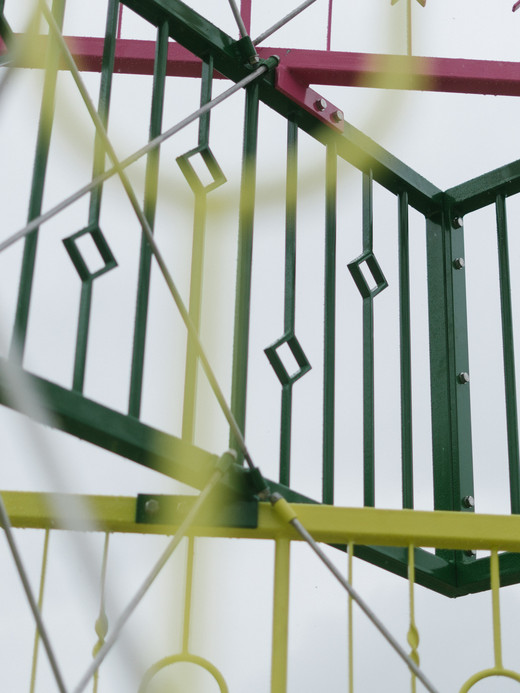
On a square ground plan, eight elements of different heights and colours are stacked at equal angles to form a tall tower. The artist Frank Maibier, who was born in 1959 in Werneuchen near Berlin and lives in Chemnitz, documented the formal and colourful models for the sculpture Ornamente on forays through the eight villages in the municipality of Lichtenau. As a sculptural homage to the cheerful stylistic pluralism of garden fences and their owners, Maibier's sculpture quotes their ornaments and has them realised by a master locksmith from the municipality. Maibier, who often explores the limits of stability and balance in his sculptures, installations and works on paper in order to question the principles of material laws and norms in both a concrete and figurative sense, dedicates his sculpture to Lichtenau's local spirit of resistance to the boredom of everyday objects.
Property boundaries made of metal remnants are among the secret trademarks of private everyday culture in East Germany and Eastern Europe. They testify to the ingenuity with which the lack of products from the former socialist planned economy was compensated for by the reuse and further utilisation of leftovers, often from state-owned enterprises in the private sector. With imagination and skill, garden fences with stylised plant tendrils, concrete-abstract patterns, underwater scenes or bouquets of flowers were created from punched slugs, ironwork, cogwheels or brake discs. With their richness of form, they can still hold their own today against the lack of aesthetics of DIN-standardised fence irons from the DIY store and confidently transport their stubbornness into our present day.
(Text: Alexander Ochs / Ulrike Pennewitz)
Frank Maibier
Ornamente
In Lichtenau
Material: steel, concrete base
Erected with the support of the municipality of Lichtenau.
Address:
Chemnitzer Str.
Height of the "Chemnitzer Straße" industrial estate - opposite the Oberlichtenau agricultural business
09244 Lichtenau
to the location on Google Maps


Lichtenau - New views, new connections
The municipality of Lichtenau lies between the Chemnitz and Zschopau rivers and on the visual axis of two landmarks: Daniel Buren's Bunte Esse in Chemnitz and the Ferris wheel in the Sonnenlandpark Sonnenlandpark . Anyone travelling on the motorway can see both. The leisure park with several adventure worlds, including the highest slide tower in Germany, has become a well-known trademark of Lichtenau.
A new, third landmark was added in May 2025. During the Capital of Culture year, Frank Maibier's artwork Ornamente was created on the outskirts of Oberlichtenau, directly opposite the industrial estate. From here, too, there is a direct view across the landscape to Buren's Bunter Esse in Chemnitz. The art on the Purple Path creates a completely new connection between the city and the rural community.
Eight becomes one: districts grow together
German reunification opened up new perspectives and connections for the local inhabitants. In the 1990s, the municipalities in the region began to increasingly merge. Lichtenau grew out of eight districts, some of which were founded in the 12th century: Auerswalde, Biensdorf, Garnsdorf, Krumbach, Niederlichtenau, Merzdorf, Oberlichtenau and Ottendorf. What has kept them together since then?
Almost 7,000 inhabitants live here. In a survey in 2000, 51% of the population voted in favour of the new municipality name Lichtenau. Joint projects have brought people together, such as the unified town hall in 2005, the opening of Sonnenlandpark in 2006 and the inauguration of a new secondary school in 2011. Community needs such symbols of new beginnings. In the meantime, these and other initiatives have forged a strong bond between the districts.
Agile economy: over 600 businesses in Lichtenau
One reason for this is that the economy has developed well here in recent years, which keeps people in the community: Over 600 small and medium-sized businesses are based here, creating jobs and cohesion. One of these is the company Metallbau Raschke in the Auerswalde district. The family business was founded in 1907 and is now run by Dorit Thieme in the 4th generation.
Over more than 100 years, the company has developed from a traditional forge into a metal construction company with a wide range of products: stairs, carports, balconies as well as gates, railings and fences made of steel. Elaborate reconstructions of historical forging work are also realised with great attention to detail. Dorit Thieme and her team helped with the construction of Frank Maibier's work of art Ornaments .
From Auerswalde to Chemnitz: Carl Gottlieb Haubold - the father of mechanical engineering
Incidentally, a man was born in Auerswalde who drove the economic development of the region with many pioneering achievements: Carl Gottlieb Haubold (1783-1856). He is commonly referred to as the founding father of mechanical engineering in Chemnitz. His factory production of spinning machines for textile companies as well as shredders and presses for the paper industry was the origin of the booming industrialisation in the 19th century and thus of today's mechanical engineering cluster in Chemnitz.
From the depths of the Ore Mountains: Mild mineral water
Another entrepreneurial success story has been written since 1990 by the Lichtenauer mineral springs. More than 200 employees produce around 700,000 bottles of refreshing mineral water, spritzers, lemonades and fitness drinks every day. Whether at cultural or sporting events in the region, thirst is quenched with Lichtenauer everywhere. The company was also involved as a sponsor and partner of the European Capital of Culture Chemnitz 2025.
Altars to kneel at: St Ursula Auerswalde
Auerswalde is one of the oldest districts in the municipality of Lichtenau. The evidence dates back to the 12th century. This also includes the Protestant-Lutheran Parish of St Ursulafirst mentioned in a document in 1186.
The church was once built in the Romanesque style, although only a few traces remain due to the remodelling in the 18th and 19th centuries, e.g. the large triumphal arch made of Rochlitz porphyry between the hall and choir and the elaborate structure of the apse behind the altar. An architectural influence from the building workshop of the Wechselburg collegiate church.
The late Gothic carved altar is remarkable. It was created around 1503 and is the work of Peter and Jakob Naumann, the main masters of the Altenburg workshop. In the centre shrine is a figure of Mary with a halo. She is flanked by St Margaret and St Barbara. In the predella is a depiction of the Annunciation, which can be closed by altar wings painted in the style of Lucas Cranach.
The sound of the Purple Path: Jehmlich organ in St Ursula Auerswalde
The 1907 instrument from the Saxon organ manufacturer Jehmlich in the church of St Ursula in Auerswalde is interesting, worth seeing and hearing. Jehmlich Orgelbau left its mark on music-making throughout Saxony for more than 200 years. in 1808, the brothers Gotthelf Friedrich, Johann Gotthold and Carl Gottlieb founded the family's organ building tradition in Cämmerswalde in the Ore Mountains. Since 2006, Ralf Jehmlich has been running the company in Dresden in the 6th generation. This makes Jehmlich Orgelbau the oldest surviving organ builder in the world.
A typical mentality in Central Saxony
Innovation and a sense of tradition, openness and immigration have always ensured survival in Central Saxony. All of this bears witness to many transformation processes that reach far back into history and in some cases continue to this day. The region has always been on the move. People came and went with the economic ups and downs, reinvented themselves culturally and further developed crafts and technology. This is still the case today.
Old rooms, new life: From school building to Lichtenau workshop
Economic change has been omnipresent in Lichtenau since 1990 - and is still ongoing. It takes skilful hands and clever minds to shape this successfully. There are many of them in Lichtenau, for example in the Werkraum Lichtenau. Craftsmen and women have turned an old school building into a creative studio centre. The history of the building goes back even before its time as a school, as a textile company originally worked here.
Creative products are now being made here again. Ulrich Czerny's leather workshop, Birgit Reichert's handbook printing workshop and Florian Schwarze's guitar workshop have recently come together here. Jana Schrammel and her therapeutic counselling practice were the fourth addition to the group. In the "Mashup" event series, the four Lichtenauers open their workspaces to other creative people and guests.
Community on wheels: Christian Motorcyclists Saxony e.V.
High-spirited, powerful, committed: these are three words to describe the Christian motorcyclists who come together time and again at the vicarage in Lichtenau-Auerswalde. The non-profit organisation based in nearby Flöha (LINK: Topic Flöha) has 250 members and was founded in 2003. Its primary aim is to spread the good news of Jesus Christ, but the life of the association goes far beyond this. It is about bringing people together, for example at motorbike church services, joint rides and motorbike camps throughout Saxony. The bikers also support aid transports, events and seminars for further training.