Jana Gunstheimer: dingenunner, dingenauf
Zwickau

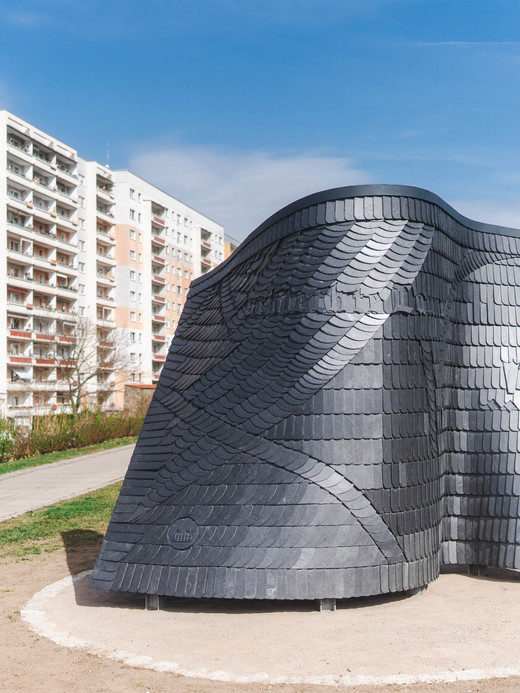
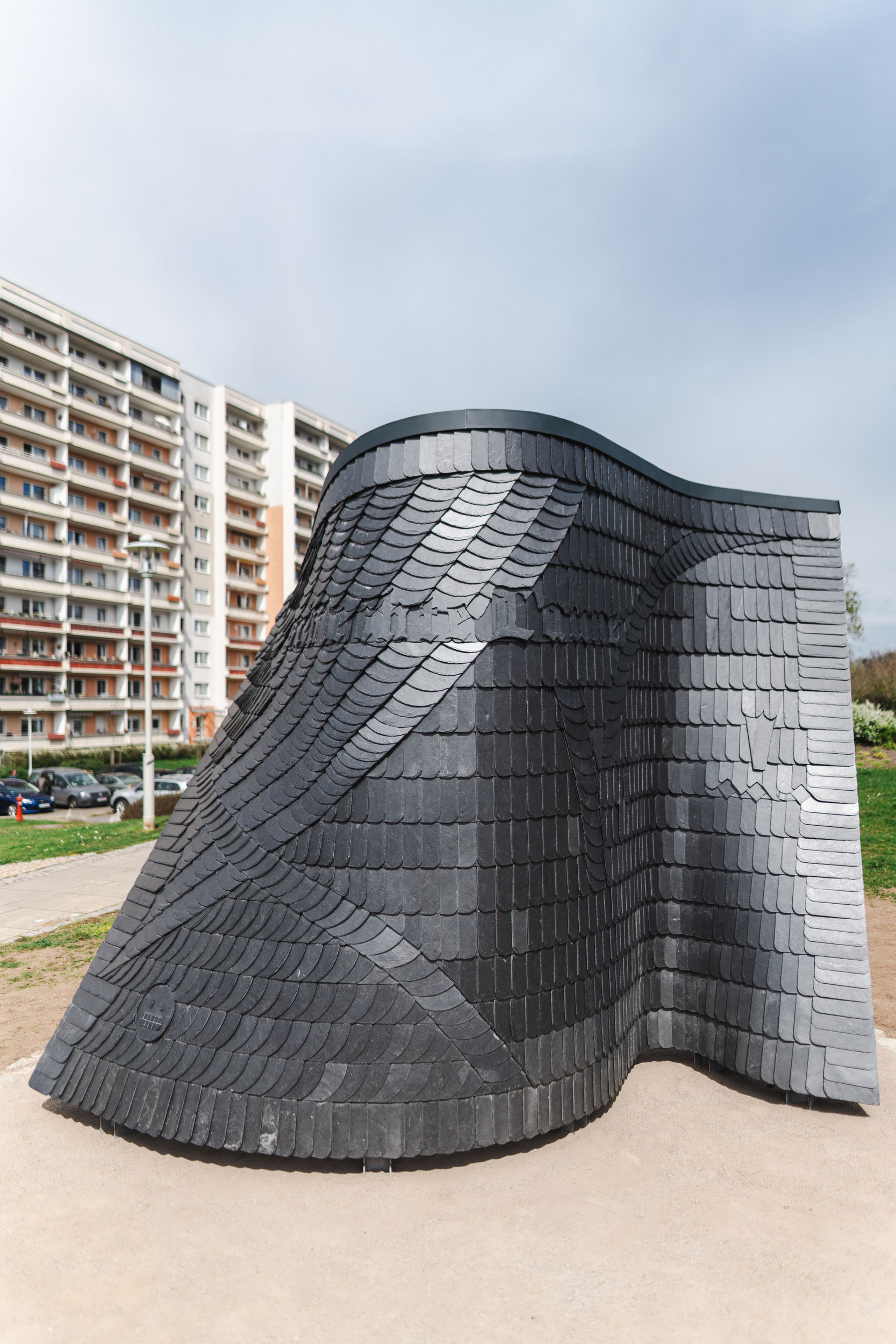
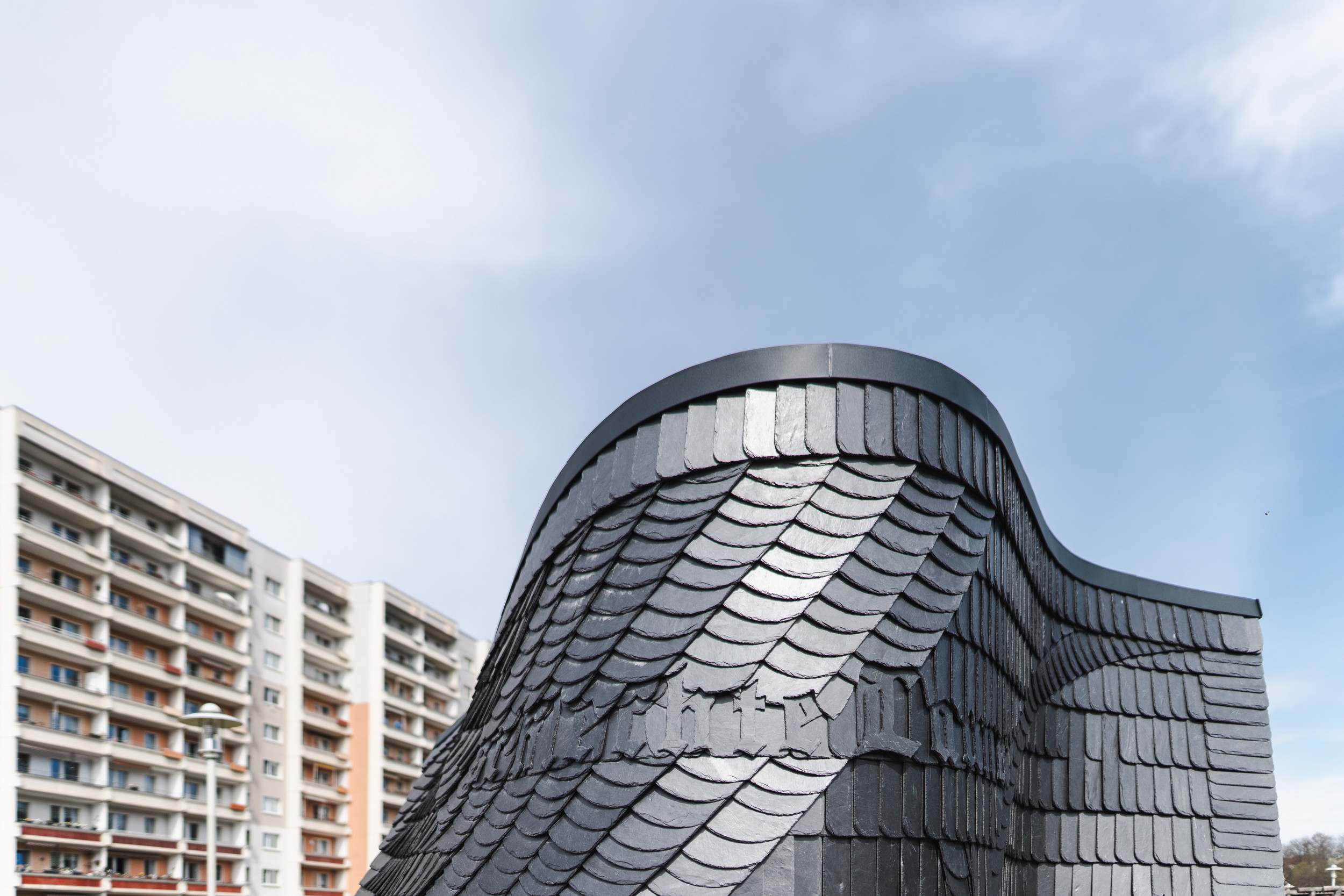
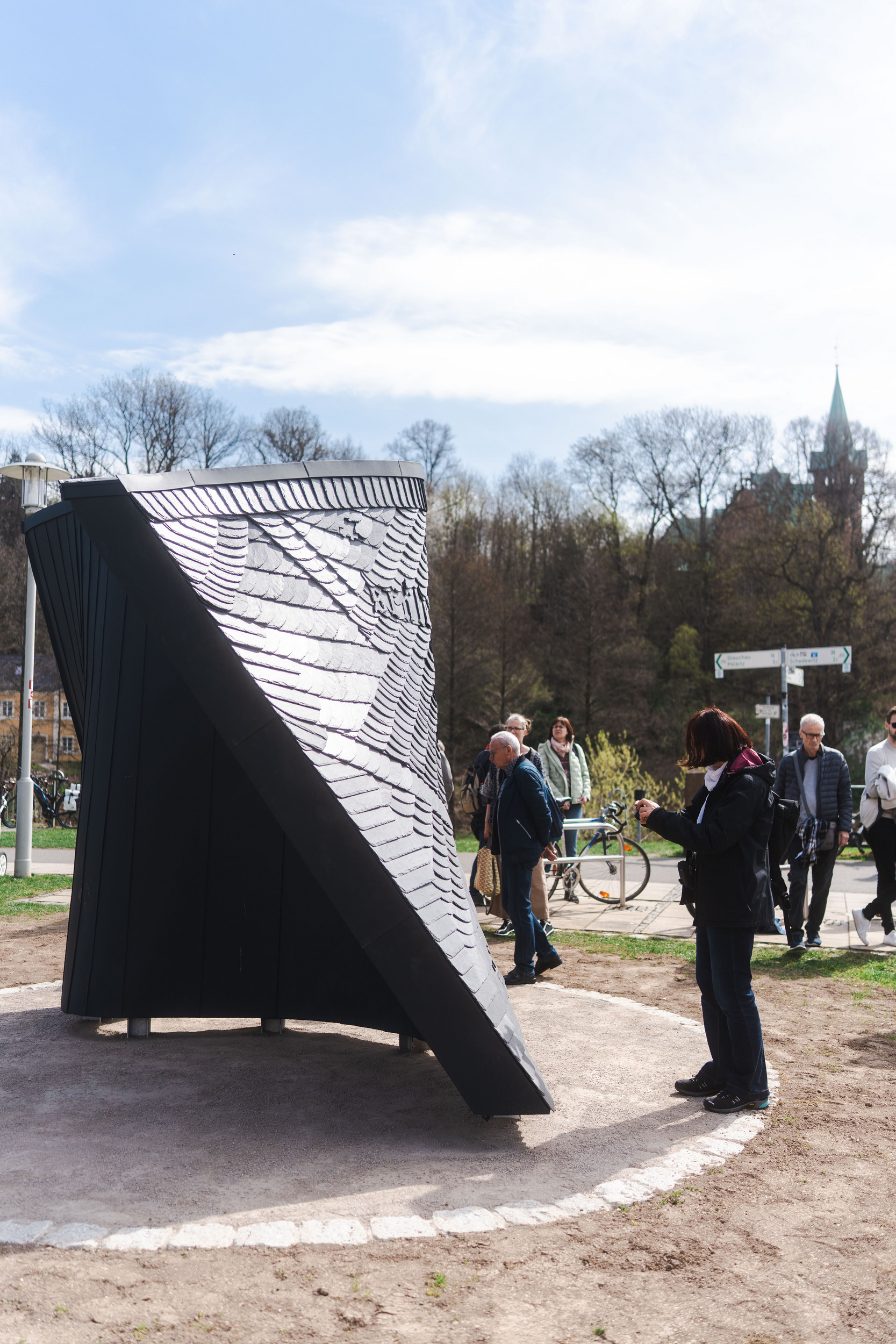
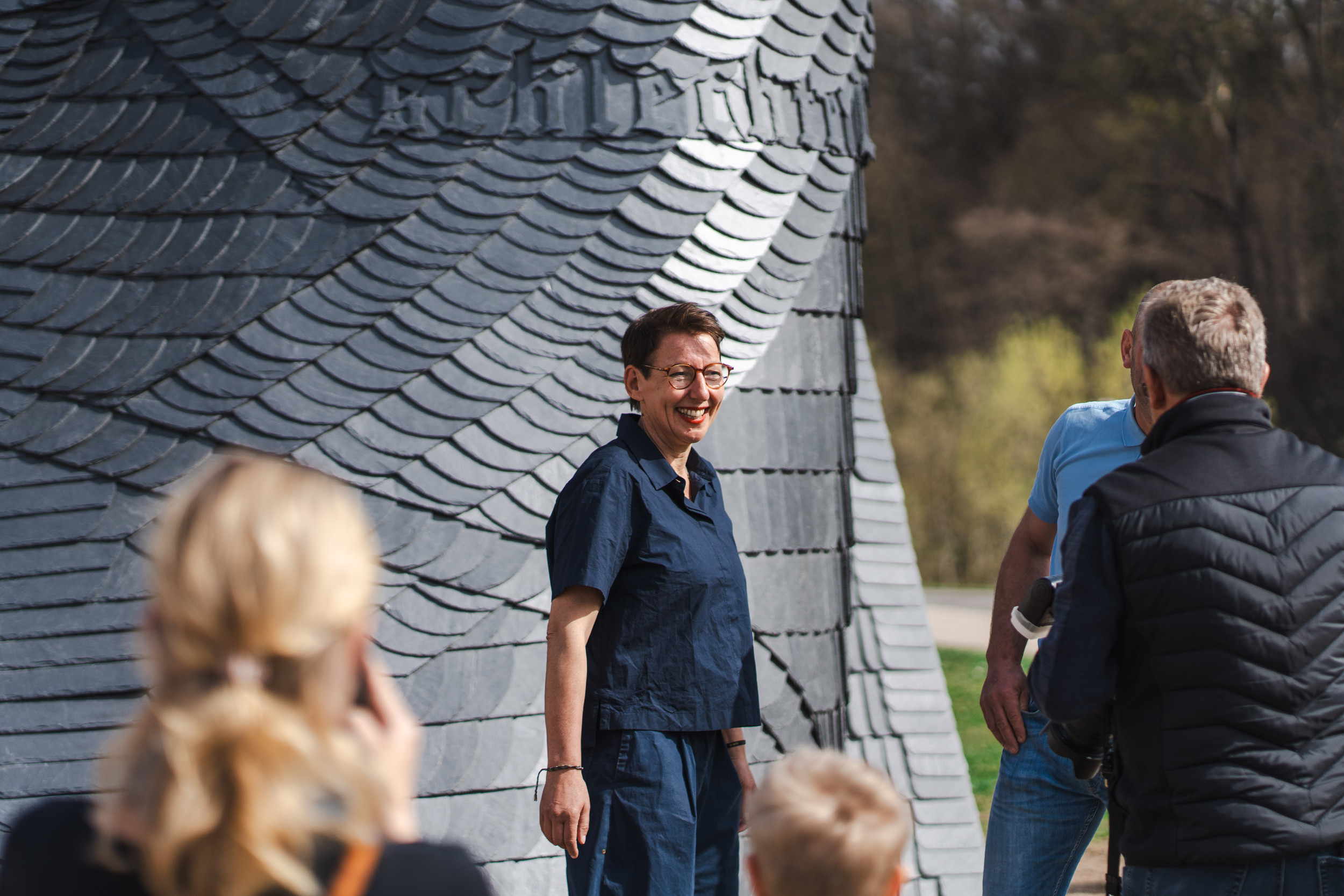
A conically undulating, rectangular surface stands at ground level in view of the banks of the Mulde river that flows through Zwickau. The exterior is made up of a skilfully crafted slate covering. Depending on the incidence of light and the time of day, a slogan shimmers silver-grey to deep black in the moving arrangement of the slate tiles: "schlechte Laune" can be read in Fraktur script with a round "s" at the beginning. The artist Jana Gunstheimer, who was born in Zwickau in 1974 and now works and teaches in Jena, integrates this saying as a sculpturally translated form of the alienation effect that Bertolt Brecht developed as a stylistic device for his epic theatre. Audience and actors alike are literally supposed to fall out of their roles and open themselves up to the message of the literary-artistic material in an irritated way. Both questioning and flirtatious, Gunstheimer's sculpture invites us to take a stand: "Are you in a bad mood?"
In her work, the Villa Massimo scholarship holder thematises regional cultural heritage that developed from her collaboration with a Saxon master roofer, as many houses and parts of their façades in the Erzgebirge are covered and clad with slate.
These are not only a symbol and expression of a traditional craft with a wealth of knowledge that has been handed down over the centuries, but also bear witness to a strong creative will that has been passed down in the past in a lively canon of ornaments and symbols in carvings, façade decorations, bobbin lace letters and samplers. On the other hand, the artist alludes to the current problem of identity-destroying classism, which has become established in the media as the cliché of the "bad-tempered Saxon". Based on everyday sayings and wishes that were embroidered on linen cloths in the tradition of Erzgebirge cloth makers, Gunstheimer places her sculpture in public space with the appearance of a curved cloth: decorated with a spell in the tradition of the Zwickau weavers, it conveys the positive message: "Stay in a good mood!"
(Text: Alexander Ochs / Ulrike Pennewitz)
Jana Gunstheimer
dingenunner, dingenauf (2024)
Material: timber construction, timber panelling, slate tiles
Set up with the support of the City of Zwickau.
Address:
Muldeparadies/Near Paradiesbrücke
08056 Zwickau
to the location on Google Maps

Zwickau - cloth, coal, cars, art.
"dingenunner, dingenauf" in the Erzgebirge dialect means "uphill, downhill". Jana Gunstheimer's artwork of the same name on the Purple Path in Zwickau symbolises the eventful history of the mining tradition. for 850 years, people were characterised by the changes of decline and new beginnings, downturns and upturns, fear and confidence. When raw materials ran out or trades fell into crisis, alternatives were sought. The survival of the people in the Zwickau and Erzgebirge region demanded that they dare to try something new economically, utilise technical innovations, rethink culturally and engage in difficult social discourse. This is still true today.
Together with master roofer Marcel Frieß from Stangengrün, Jana Gunstheimer developed an installation made of wood and black Lößnitzeslate. The curved surface refers to the tradition of clothmaking. Zwickau and the surrounding area had grown rich over the centuries with textile production and trade (cloth) as well as raw material mining and trade (coal, ore, stone). "Are you in a bad mood?", the viewer reads on the artwork. Here, the artist takes up the medieval practice of clothmakers weaving protective spells into textiles. Then as now, the decisive factor in controversial reading is the mindset of seeing things negatively or positively.
Just a two-minute walk from the artwork towards the city centre, the slate-roofed Gewandhaus with its Renaissance gable (built 1522-25) comes into view, the former guild house of the clothmakers. In the 19th century it was converted into a municipal theatre and is now called the Plauen-Zwickau Theatre. This is the best place to start a cultural and historical tour of the town from the main market square with its historic town houses.
In its colourful appearance, the black of the stylised slate cloth is also reminiscent of Zwickau's black gold: hard coal. Right next to it is a sculpture of a coal miner resting on a bench along the Mulde cycle path. In this allusive context, Jana Gunstheimer and Marcel Frieß tell the rich history of the textile trade and cloth trade, mining and industry in a new artistic way.
Coal - the bread and butter of industry
Coal discoveries in the cloth-making and trading town of Zwickau were first documented in 1348. In almost 700 years, there were over 1,000 shafts and mines in the Zwickau mining district. Coal was the driving force behind industrialisation from the second half of the 19th century. the last coal shaft in the mining district was closed in 1978. Today, the mining and coking plants have almost disappeared from the cityscape. The large areas were redeveloped and rebuilt after German reunification.
The last architectural witnesses of the old mining district include the winding tower of Morgenstern shaft II in the neighbouring village of Reinsdorf - now a mining museum - and the winding tower of Martin Hoop shaft IVa on a hill to the west of the town. A 16 x 30 metre work of art on mining by the Leipzig artist Christoph Steyer can be seen on it. The motif is intended to commemorate the mining tradition and the pioneering spirit of the people.
One of the pioneers in the mining industry was the inventor Carl Wolf. His innovation was a new safety miner's lamp for use in coal mining. It signalled the concentration of dangerous mine gas (methane) and has been a lifesaver for miners all over the world ever since. Over many decades, Friemann & Wolf developed further innovations that were exported worldwide.
Zwickau becomes car city and department stores' centre
Since 1904, (almost) everything in Zwickau has revolved around cars. Back then, car pioneer August Horch (1868-1951) relocated his company from Cologne on the Rhine to the city on the Mulde River. His name is associated with the noble luxury cars of the Horch brand and the sporty coupés of the Audi brand. The original site, the halls of the former Audi factory, is now home to the August Horch Museum.
Incidentally, the Trabant, probably the most famous car of the GDR era, was also built here from 1957. Volkswagen built on this automotive tradition in 1990 and built a large plant on the outskirts of the city. Volkswagen Saxony converted its plant to purely electric car production in 2020. Several all-electric model series from the VW, Audi and Cupra brands roll off the production line here.
The early 20th century was a time of change in Zwickau, and not just in terms of technology. The city grew and completely new business models in the goods trade emerged with the modern consumer society. The famous brothers Salman and Simon Schocken ran the headquarters of their 20 department stores here. Around 1930, Schocken was the fourth largest department stores' chain in Germany.
City of art: from late Gothic to Expressionism
Two Zwickau natives form the arc of 500 years of art history that have shaped the region and are prominently represented in the Zwickau art collections: the late Gothic sculptor and woodcarver Peter Breuer (1472-1541), a pupil of Tilman Riemenschneider, and the Expressionist painter and graphic artist Max Pechstein (1881-1955), a member of the artists' group "Die Brücke" founded in Dresden in 1905. Art, culture and education thrived in the city, which flourished economically for centuries. This is also reflected today in an active civic art scene.
The Zwickau art collections were founded in 1914 as the König-Albert-Museum and today house an important collection of sacred art and the world's largest collection of works by Max Pechstein. in 1925, the young Dresden art historian Hildebrand Gurlitt (1895-1956) was appointed to Zwickau, where he began to build up a modern art collection. Gurlitt was dismissed as early as 1930, a sign of the radicalising political climate during the Great Depression.
Hildebrand Gurlitt and the art theft of the Nazi regime
The days of a liberal understanding of art thus seemed to be over; they were finally over after Hitler came to power. Although his modern view of art contradicted the National Socialist understanding of art (keyword: "degenerate art"), Gurlitt made a career as an art dealer in the 1930s. His expertise in modern art was well known. Among other things, Gurlitt sold works confiscated by the Nazi regime and thus became entangled in the exploitative art policy of the Third Reich.
In occupied France from 1943, he was even responsible as the "main buyer" for the large museum planned by Hitler in Linz and was involved in art theft on a large scale. Gurlitt also personally appropriated looted art. in 2012, German customs investigators confiscated 1,280 works in the Munich flat of Gurlitt's son Cornelius, most of them Nazi-looted art.
Altars to kneel at (I): St Mary's Cathedral
St Mary's Cathedral in the heart of the old town is Zwickau's main church. Its history stretches back over 800 years to the Romanesque period and the time when the town was founded. Today, the Protestant church presents itself to worshippers and visitors as a late Gothic hall church with an open choir, ornate tracery and vaults. The reconstruction took place during a period of economic prosperity and lasted more than a century (1453-1565) due to its size and architectural ambitions.
At that time, the Zwickau patricians profited from their involvement in silver mining in the nearby mining town of Schneeberg Mining town of Schneeberg. The merchant and mining entrepreneur Martin Römer (1432-1483) was one of the richest citizens in Saxony at the time, rising to the position of district governor and Saxon mining governor. He donated considerable sums of money to the cathedral, including for the main altar and St Mary's altar (1479) from the workshop of the famous Nuremberg artist Michael Wohlgemut (1434-1519).
There were once 23 medieval altars in the cathedral, not all of which have been preserved. But the furnishings are still rich with sacred paintings, wooden figures and stone sculptures, ornate epitaphs, crucifixes and stone carvings from the 15th to the 17th century: Peter Breuer (Pieta in lime wood, 1502), Hans Hesse (epitaph for Baldassar Teuffel, 1509), Lucas Cranach the Elder (epitaph for Johannes Unruh, 1550) and Paul Speck (pulpit and baptismal font in sandstone, 1538).
→ Tip: Four historic houses have been preserved opposite the cathedral. In the museum "Priests' Houses Zwickau" you can travel back in time to the medieval world of the people of Zwickau.
Soundtrack on the Purple Path: Robert Schumann
On 8 June 1810, in the house at Hauptmarkt 5 in Zwickau, a man was born who is now regarded as one of the most important composers of the 19th century: Robert Schumann. You can see and hear extraordinary things about the work and life of the romantic composer in the exhibition at the Robert Schumann House. His life for music, the genius of his work and his love for the famous pianist Clara Wieck continue to fascinate visitors from all over the world to this day.
Here you can see the world's largest Schumann collection with manuscripts, portraits, instruments and private items belonging to the family. This permanent exhibition is complemented by changing special exhibitions and marvellous concerts. Every year in June, the world is a guest in Zwickau in the truest sense of the word. At the International Robert Schumann Competition for Piano and Voice, young talents compete with their Schumann interpretations.
People in the history of Zwickau: Visionary. Inventive. Powerful.
The revolutionary: Thomas Müntzer (1489-1525)
Chemnitz's year as Capital of Culture 2025 also marks the 500th anniversary of the Peasants' War. One of the key players stayed in Zwickau in 1520/21 on the recommendation of Martin Luther: the priest, reformer and revolutionary Thomas Müntzer. Because of his radical theology and his tragic end in the Peasants' War, he is probably one of the most memorable personalities of the Reformation era. he was ordained a priest in Halberstadt in 1513/14 and came into contact with Luther in Wittenberg between 1517 and 1519. He was initially enthusiastic about Luther's new understanding of the Bible and faith.
Social revolutionary sermons in Zwickau
However, Luther's reformation of the church did not go far enough for Müntzer. He developed his own ideas of a fairer social order based on a mystical understanding of faith. He wanted to change the order of the world (utopia). In his emotional, visionary sermons, in which there is much talk of the end times and the return of Christ to earth, he sweeps people away.
This was also the case in Zwickau, where he first took up a preaching post in St Mary's Cathedral in 1520, then in St Catherine's Church (first mentioned in 1219). His social revolutionary ideas in the church service and his contacts with rebellious craftsmen ("Zwickau prophets") led to fierce conflicts with the townspeople. He leaves Zwickau in 1521 and goes to Bohemia.
in 1523, he returns to Electoral Saxony and takes up a preaching post in Allstedt. In 1524, he addressed his famous sermon to the Elector John the Steadfast, urging him to press ahead with the Reformation: The upheaval within (faith) corresponds to the political and social upheaval (rule, order). This was a deliberate affront to Johann and Luther, who were against the Reformation questioning the authorities. in 1524, he fled Allstedt, as his radical ideas and dissociation from Luther and the Elector caused further conflict. In February 1525, he was given a pastor's post in Mühlhausen.
Leader of the Peasants' War
Here Müntzer showed solidarity with the peasants' protest movements that had begun in the south-west of Germany in 1524. Müntzer now even saw himself as a prophet of God: the pious should wield the sword against the unbelievers. In anticipation of the imminent judgement day (end of the earthly world), Müntzer took the lead in the peasants' war and led the rebels against the army of the princes. On 15 May 1525, the peasants were defeated near Frankenhausen, and a few days later, on 27 May, Thomas Müntzer was executed near Mühlhausen. This marked the end of the revolutionary movement and from then on the Reformation was increasingly controlled by the princes.
Altars to kneel at (II)
Pictorial testimony to the Reformation: Cranach Altar (1518)
A winged altar from the Reformation period has been preserved in the choir of St Katharinen. It comes from the workshop of Lucas Cranach the Elder (1518). It shows the rare scene of the washing of the feet. Elector Frederick the Wise (left) and his nephew Duke and later Elector John the Steadfast (right) can be recognised on the inside of the wings. The latter was the addressee of Thomas Müntzer's famous sermon in 1524.
The panels on the festive side depict the Saxon King (from 1002) and German Emperor (1014-1024) Henry II and his wife Cunegonde. A scene in the Garden of Gethsemane, the Crucifixion on Golgotha and the Wise Men from the East with the Holy Family (predella) are further images on the altar. The late Gothic carved figure of Christ by Peter Breuer (1497/98) is also remarkable.
It is nothing short of a miracle that Breuer's works of art survived the iconoclasm of the Reformation, especially after Müntzer's seditious sermons. Further works by Peter Breuer can be found in the Zwickau Art Collections.
Richard Long: Petrified Wood Circle in St.Katharinen
Until October 2024, the work "Petrified Wood Circle" was on display in St. Catherine's Church in Zwickau "Petrified Wood Circle" by Richard Long: a circle filled with petrified wood. In 2023, the artwork could already be seen on the Purple Path in Chemnitz, in front of the late Gothic winged altar in the St Jakobi city church. Long has created many similar works of art outdoors, mostly on hikes through nature. He leaves his artistic traces, often unnoticed at first, in the form of circles, lines, spirals and other geometries and documents them photographically.
St Katharinen Zwickau: Station on the Way of St James
St Catherine's Church is also a stop on the Way of St James. The Saxon Way of St James and the Vogtland Way of St James run along the medieval Franconian Way through Saxony. Both routes are part of the European Way of St James network, which converges in St Jean-Pied-de-Port in France and leads from there to Santiago de Compostela (Spain). Marked throughout and equipped with pilgrim accommodation, the Saxon path begins in Bautzen and leads along the Frankenstraße through Zwickau and several other towns along the Purple Path.
Other places on the Purple Path along the Way of St James are:
Flöha, Oederan, Freiberg, Oelsnitz/Erzg., Jahnsdorf, Stollberg
The inventor: Carl Wolf (1838-1915)
A large industrial complex is located at Reichenbacher Straße 89 in Zwickau, an arterial road in the direction of Vogtland. This is where the US company Clarios produces batteries for cars. the company's 80 millionth battery was delivered in 2023. Battery production is one of Zwickau's success stories after German reunification in 1990. It is a showcase plant in terms of technology and employs around 400 people.
Electrotechnical products have been manufactured at this site since 1885. It all began with a technically new safety miner's lamp for use in coal mining. This was invented by the Zwickau entrepreneur Carl Wolf. The lamp signalled the concentration of dangerous mine gas (methane) and has been a lifesaver for miners all over the world ever since.
Over many decades, Friemann & Wolf produced further innovations that were exported worldwide. in 1903, the company also built the first electric miner's lamp with a lead-acid battery. This and other products made the company the world market leader for miner's lamps. The Zwickau entrepreneurs even established a branch in the USA.
In the mid-1920s, at the height of coal mining in Reinsdorf near Zwickau, Friemann & Wolf began producing car batteries. The Zwickau car industry was a driving factor. The famous car pioneer and luxury car manufacturer August Horch had been based in the town since 1904. The electric starter, which was powered by a battery that had previously only been used for lighting, replaced the starter crank.
Until the 1940s, Friemann & Wolf was a global company, the largest producer of innovative miner's lamps. Sales of car batteries increased in line with Hitler's armaments policy. After the Second World War, the company was expropriated and renamed: first as the Soviet Joint Stock Company (SAG) Kabel, then as VEB Grubenlampenwerke. Although pit lamps and starter batteries for cars continued to be produced in the GDR, the company's global reputation was gone, at least as far as other Western countries were concerned.
Today, the search for traces of the historic Friemann & Wolf miner's lamps leads to the Mining museum in Reinsdorfa few kilometres outside of Zwickau, on the site of a former coal mine.
→ Book tip: Norbert Peschke, 130 years of miner's lamp and accumulator production in Zwickau. Zwickau 2014
The car pioneer: August Horch (1868-1951)
1904 was the year in which the car town of Zwickau was founded. The Cologne-based car entrepreneur August Horn relocated his factory here. Saxony was not unfamiliar territory for the inventive engineer. From 1888 to 1891, he studied at the renowned Technical centre in Mittweidatoday's University of Applied Sciences for Technology and Economics.
August Horch is a colourful figure in German industrial history. On the one hand, his name is associated with technical innovations (six-cylinder engine, introduction of left-hand drive) and the trend-setting car brands Horch and Audi. On the other hand, he cultivated close ties to politics and the armaments industry early on, for example in 1917 during the First World War with his involvement in the development of the first German tank. He joined the NSDAP as early as 1933 after Hitler came to power. On the supervisory board of Autounion, into which his companies were merged from 1932, he shared responsibility for collaboration with the Nazi regime, armaments policy and the exploitation of forced labour.
History at the original location
The August Horch Museum is now located at Audistraße 7, close to the original site where car pioneer August Horch once built his luxury vehicles. The huge 6,000 square metre exhibition shows vehicles in everyday scenes, imparts knowledge and arouses emotions. A wealth of information from 120 years of Zwickau's automotive history alternates with entertaining areas: marvel at unique vehicles, study multimedia displays and fact panels, watch short films and experience multimedia shows, explore hands-on stations and be challenged by driving simulations.
The August Horch Museum Zwickau is considered the visitor magnet in Saxony for car enthusiasts from all over the world. Here, car enthusiasts can learn a great deal about the pioneering spirit and inventiveness of the Saxon automotive industry, from Horch to Trabant and Volkswagen. One highlight is the elaborate 15-minute multimedia show about the legendary Silver Arrows from Zwickau, the fastest racing cars of their time (1934-1939).
The spectators take their seats on a grandstand. It gets dark. Backdrops, images and sound then stage the action in the pit lane at the start of a Grand Prix in the 1930s. Two original Auto Union Silver Arrows line up on the starting grid. An incredibly impressive spectacle! Incidentally, Ferdinand Porsche was in charge of the development of the Auto Union racing department at Horch in Zwickau until 1937.
The dark side of car production in World War 2
At the time, Auto Union was the second-largest car manufacturer in Germany after Opel. The group of companies, founded in Chemnitz in 1931/32, included the Zwickau sports and luxury car brands Audi and Horch, the Wanderer plant for mid-range cars in Chemnitz-Schönau and the DKW plant for motorbikes and small cars in Zschopau. Like so many companies, Auto Union became an armaments factory during the Second World War, employing forced labourers and concentration camp prisoners.
In Zwickau there was a satellite camp of the Flossenbürg concentration camp. Between 1943 and 1945, the main concentration camp had a total of 77 satellite camps. Twelve were located at today's PURPLE PATH: in Aue, Chemnitz, Flöha, Freiberg, Hainichen, Hohenstein-Ernstthal, Mittweida, Oederan, Wilischthal/Amtsberg, Wolkenburg, Zschopau and Zwickau. Five of the camps were operated by the Auto Union, sometimes as front companies together with the SS.
Few of these former camps function as memorials, many of the buildings operated at the time are now in very mundane use, while other sites have fallen into disrepair. In Chemnitz's year as Capital of Culture 2025, the artistic architectural photographs are to be shown in the aforementioned communities in the region. They will be presented by the curator of the PURPLE PATH, Alexander Ochs, as part of the event.
The department stores' founders: Salman Schocken (1877-1959) and Simon Schocken (1874-1929)
The new century was still young when the brothers Moritz and Julius Ury founded a department store at Wilhelmstraße 9 (now Hauptstraße) in Zwickau in 1901. Simon Schocken became the manager of the department stores' and brought his brother Salman into the business in the same year. The brothers came from a Jewish-German family. in 1904, they founded their own Schocken department stores' in Oelsnitz/E.. With the upturn in business, it was also possible to take over the Zwickau department stores' in 1906/7. This laid the foundations for a unique success story.
The Schocken brothers' principle was as simple as it was ingenious and was the harbinger of the modern consumer society: affordable goods of good quality at a favourable price for a wide range of shoppers. Consumer goods and textiles were part of the core range. Carpets from the Orient, previously a luxury item, were imported by the Schocken brothers via their headquarters in Zwickau. In the textile and racing museum in Hohenstein-Ernstthal the exhibition also includes exhibits from the regional carpet tradition.
By 1930, Schocken had grown to 20 branches, making it the fourth largest department stores' chain in Germany. There were and still are some Schocken stores in towns along the Purple Path: Aue-Bad Schlema, Chemnitz, Frankenberg, Freiberg, Oelsnitz/E.. Simon Schocken only just lived to see the company's great success, as he died in an accident in 1929.
The department stores' group's greatest tragedy was then suffered by his brother Salman, who had already emigrated to Palestine in 1934: in 1938, the company was expropriated by the National Socialists as part of the "Aryanisation" policy. in 1940, Salman Schocken went to the USA. In 1949, he was able to reacquire 51% of the department stores in West Germany, while those in East Germany remained expropriated.
The Schocken in Zwickau remained a department store even during the GDR era. It stood empty for a long time in the 2000s. The listed building is currently being being renovated. In future, a hotel, offices and a supermarket are to move in here.
Making the future: A typical mentality in the Zwickau region
Innovation and a sense of tradition, openness and immigration have always ensured the survival of the Zwickau region. All of this bears witness to many transformation processes that reach far back into history and in some cases continue to this day. The coal and industrial region has always been on the move. People came and went with the economic ups and downs, reinvented themselves culturally and further developed crafts and technology. The awareness of origin and tradition has always played a major role, as has civic commitment to artistic freedom and an open society.
Preserving history: Günter Aurich, Heimatverein Reinsdorf e.V.
Günter Aurich, the director of the Reinsdorf Mining Museum, always welcomes his guests in a traditional miner's habit, which he wears with pride. The museum is located in the last structural witness to the Reinsdorf coalfield: the tower of Morgenstern shaft II, which was operated from 1872 to 1962 and dates back to 1903, when the mine was extended to the north. A crosscut at a depth of 610 metres created the connection from here for the ventilation (fresh air supply) of Morgenstern shaft III. At 1240 metres, this was once the deepest coal shaft in Germany.
The striking tower was due to be demolished in 1989, but Günter Aurich and many fellow campaigners fought to preserve it. It was saved by the local history association founded in 1997. With the support of the mayor of Reinsdorf, Steffen Ludwig, the tower house was renovated and turned into a museum.
Günter Aurich once worked at the bottom, at a depth of 610 metres. He learnt to be a mine fitter here from 1953 to 1956. After his apprenticeship, he travelled here to maintain and repair pumps and pipes in the ventilation shaft. One day in 1956, he found himself in great danger when he was almost buried when the tunnel collapsed. "That was a decisive day in my life," Aurich recalls. After this experience, he went above ground and studied at the TU Bergakademie Freiberg/Saxony specialising in mining machinery. From 1964, he worked in uranium mining in Aue at the SDAG Wismut mining equipment plant.
Günter Aurich has witnessed the ups and downs of mining history in Saxony for more than half a century. Born in Reinsdorf, he is now retired and is committed to preserving the tradition. "I've grown very fond of everything here," says Günter Aurich. Over the years since the museum opened in 1997, people from the region have brought many collector's items: Tools, clothing, machines, documents.
A centrepiece of the exhibition in the Reinsdorf museum is the rich collection of over 300 miner's lamps. It is the second largest collection in Germany after the German Mining Museum in Bochum/North Rhine-Westphalia. One example really does date back to the founding years of the Zwickau-based company Friemann &Wolf in 1885. The collection was compiled by Klaus W. Hoy, once the last director of the state-owned mining lamp factory of the GDR in Zwickau.
Entrepreneurs with a flair for art: Jürgen and Steve Zampieri
What do you do with the huge winding tower of an old coal mine on your own company premises?
Jürgen Zampieri experienced the shaft in full operation. He learnt the trade of maintenance mechanic here from 1974 to 1976. After the shaft closed in 1978, the housing construction combine was established on the site. Zampieri worked his way up to head of the metal construction department. After German reunification, he succeeded in privatising this part of the company in 1992. Balconies and gate systems were popular products. The company started with 16 people, and today MSB Metall- und Stahlsystembau GmbH has 70 employees.
The Zampieri family has mastered the structural change in the region twice in a short space of time: the end of the coal mining industry in the 1980s and the end of GDR housing construction in the 1990s. Jürgen Zampieri is proud to have achieved this. His motto in life is: "There's no such thing as impossible." There is probably no saying that better expresses the mentality of the local people.
Son Steve Zampieri, a graduate engineer (FH) in mechanical engineering, and his twin sister Sandra Zampieri-Wagner, a business economist (HWK), will one day continue their father's life's work together. Father and son identify strongly with the company and the history of the company site. The 60 metre high winding tower has become a new symbol of this.
An art project was initiated in 2018 as part of the renovation work financed by the Zampieris. About the EU project "InduCult 2.0 "Living Industrial Culture" regional partners were mobilised. Artist Christoph Steyer (alias "Flamat") from Leipzig realised the 30 x 16 m work of art with a mining landscape. It took him two weeks, 150 litres of facade paint and 250 spray cans.
The motif is intended to honour the mining tradition and the pioneering spirit of the people. "The tower itself was ugly. Young people didn't know what to do with the grey concrete block," says Jürgen Zampieri. Nevertheless, it is a striking building in the Zwickau cityscape. "This project really made me realise the topic of mining," says Steve Zampieri. The tower with its work of art is now an important place of remembrance for Zwickau, 40 years after its closure.
Promoting young talent: Kunstverein Zwickau e.V.
The roots of the Kunstverein Zwickau e.V. go back to the year 1864. From then on, civic interest and support for art was part of the cultural life of the town. The association had around 400 members at the turn of the 20th century. In 1938, during the Nazi era, the association was dissolved. It took more than half a century before the association was re-established in 1991 by committed citizens of Zwickau.
The association organises exhibitions, holds symposia and awards the Max Pechstein Prize. Promoting young talent is another essential task of the association's work. In January 2024, the youth art school was opened in the Galerie am Domhof. It provides children and young people with affordable artistic training. The project receives support from the Free State of Saxony and the region. The young talents attend weekly courses in painting and drawing.
Free contemporary art: Freunde Aktueller Kunst e.V.
founded in 1998, the Freunde Aktueller Kunst in Zwickau is one of the largest civic cultural organisations in Saxony with around 270 members. The association is active as a cultural organiser, exhibitor and promoter of regional, national and international contemporary art. In particular, networking beyond the region is intensively cultivated.
The Friends of Contemporary Art are also socio-politically committed to free art and an open society. As a result, the association's chairman Klaus Fischer and his fellow campaigners repeatedly experience right-wing extremist hostility. Through exhibitions and public relations work, they try to sensitise and mobilise politicians and citizens to defend the values of artistic freedom and democracy.
With the kind support of Volksbank Chemnitz eG