Jeppe Hein: Modified Social Bench for Jahnsdorf #1
Jahnsdorf

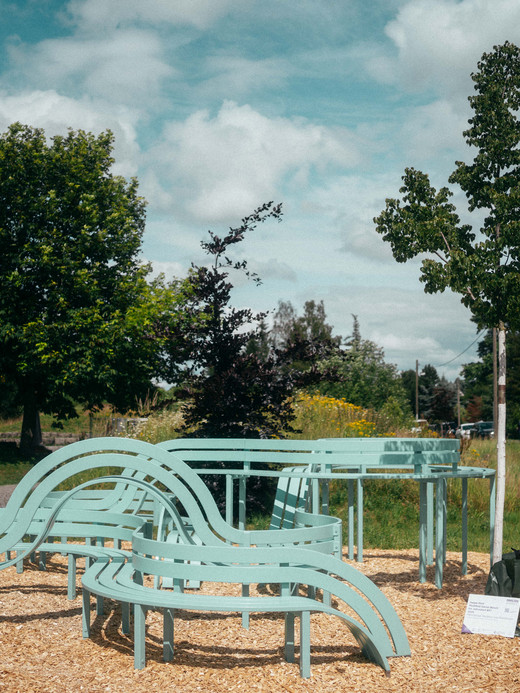
Inspired by the benches in New York's Central Park and his exploration of themes such as "proximity and distance", the artist Jeppe Hein, who was born in Copenhagen/Denmark in 1974 and lives in Berlin, has developed a series of sculptures entitled "Modified Social Bench". The artist modifies the typical arrangement of seating surfaces, backrests and angles found around the world, as well as the height of benches as part of street furniture, so that sitting becomes both a physical and non-verbal communicative act.
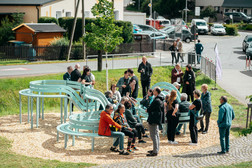
Hein's bench object, specially designed for the Jahnsdorf location, uses curves and differences in height to create a course that invites people to sit, lie down or slide around dynamically. In a playful way, he also dissolves the common principle of prohibiting the direct touching or use of art and poses questions about the conventions of dealing with the artwork. Hein also extends his questioning to today's common functional objects of public space themselves, which are usually set up and initiated by local authorities and municipal administrations: Sealed surfaces, city benches, playground furniture or even design sculptures. As a result, egalitarian and open spaces are increasingly disappearing, being rendered unusable or closed off with the aim of protecting them from vandalism, misappropriation or sabotage.
Together with the citizens of Jahnsdorf, the artist counters this controlling and marginalising design of urban space with a work of art in an undesigned space below the railway station. Here, Hein's sculpture "Modified Social Bench for Jahnsdorf #01", created in 2024, playfully opens up a field of interpersonal communication in which the meeting of people takes centre stage.
(Text: Alexander Ochs / Ulrike Pennewitz)
Jeppe Hein
Modified Social Bench for Jahnsdorf #1
In Jahnsdorf, playground at the railway station
Material: powder-coated aluminium
Size: 1.45 x 6.61 x 5.32 m
Set up with the support of the municipality of Jahnsdorf.
Address:
Playground at the railway station
Straße der Jugend 5
09387 Jahnsdorf / Erzgebirge
to the location on Google Maps
There is a lot to discover at the PURPLE PATH! Experience tips presented by the Tourismusverband Erzgebirge e.V.
↗Recommendations for Jeppe Hein's ‘Modified Social Bench for Jahnsdorf #1’
Jahnsdorf - time to take off.
When Jahnsdorf was founded around 1170, it was a forest village. Over the centuries, the town, which today includes the districts of Leukersdorf, Seifersdorf and Pfaffenhain, remained predominantly rural. It was not until the 19th century that the first triggers for industrialisation arrived from Chemnitz. The population grew. Around 5,500 people live here today.
The beautiful landscape at the foothills of the Erzgebirge has remained a constant despite all the changes. Land and labour, people and nature are in harmony, though not without disruptions to their lives. Following the political and economic transformation after 1989, people here now feel at ease again, having found a new balance. Businesses are thriving in Jahnsdorf, including medium-sized metal processing companies such as Püschmann Maschinenbau and markSTAHL Präzisionsstahlrohre, and larger international companies such as ABUS, a well-known mechanical security brand.
Chemnitz Airport: Ready for take-off? Let’s go!
One symbol of the upswing is Jahnsdorf airfield, officially known as the Chemnitz/Jahnsdorf airfield. People travelling for both leisure and business use it as a quick way to get to the Chemnitz economic region. Offering sightseeing flights, balloon trips and flying schools, it also helps the public take to the skies.
You can take off here in a very real sense: on the one hand in an aircraft, and on the other metaphorically. Leaving familiar ground to try something new, standing out in a positive way, but always coming in safely to land. Knowing what you are capable of and where you belong. This mentality is key to shaping a liveable future in rural areas.
The mindset in Jahnsdorf is clearly focussed: they dare to try new things, think ahead. Two farming families organise a “barn transfer”. from Bavaria to Saxony in order to preserve valuable cultural heritage. A cosmopolitan restaurateur tells the story of the cultural melting pot that is the Erzgebirge through culinary theatre.
Citizens’ budget: project ideas competition
To further promote this mindset, Mayor Albrecht Spindler and his team at the Town Hall launched an ideas competition between January and March 2024, providing a citizens' budget of 10,000 Euros, with up to 2,000 Euros available for each project. Residents and local associations were all invited to take part. Galvanising people, developing new ideas, shaping the future together. All based on open communication. As a location on the Purple Path, Jahnsdorf has been given a work of art by Jeppe Hein that fits perfectly with the ideas competition: the Modified Social Bench.
Art at the railway station: Sitting together on social benches
Jeppe Hein created his Modified Social Benches for Venice in 2019. They took their basic shape from the ubiquitous benches found in parks and gardens. However, the design is modified in various ways, as the artist writes on his website, in order to make sitting a conscious physical process. The benches challenge spatial separations in social situations and question the amount of space people feel they need between themselves and others.
The modifications to the benches transform their surroundings into places of social activity, fostering dialogue between users and passers-by, Hein explains further. People are invited to play an active role by not only using the benches as seats, but also expanding the opportunities for social interaction and communication.
Take a seat: What do we have to say to each other?
The idea of “social benches” can become a reality wherever many people are in the same space, for example at train stations. Anyone can take a seat here, next to anyone or everyone else. This raises the question: What do we have to say to each other? It’s a small, open experiment that aims to encourage people to communicate. Jeppe Hein has created a Social Bench for Jahnsdorf station as part of the “Art at the Station” series and the art stations already established along the Purple Path.
Shaping the future: a typical Erzgebirge mindset
Innovation and a sense of tradition, openness and immigration have always ensured the survival of the Erzgebirge mining region. All of this bears witness to many transformations that stretch far back into history, some of which are still continuing to this day. The region has always been in motion. People came and went with economic ups and downs, reinventing themselves culturally and advancing craftsmanship and technology. This is still going on.
Barn transfer from Bavaria to Saxony: Ziegs farm market
Imagine the scene: An old hay barn takes off from Bernbeuren in Bavaria and lands in Jahnsdorf in the Erzgebirge. What was going on? Georg and Maria Huber no longer had any need of the barn and wanted more space on their farm. But simply chopping it up and disposing of the wood, when so much family history was attached to it? Out of the question.
Diana and Peter Ziegs from Jahnsdorf, who have been running a small agricultural business, selling directly to regional buyers and from their own farm market since 1991, had the space and an idea. The old hay barn from Bavaria could be rebuilt here in Saxony, completely renovated and used as a cultural venue. No sooner said than done. At the annual farm festival in May, guests will be able to see for themselves how far the project has progressed.
The project was supported by Capital of Culture Chemnitz 2025. Artist Anastasia Koroshilova (link) documented the “Barn transfer from Bernbeuren to Jahnsdorf” in photographs as part of an art project.
The cosmopolitan restaurateur: Claudia Lappöhr
The Sportgaststätte Leukersdorf sports restaurant is a true institution in Jahnsdorf. A pub by the village football pitch? Seriously? Hold on: Just as you shouldn’t judge people by their appearance, you shouldn’t judge a restaurant by its name. Words can be deceptive at first glance. But it’s worth taking a look inside the Sportgaststätte.
“We are whole food junkies,” says chef and owner Claudia Lappöhr of her kitchen. So all the clichés – like currywurst and chips – are off the table. The menu in her restaurant focuses on healthy, seasonal dishes with regional ingredients. No flavour enhancers and no processed products, just traditional fresh food according to family recipes. Only nutritious ingredients go into the pan; they are transformed into culinary delicacies by skilled hands.
Miriquidi Melting Pot: Food theatre in the cultural melting pot of the Erzgebirge
Transformation is a topic that is very close to Claudia Lappöhr’s heart. She has created a food theatre called the Miriquidi Melting Pot, where her culinary performances tell the story of the region since the Middle Ages. This history would be impossible to imagine without Europe, without immigration and without innovation, says the restaurateur. Since the “Großen Berggeschrey” (great mining rush) in 1168, people have continuously been drawn to the Erzgebirge to seek their fortune in mining or later in industry.
Over the centuries, the Miriquidi, or Dark Forest, has turned into the melting pot that is the Erzgebirge. People have brought skills and ideas, crafts and culture, customs and food with them to the region, and it has all blended together to create something unique and new. This is what we know today as the Erzgebirge Mining Region, and which is proud to be designated a UNESCO World Heritage Site.