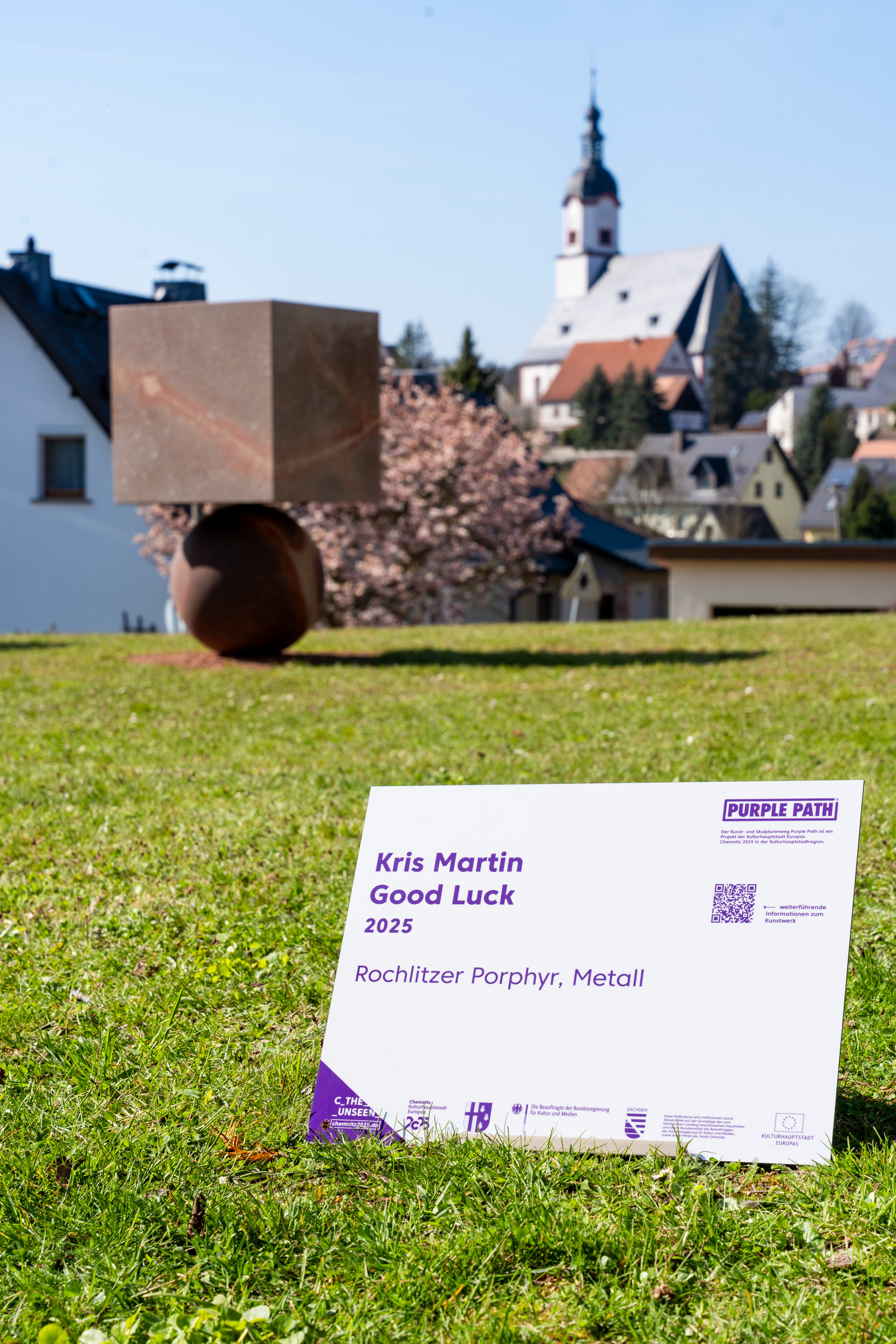
Kris Martin: Good Luck
Wechselburg

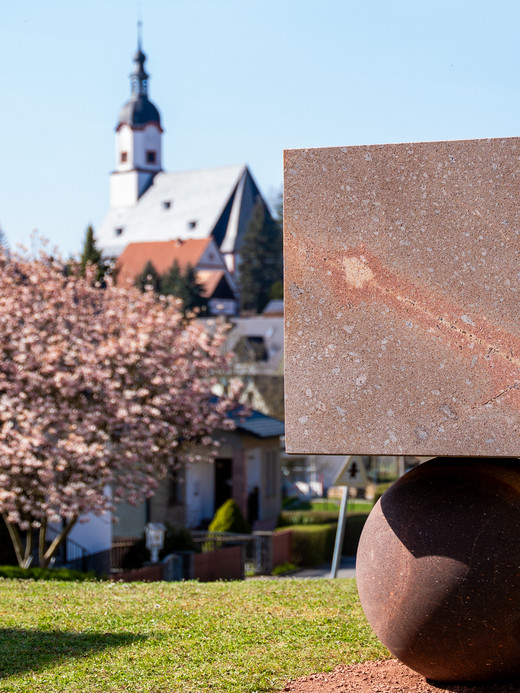
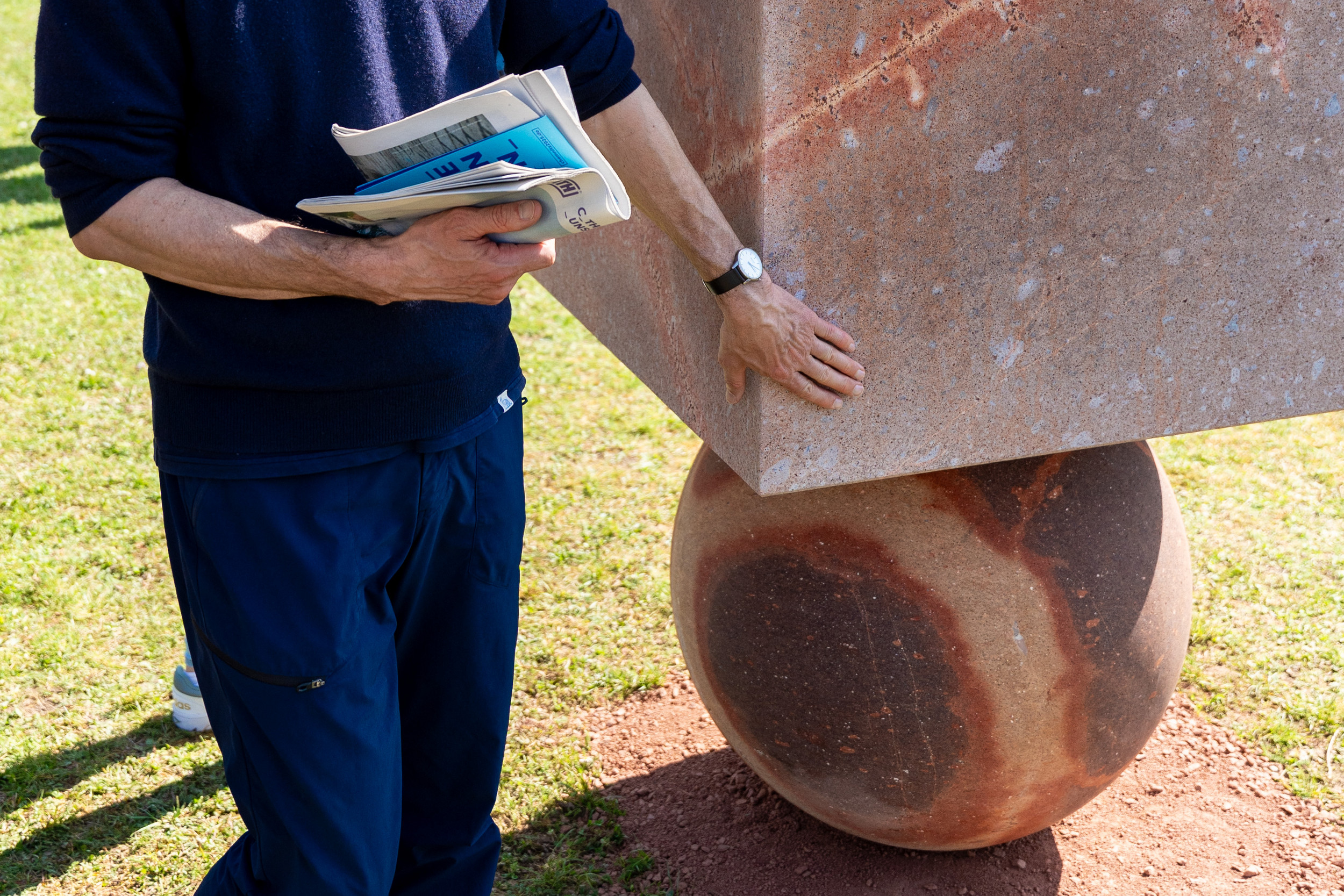
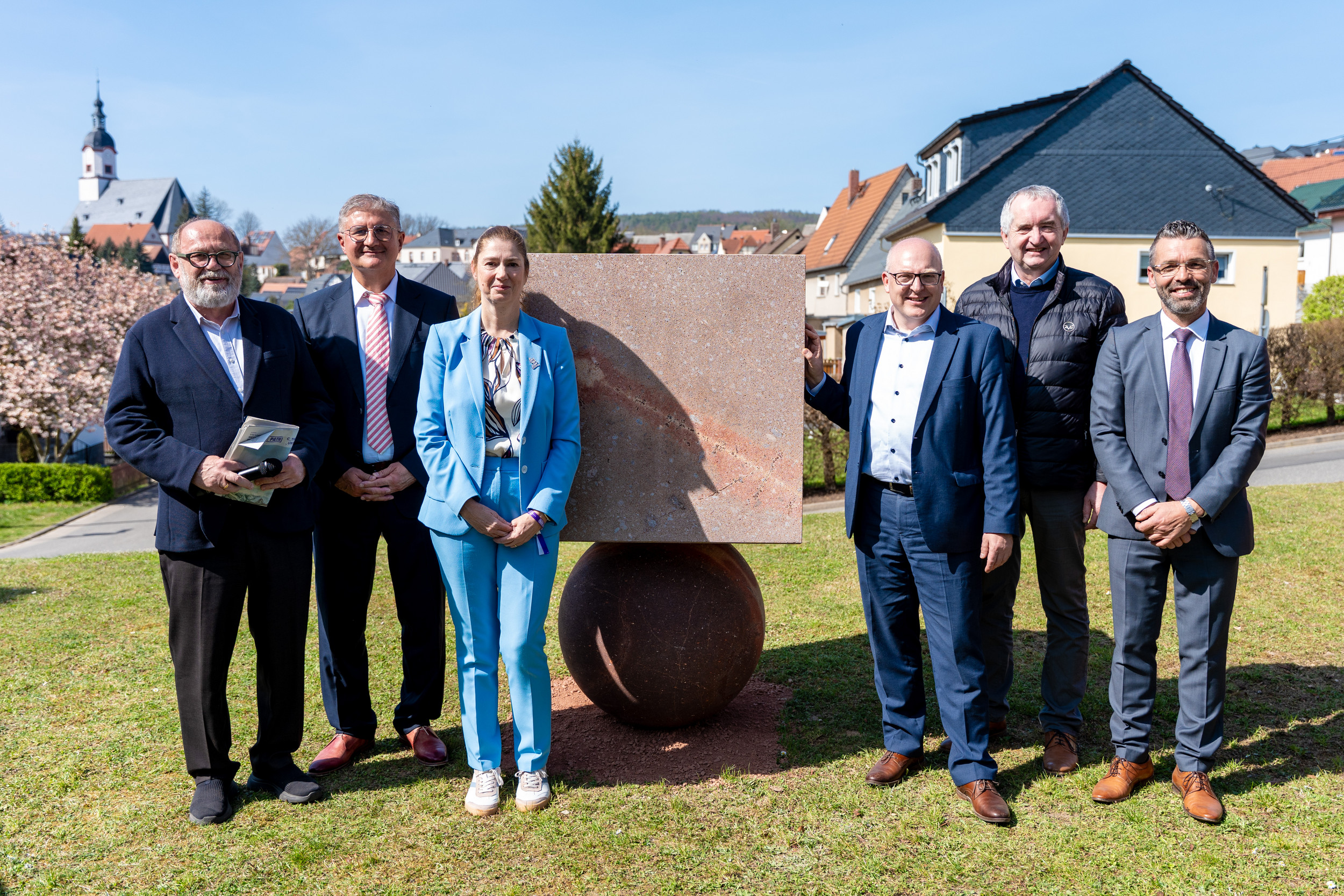
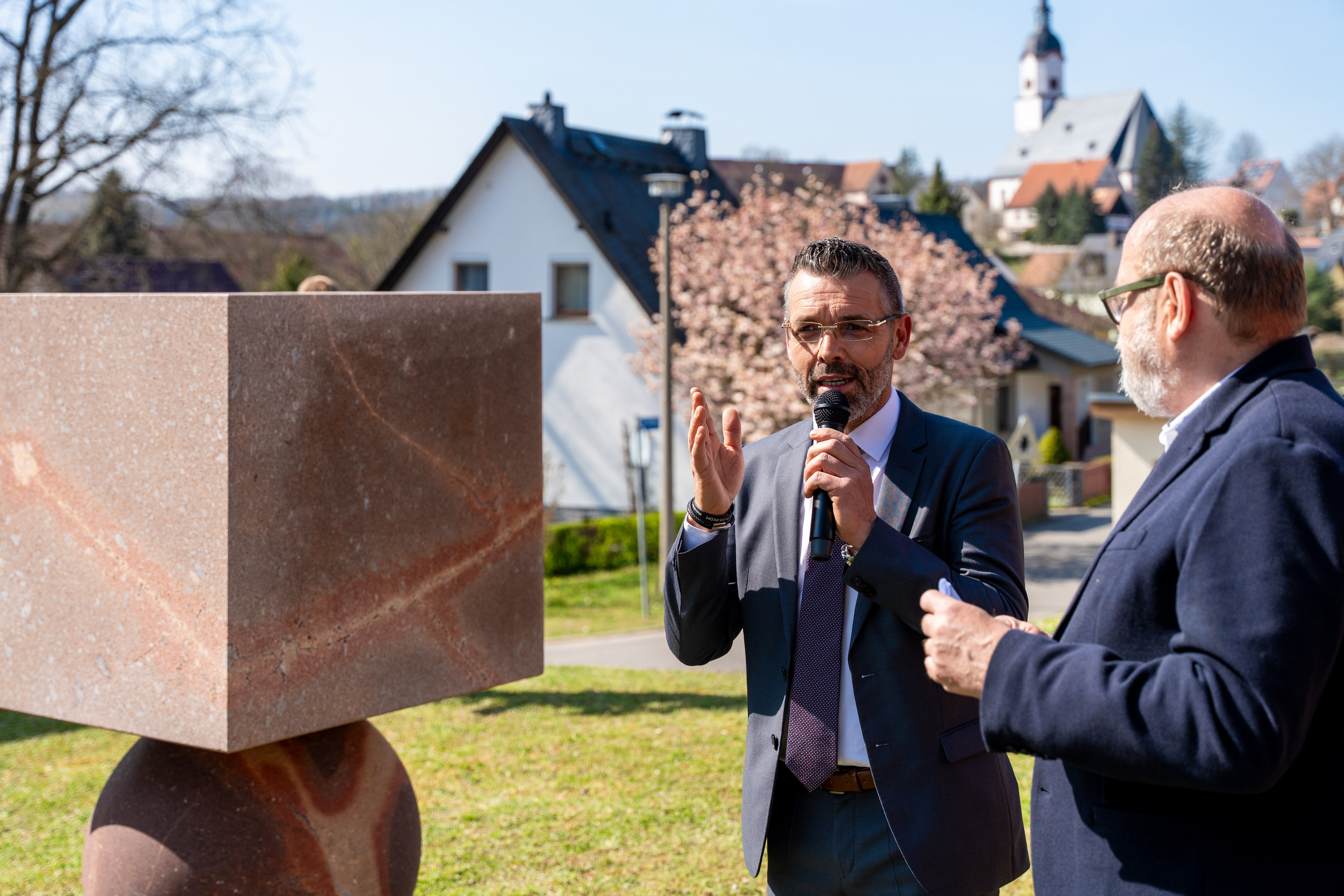
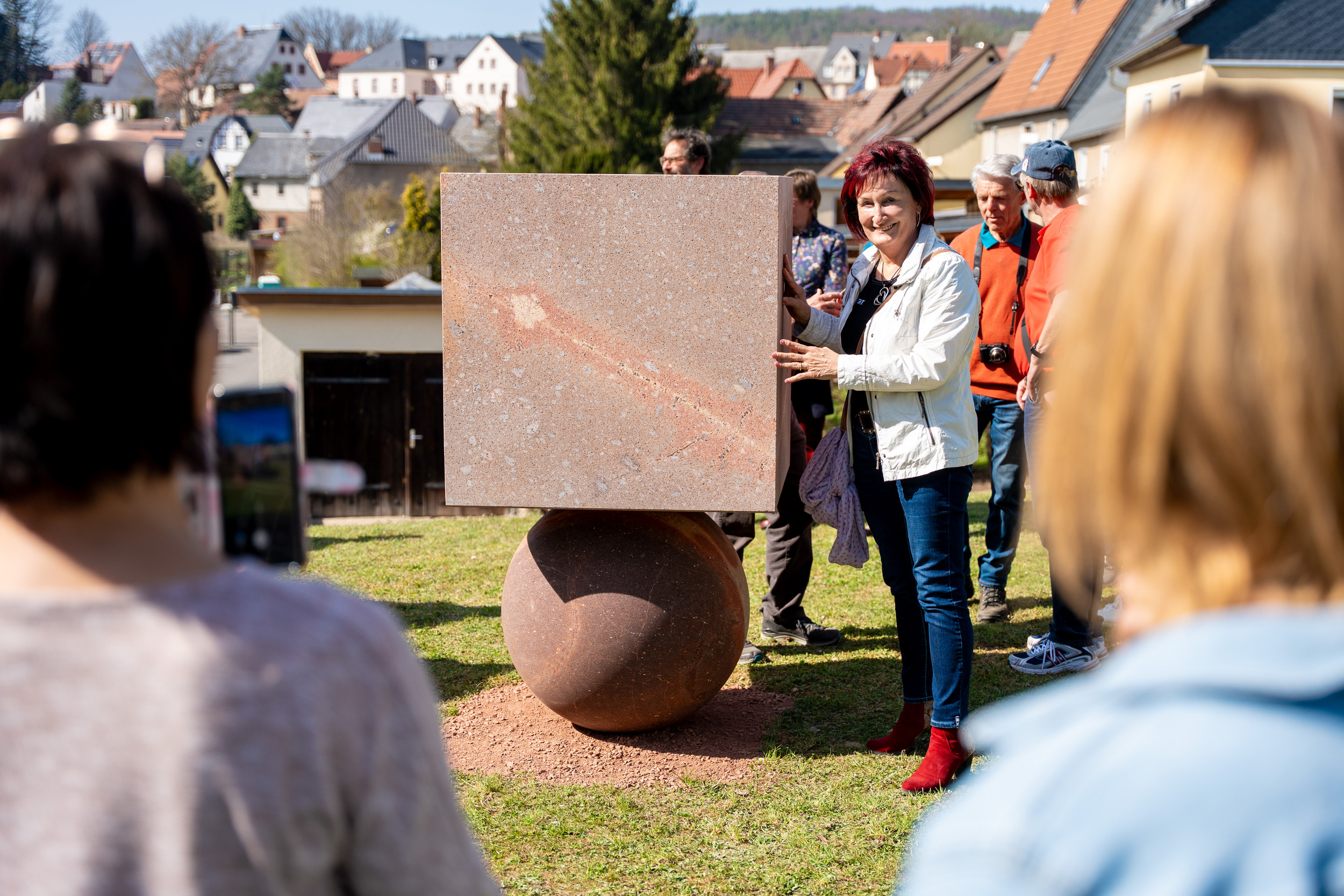
The sculpture "Good Luck" by conceptual artist and sculptor Kris Martin, born in 1972 in Kortrijk/Belgium, is made up of a contrasting shape. A cube is placed in the centre of a sphere. The golden ratio of the sphere corresponds exactly to the dimensions of the cube, which virtually encloses the sculpture. Its paradoxical arrangement conveys precarious instability, as the laws of gravity make it impossible to place the cube on the indivisible spherical form without further fastening. Martin found the material for his sculpture on site: Rochlitz porphyry tuff, a rock marbled in various shades of red with yellowish veins and purple patches, which was formed 294 million years ago from the pyroclastic deposits of a supervolcano near the present-day town of Wechselburg. Its use for facades, sculptures and jewellery can be traced back to the early modern period and still characterises the townscape of Wechselburg today.
The title and model for Martin's sculpture "Good Luck" alludes to the first abstract sculpture in art history, which the poet and privy councillor Johann Wolfgang von Goethe designed and had installed in the garden of his first residence, today's Goethe Garden House, in Weimar. Goethe documented this world event with a short entry dated 5 April 1777: "αγαθη τυχη [Agathé Tyche] founded!". In this sculpture dedicated to Tyche, the goddess of fate, which was later referred to as the "Stone of Good Fortune", the sphere is arranged on the cube and reflects the idea of a classicist ideal based on law and order that brings the fluctuating chaos and fate to rest. Martin's arrangement literally turns this world view on its head, causing the ideal to falter and turning the title into a wish: Good luck.
(Text: Alexander Ochs / Ulrike Pennewitz)
Kris Martin
Good Luck (2024)
In Wechselburg
Material: Red / Rochlitz porphyry tuff
Erected with the support of the municipality of Wechselburg.
Address:
At the town hall
Bahnhofstr. 16
09306 Wechselburg
to the location on Google Maps
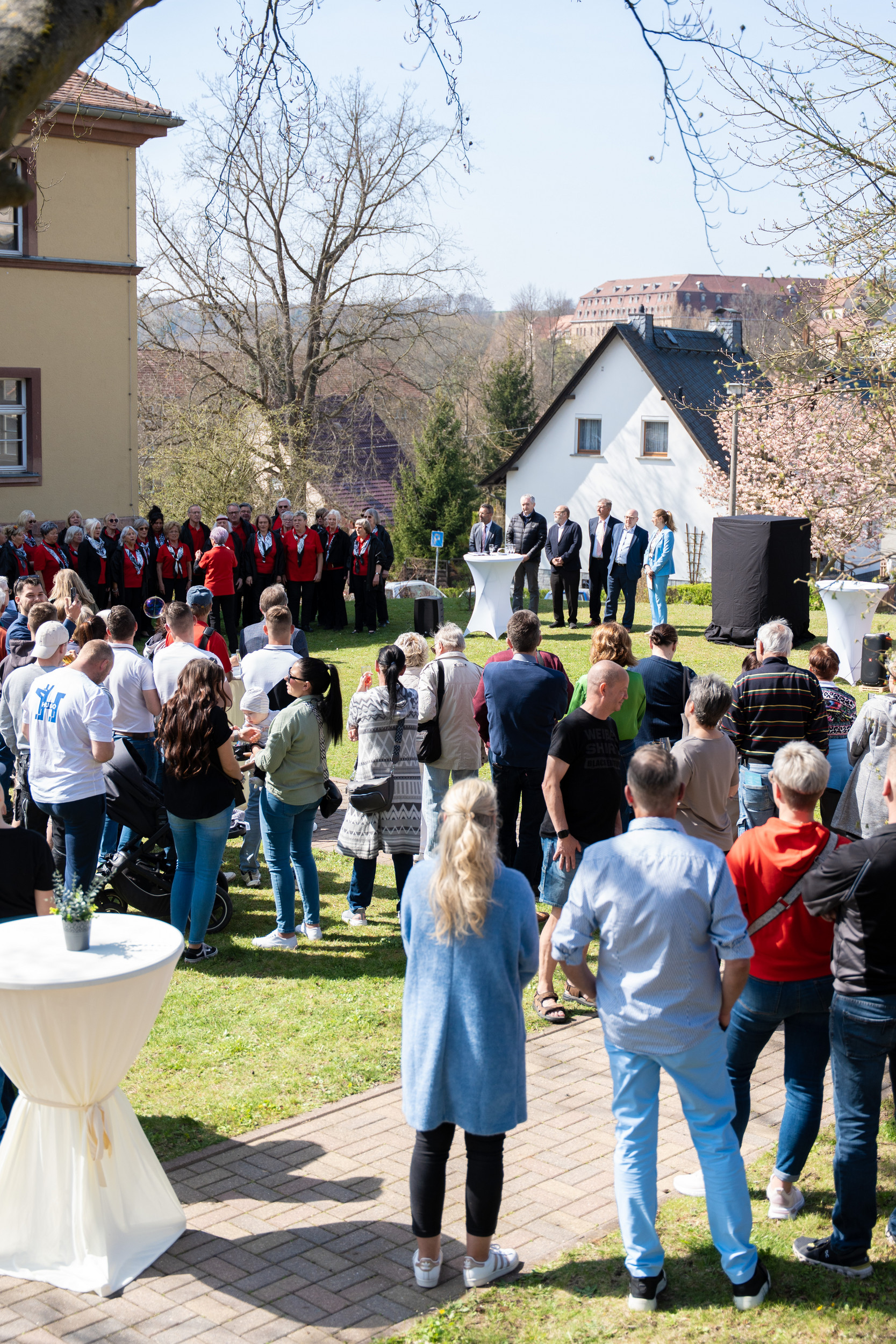
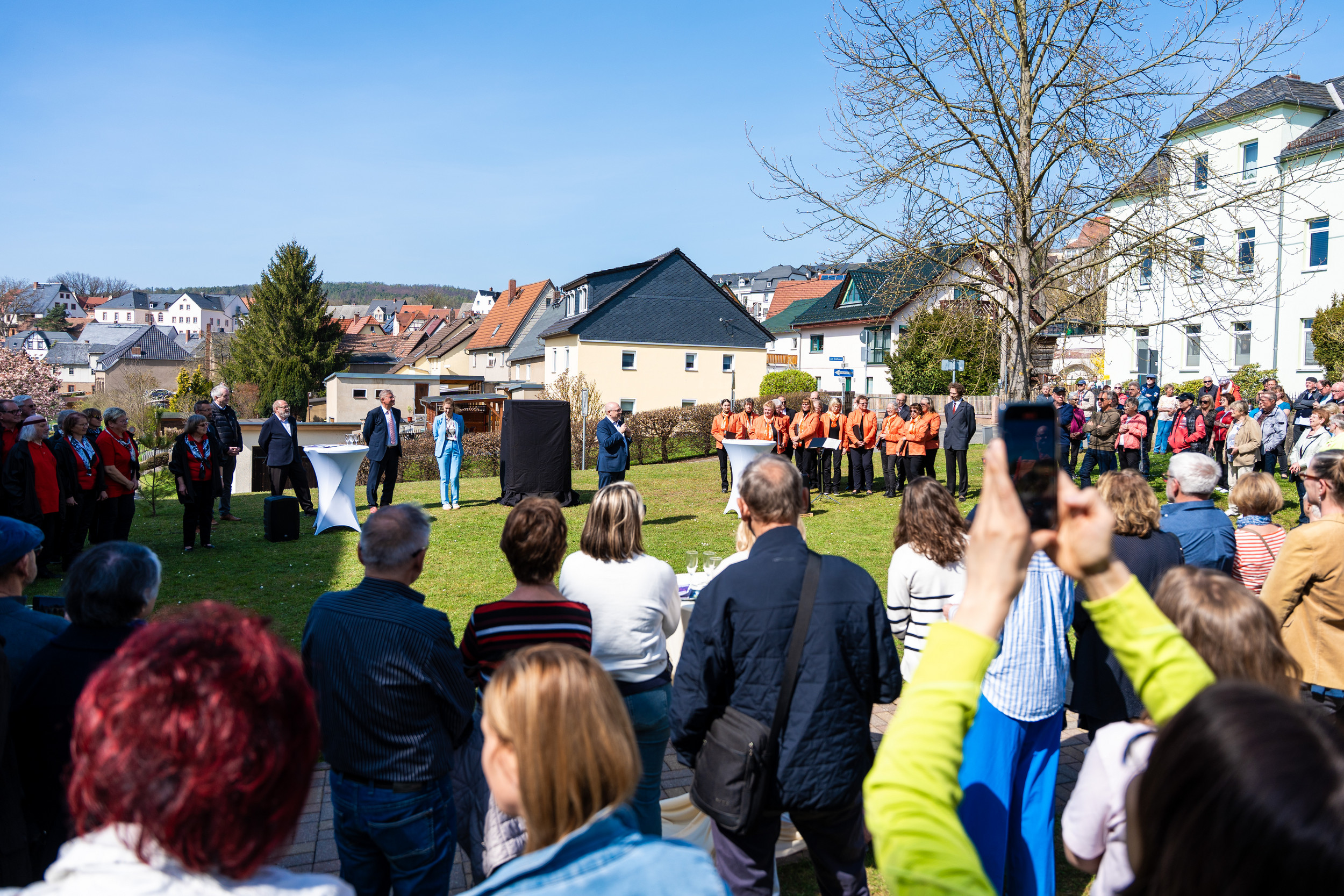
Wechselburg - Romanesque porphyry stones and baroque songs
Close to the confluence of the Chemnitz and Zwickauer Mulde rivers, the more than 800-year-old Wechselburg rises on a mountain spur. The charming town is accessed from the west via a large bridge over the Mulde. It is built from ashlars of red Rochlitz porphyry tuff. Two bridge figures made of the same stone by the artist P. Georg Roß greet those arriving. For centuries, porphyry has been the traditional and very striking building material that accompanies the eye of all visitors throughout the entire village.
Brückenstraße leads uphill into the centre of Wechselburg. The door frames and window reveals of the houses to the right and left of the road are made of porphyry. The village was originally called Zschillen. It was based on an Augustinian canon monastery founded by Count Dedo von Groitzsch-Rochlitz (documented in 1174), a son of the powerful Margrave Konrad von Meißen.
It was not until 1543 that Zschillen passed from Duke Moritz of Saxony to the noble family of Schönburg, who had other possessions in and around the Mulde valley, e.g. Lichtenstein and Glauchau. According to tradition, the town has probably been called Wechselburg since this time.
The vicissitudes of fate: constancy and restlessness
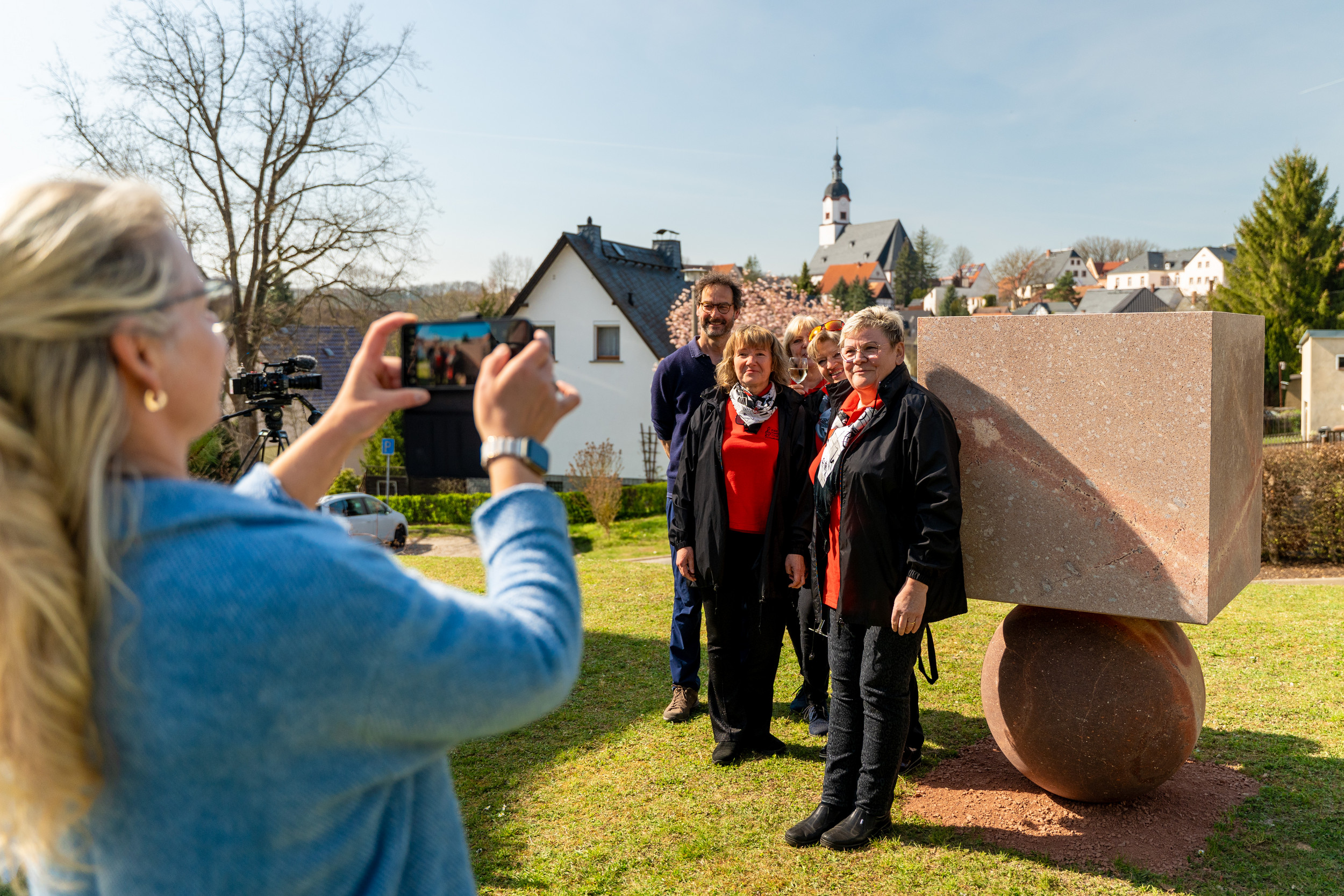
Kris Martin's porphyry sculpture 'Good Luck' stands next to the town hall (built in 1924), which is adorned with porphyry. A cube dances fragilely on a sphere. The work is a reversal of an earlier type of this sculpture. It refers to the 'Stone of Good Fortune', which was created in 1777 from an idea by Johann Wolfgang Goethe. It can be seen on the grounds of Goethe's garden house in the park on the Ilm in Weimar, which he lived in from 1776 to 1782. According to an entry in Goethe's diary, the work bears witness to his admiration for Charlotte von Stein. He had a deep friendship with Anna Amalia's lady-in-waiting.
The 'Stone of Good Fortune' is considered one of the first non-figurative works of art in Germany. Goethe drew on a symbolism deeply rooted in art: the cube as a symbol of permanence, the sphere as a symbol of impermanence. The artwork unites these opposites and thus refers to the exciting vicissitudes of happiness in human life.
With 'Good Luck', Kris Martin turns the cube and the sphere upside down, so to speak. The balance of the composition of the two opposing bodies made of red Rochlitz porphyry thus becomes precarious. This revolution - in the literal sense of the word: revolution - calls for a conceptual rethink of certainties and doubts, of unrest and stability in the world. With this thought in mind, you should make your way to the Wechselburg Monastery with its Romanesque basilica.
Romanesque basilica: the origins of Wechselburg
From the town hall, through Bahnhofstraße and across the historic market square, you reach the grounds of Wechselburg Abbey with its Romanesque basilica and baroque castle. The rulers and residents have changed over 800 years. Various architectural styles and building types bear witness to the historical changes. And yet there is one constant in this place: the Wechselburg Basilica. It is one of the most important Romanesque monuments in central Germany east of the Saale.
It has probably been under construction since 1160, was partially consecrated in 1168 and completed in the last quarter of the 12th century. A document from 1174 attests to the foundation of the Augustinian canons by Count Dedo von Groitzsch-Rochlitz (+1190). The first canons came from the Petersberg monastery near Halle. The tomb of the founder and his wife Mechthild (+1189) - made of red porphyry with two reclining sculptures (early 13th century) - is preserved in the church.
Architecture made of red porphyry tuff
Like the tomb, all the striking architectural elements of the late Romanesque basilica are made of red Rochlitz porphyry tuff, both inside and out: moulded pilaster strips and round arch friezes, round arched windows, pillars, arcades, vaulted arches and the ornate rood screen (around 1230/35), which separates the choir from the nave. Between 1278 and 1543, the basilica and monastery were owned by the Teutonic Order. Construction and remodelling continued during this period, as evidenced by the vaults in the crossing and transept (15th century) and the vaulting of the nave (1476).
The history of the monastery ended for several hundred years when it was secularised during the Reformation and transferred to the new lords of the House of Schönburg (1543). A small castle was built on the site. The secular use was followed by several conversions. The most significant were the Baroque remodelling of the church (1678-84) and castle (1753-56) in the Baroque period. The baroque castle and an English-style park have been preserved to this day, while the baroque alterations to the basilica were removed in the 19th century.
Several restorations followed in the 20th century, so that the medieval character could be almost completely restored. The most significant of these was certainly the re-erection of the rood screen (1971/72) in its original location. it had been torn apart in 1683 and the material used partly as an altar structure and partly as a pulpit. Today, the large crucifixion group (1230-40) carved from oak is once again enthroned on it. Also worth seeing are two late Gothic carved altars (around 1510) in the main apse and in the north apse, as well as other stone and wooden sculptures from the Romanesque and late Gothic periods.
Today, the basilica is once again the collegiate church and central place of prayer of the new Benedictine monastery of Wechselburg, which was founded in 1993 and belongs to the priory of the Benedictine abbey of Ettal in Bavaria.
The sound of the Purple Path: Jehmlich organ in Wechselburg Basilica
The Jehmlich organ from 1980 in Wechselburg Basilica is interesting, worth seeing and hearing. Although not very old, the instrument fills the sacred place with sound at church services and concerts. The Jehmlich organ manufactory goes back to the Jehmlich family of master organ builders in Dresden, Saxony. Jehmlich organ building left its mark on music-making throughout Saxony for more than 200 years. in 1808, the brothers Gotthelf Friedrich, Johann Gotthold and Carl Gottlieb founded the family's organ building tradition in Cämmerswalde in the Ore Mountains. Since 2006, Ralf Jehmlich has been running the company in Dresden in the 6th generation. This makes Jehmlich Orgelbau the oldest surviving organ builder in the world.
From Wechselburg to the world: Widely travelled poets and scientists
Poet and doctor in Russia and Persia: Paul Fleming (1609-1640)
From the basilica back across the market square and Schloßstraße, visitors interested in literature can reach house no. 10 in Paul-Fleming-Gasse. Here, a red porphyry plaque commemorates one of the most famous poets of the Baroque era: Paul Fleming. The vicarage where the family lived once stood on this site. Father Abraham Fleming was the castle chaplain in Wechselburg from 1625 and parish priest at the Protestant church of St Otto am Markt.
The family came from Hartenstein/Erzgebirge, where Paul Fleming was born in October 1609. in 1622, he was a boarder at St Thomas' School in Leipzig, now famous for the St Thomas Choir. He had previously attended the Latin school in Mittweida. He enjoyed an excellent linguistic and musical education in both places. His most famous teacher was the Thomaskantor Johann Herman Schein (1586-1630). From 1623/24, he studied philosophy and then medicine at the University of Leipzig.
German is reinvented as a literary language
With his father's promotion by the Schönburg lords, Paul Fleming also received a five-year scholarship in 1628. Wechselburg was therefore a place of his youth, which Fleming probably only visited during the semester holidays. In Leipzig, he met well-known poets of his time, including Martin Opitz from Breslau (1597-1639) in 1630, the great literary reformer (1624: "Buch von der deutschen Poeterey"). Alongside Latin, German now became the language of scholarly poetry with the leading Silesian and Saxon authors.
Fleming publishes his first poems in both languages. Central themes are academic and social life in Leipzig and Wechselburg, the Thirty Years' War, sacred songs and the then modern love poetry modelled on antiquity and the Italian Renaissance. in 1632, the Schönburg castle governor Jeremias Aeschel in Wechselburg honoured him with the title "Poeta laureatus", the poet laurel, in recognition of his poetry.
From Wechselburg and Leipzig, Fleming's path led him into a world that was still almost unknown at the time: from the end of 1633 to 1639, he was a member of a legation of Duke Friedrich III of Schleswig-Holstein-Gottorf, who wanted to explore a safe land trade route to Persia. Fleming reached Moscow in August 1634 and travelled to Reval in the Baltic States in 1635. in 1637, he travelled on to Isfahan in Persia (now Iran). He did not return until 1639, obtained a doctorate in medicine in Leiden (Netherlands) and died in Hamburg on his return journey in April 1640.
The poems, which were written far away on the great rivers Moskva and Volga, contain wistful memories of his homeland, including the river Mulde near Hartenstein and Wechselburg. The lines from the poem "An den Fluß Moskaw" ("To the Moskva River" ) read:
I want to make you as well-known / as my Mulde /
which will not laugh too much about it /
because I almost don't denck home a half-lost son.*
(*Source: Paul Fleming: German Poems. Edited by Volker Meid. Stuttgart 1986, p. 115)
Paul Fleming thus went down in literary history as the first author to sing of Russian and Persian cities, landscapes and rivers in German poems. His entire oeuvre documents the enormous expansion of the lyrical-poetic scope of the German language in the first half of the 17th century. The tradition of his sacred songs is cultivated by the Wechselburg-based Paul-Fleming-Chor e.V. based in Wechselburg.
→ Read more about his biography and poetry:
Heinz Entner: Paul Fleming. A German poet in the Thirty Years' War. Leipzig 1989.
German Poets, Vol.2: Reformation, Renaissance and Baroque. Edited by Gunter E. Grimm and Frank R. Max. Stuttgart 2000, pp. 212-224 (Fleming).
Archaeologist becomes director of the Hermitage in St. Petersburg: Heinrich Karl Ernst Köhler (1765-1838)
Heinrich Karl Ernst Köhler was born in Wechselburg in 1765 and was the son of a bailiff who lived in Rochsburg near Burgstädt for the lords of Schönburg. He studied at the universities in Wittenberg and from 1787 in Leipzig. One of his professors recommended him as a tutor to the wealthy Ovander merchant family in St Petersburg. On the side, he published on the Tsar's antique art collections.
Due to his expertise, Köhler was appointed to the Hermitage in St. Petersburg in 1795 and shortly afterwards became director of the first department. Here he was responsible for the conservation and scientific cataloguing of the stone and medal cabinet. in 1804 and 1821 he undertook archaeological explorations of the ancient cultures of the Crimea and published on methods for the protection of cultural assets.
He was honoured for his services by being admitted to the Imperial Russian Academy of Sciences, first as a corresponding member (1803) and then as a full member (1817). Further international honorary memberships in the academies in Berlin, Munich, Stockholm, Rome and Vienna followed. He left behind scientific treatises on ancient antiquities, especially medals and precious stones, as well as a collection of over 10,000 casts of ancient Greek and Roman coins, which is now housed at the University of Moscow.
Making the future: A typical mentality in the Saxon Mulde Valley
Innovation and a sense of tradition, openness and immigration have always ensured the survival of the Saxon Mulde Valley. All of this bears witness to the many transformations that go far back in history, some of which continue to this day. The region has always been on the move. People came and went with the economic and political ups and downs, reinvented themselves culturally, religiously and literarily, developed the craft of stonemasonry and the townscape. This is still the case today.
Faithful to the faith, open to guests:
The Benedictine monastery (since 1993)
Today, the Wechselburg basilica is part of the new Benedictine monastery. Since 1993, Wechselburg has once again been a place of profound spirituality. The community of monks follows the rules of St Benedict (480-547) on their path of faith towards God. The youth and family centre and the House of Encounters are also open to guests for contemplative retreats. Numerous events are organised here throughout the year, and home-made products are sold in the monastery shop.
Over the last three decades, the monastery has once again become an important centre of life in Wechselburg. To mark the 850th anniversary of the consecration of the church, Pope Francis conferred the honorary title of "Basilica minor" on Wechselburg Abbey Church on 12 November 2018. Since then, the Pope's coat of arms has been emblazoned on the outside above the Benno portal and a bronze plaque commemorating the occasion hangs inside the left aisle.
In the tradition of the Thomaner pupil and baroque poet:
Paul Fleming Choir Wechselburg e.V.
The idealistic legacy of St Thomas' student and baroque poet Paul Fleming (1609-1640) is still cherished in Wechselburg today. His family moved here in 1628 when his father took up a position as castle chaplain and parish priest. The Paul Fleming Choir is a mixed and intergenerational singing community for men and women. Its history dates back to 1872 and its choir members come together from all over the region, including places on the Purple Path: Wechselburgrochlitz, Mittweidalunzenau, Königshain, Kohrener Land, Narsdorf, Limbach-Oberfohnahartmannsdorf, Burgstädt and Penig.
The choir is committed to the tradition of sacred songs from the Baroque period, in particular songs with texts written by Paul Fleming. The highlights of the year are the choir concerts in Wechselburg: Park and Basilica Singing (on the Sunday after Whitsun) and the Christmas concert in the basilica (on 4 Advent). The Paul Fleming Choir also gives concerts in other places in Central Saxony and maintains friendly links with other choirs in the region and beyond in the Leipzig area, the Ore Mountains and Western Saxony.