Leunora Salihu: Bow
Stollberg

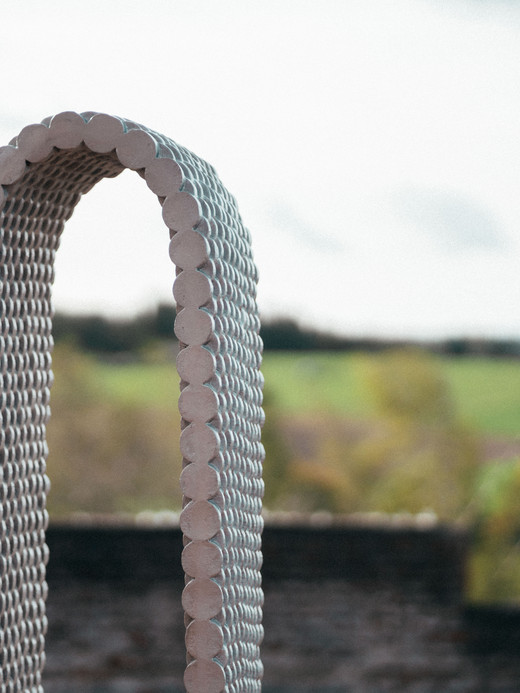
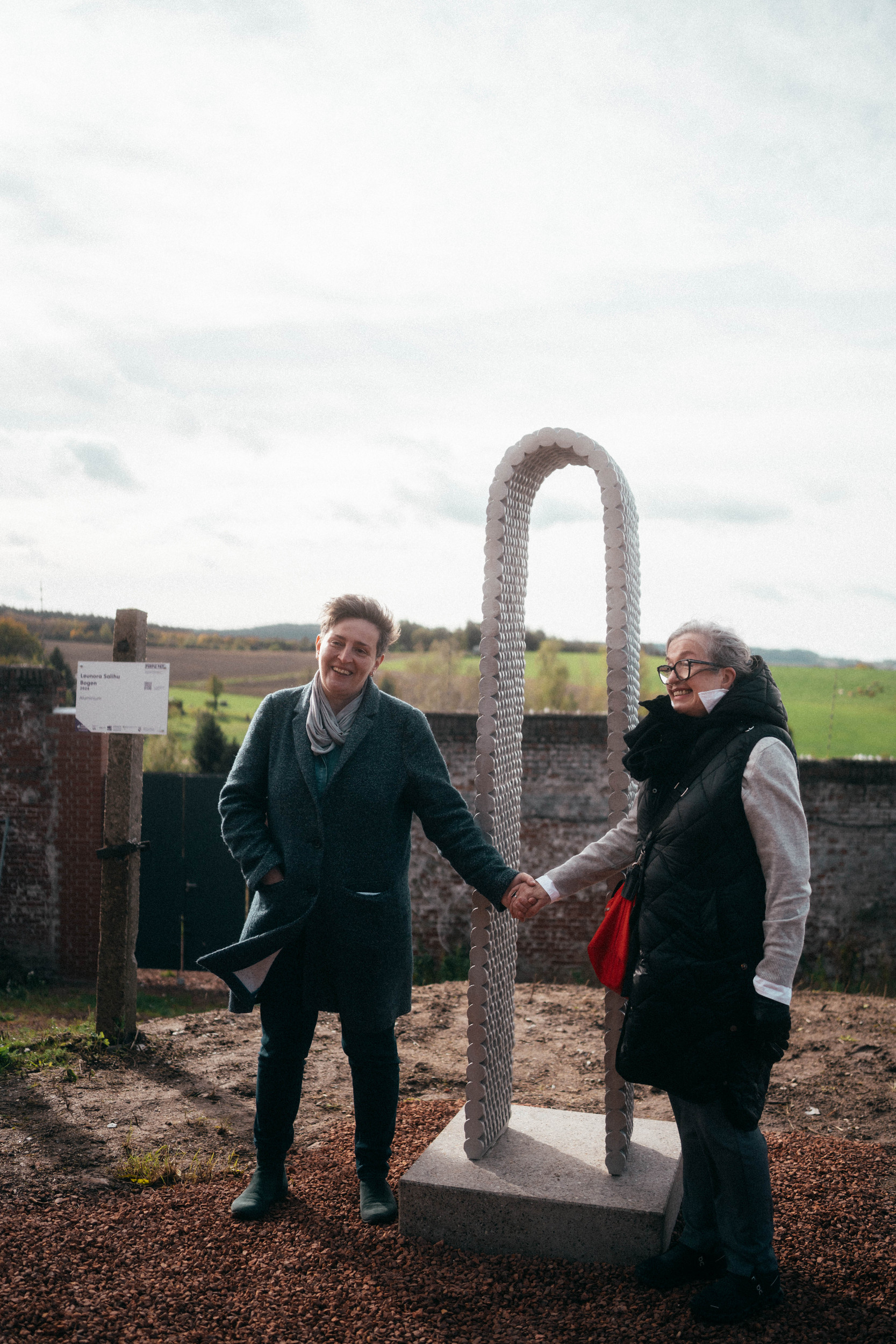
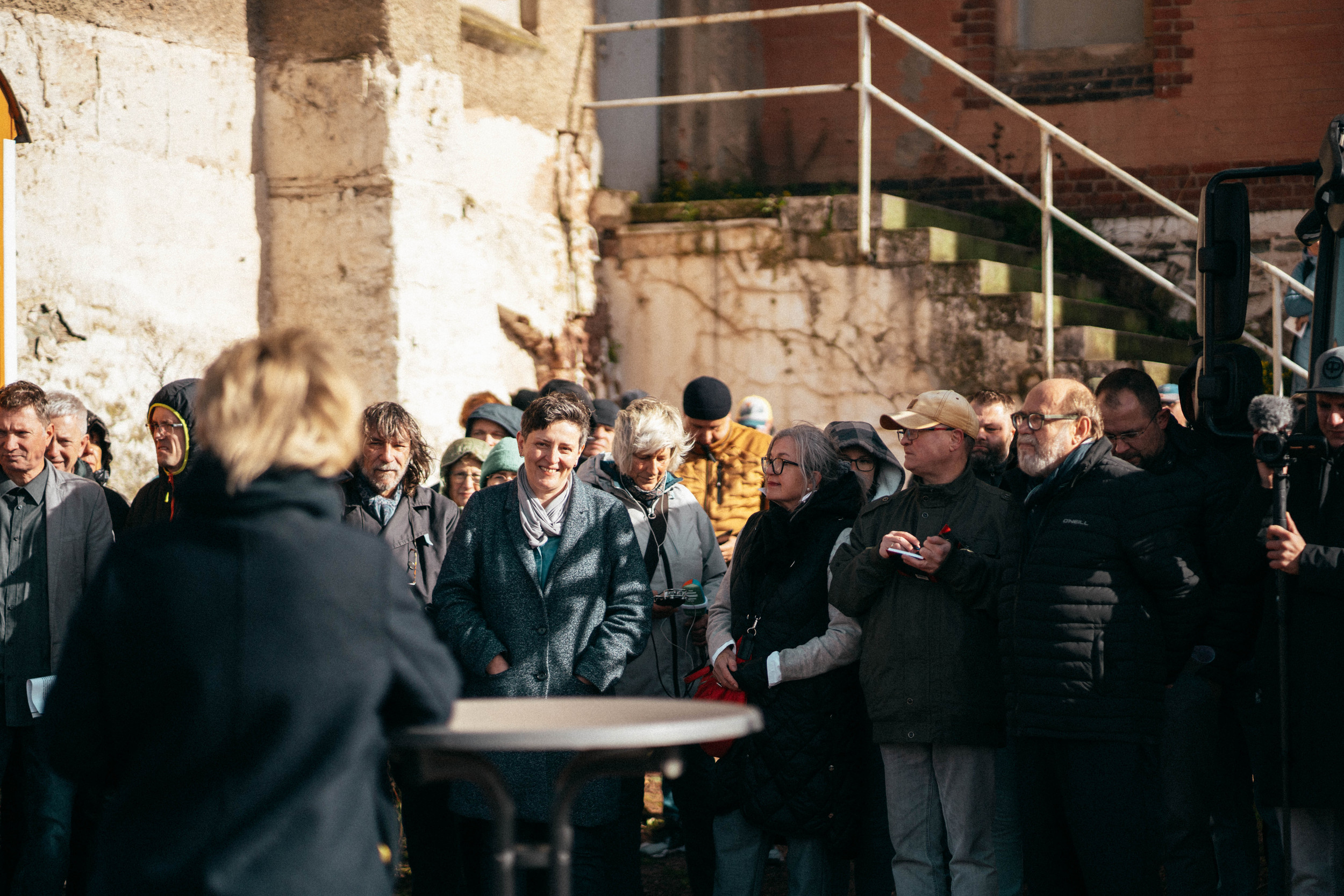
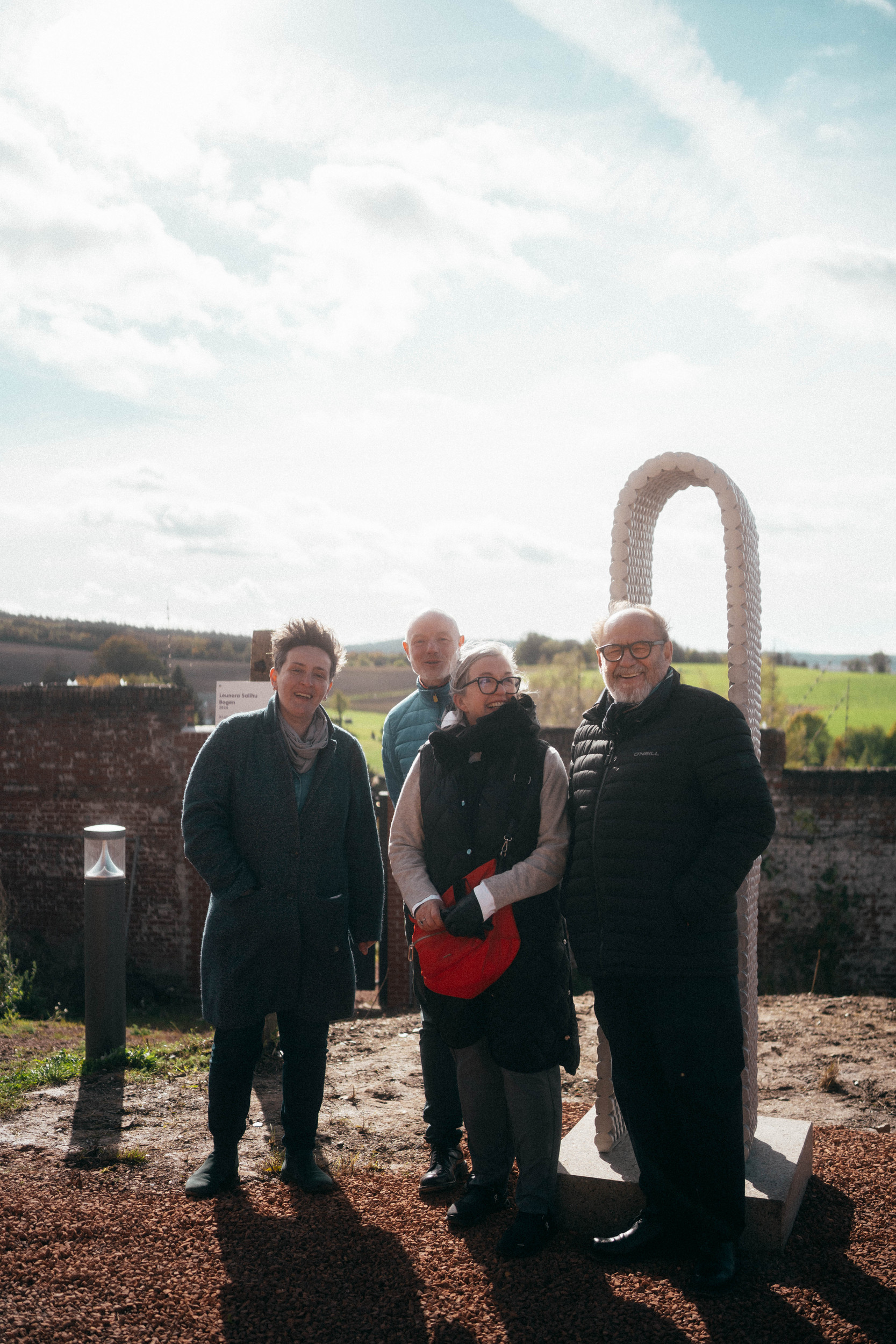
The two-metre-high sculpture Bogen by artist Leunora Salihu, who was born in Pristina/Serbia in 1977 and now lives in Düsseldorf, stands on the former dog run of the Hoheneck women's prison like a shiny silver piece of jewelry consisting of finely crafted links.
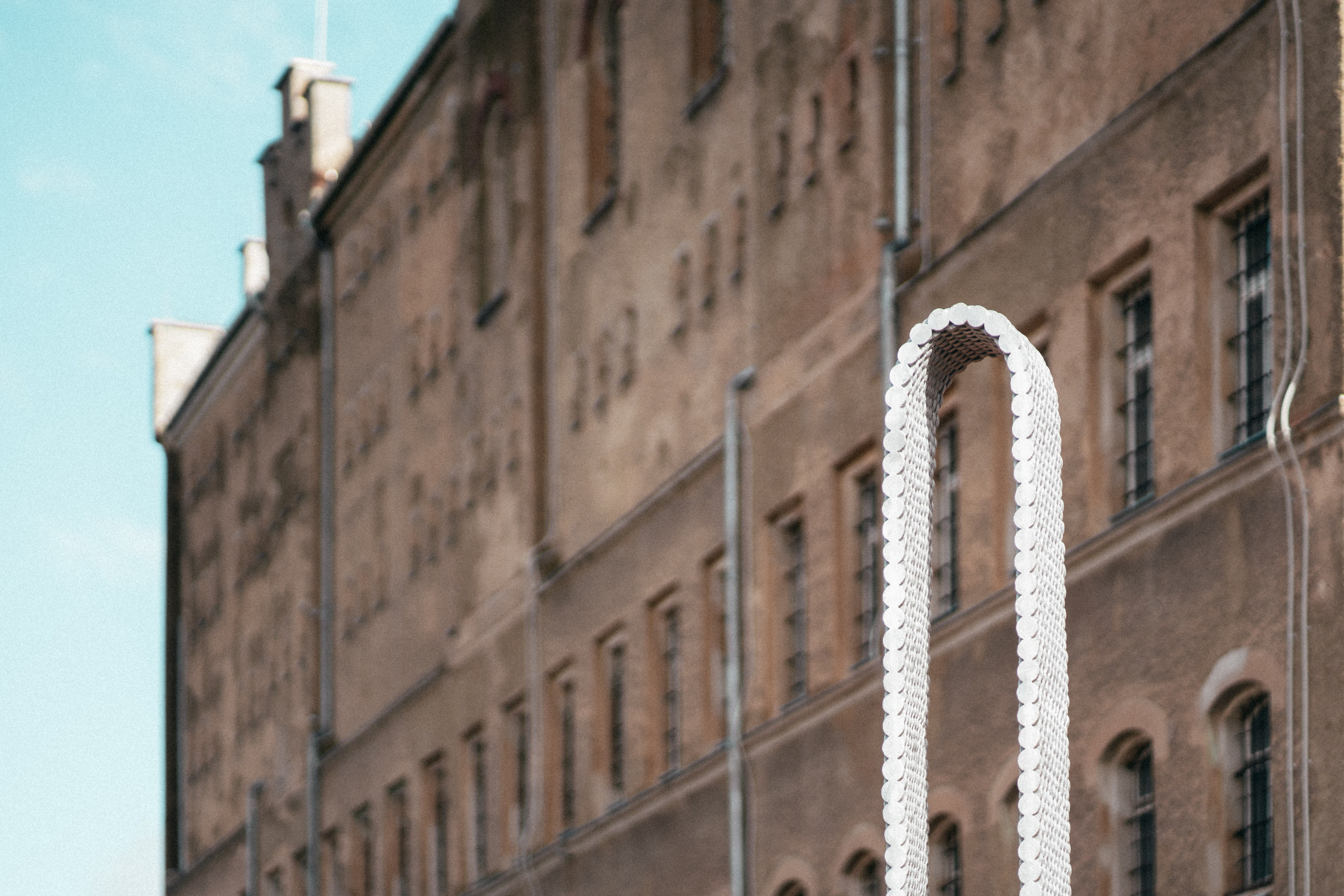
Composed of hundreds of circular aluminum discs, the work, which is reminiscent of a tall, narrow gate, invites visitors to walk through and observe the shadows that change depending on the position of the sun in an environment that is constantly changing due to the seasons and weather. With her sculpture, which is based on the repetition and arrangement of a modular pane element, the artist examines the movement in the static form, the relationship between inside and outside and the stories that are inscribed in the places. The concrete-constructive and at the same time memorable form also opens up a mental confrontation with the installation site of Stollberg, whose old town is dominated by the defiant appearance of Hoheneck Castle.
The former hunting lodge was used as a remand prison from the 17th century and eventually as a penitentiary; the building was heavily fortified. After the GDR was founded in 1949, Hoheneck became one of the largest women's prisons. The prisoners included political prisoners, at times the prison was overcrowded with 1600 women, and isolation and dark detention were the order of the day. An application to leave was often enough to become a “Hohenecker”. They worked on a piecework basis and produced tights and bed linen under the worst conditions, which were sold to well-known companies in the West. In the women's grueling daily routine, there were small signs that gave them hope of an outside, of freedom and a future - like the sun shining through the arch of the prison window into the gloomy cells.
(Text: Alexander Ochs / Ulrike Pennewitz)
Leonora Salihu
Bogen
In Stollberg, memorial side Frauengefängnis Hoheneck
Material: Aluminium
Size: 2,04 x 0,45 x 0,30 m
Set up with the support of the town of Stollberg.
Adresse:
Schloss Hoheneck
An der Stalburg 6
09366 Stollberg/Erzgebirge
to the location on Google Maps
There is a lot to discover at the PURPLE PATH! Experience tips presented by the Tourismusverband Erzgebirge e.V.
Stollberg – Open and closed gates
With the initial settlement of the Ore Mountains, the Main-Franconian noble family of Erkenbertinger received a castle and dominion as an imperial fiefdom (13th century). Mining was unable to establish itself due to insufficient ore deposits, and it was not until the 19th century that small amounts of coal were mined. The economic upswing was more likely brought about by the salt market privilege (1444) and the intersecting trade routes: the Bohemian Trail between Altenburg (today: Thuringia) and Prague (Czechia) and the road from Chemnitz to Dresden.
Gateway to the Ore Mountains: Plaything of the Powers
Over the centuries, the castle and later the developing town remained a pawn in the game of power. Rule changed hands several times between the Erkenbertingers, the Schönburgers, who were directly subordinate to the emperor, the King of Bohemia, the Counts of Schwarzburg (today: Thuringia), and the Margraves of Meissen and Electors of Saxony (Wettin family from 1564). The town's location as the “gateway to the Ore Mountains” was always of interest.
Under the spell of Chemnitz's bleaching monopoly
In the 17th century, cloth making and linen weaving became the dominant industries. Due to Chemnitz's bleaching monopoly from 1357, the local value chains became dependent on the Chemnitz textile market for many centuries. This often led to disputes, as only small quantities of cloth for private domestic use were allowed to be bleached and sold in Stollberg itself. The big business was done by the Chemnitz bleachers and cloth merchants. It was not until the 19th century, with the advent of industrial hosiery manufacturing, that the Stollberg textile industry became independent.
Today, Stollberg, with its large industrial park and diverse economic ties to Chemnitz, is a magnet for the high-tech industry.
Von der Burg zum Strafvollzug
The defining building in Stollberg is still the towering Castle Hoheneck. Nothing remains of the medieval castle complex after its conversion into a palace in the 16th and 17th centuries by the electoral architect Hans Irmisch. The complex acquired its present form when it was expanded into a large prison in 1862 and 1886/87. Initially, women were imprisoned in what was then known as the “Weiber-Zuchtanstalt” (women's reformatory), but it later became a state prison for men.
Political prisoners were imprisoned here from the very beginning. This remained the case into the 20th century: during the Weimar Republic, striking coal miners were imprisoned here, during the Nazi era resistance fighters were also imprisoned here, and after 1945 prisoners of the Soviet military administration were imprisoned here. From 1950 to 1989, the GDR regime imprisoned not only female criminals but also women who were members of the opposition in the women's prison. These women became known as the “Hoheneckerinnen.” Up to 1,600 women were imprisoned at the same time and subjected to a strict regime of forced labor.
Women's hunger strike in October 1953
In the course of the GDR-wide uprising on June 17, 1953, a strike also broke out at Hoheneck prison. Some of the female prisoners went on hunger strike to emphasize their demands for improved prison conditions. Politically wrongfully sentenced to very long prison terms by the Soviet military administration, they demanded that their sentences be reviewed by German courts. They innocently trusted the GDR's judicial system and had no idea that the prison strike would be crushed with extremely repressive measures, that the reasons for their imprisonment and sentences would not be reviewed, and that their human rights would be disregarded. Contemporary witnesses report on the strike and the inhumane prison conditions. The consequences of the hunger strike continue to have a profound impact on the lives of the women affected and their families to this day.
The end of the prison in 1989
With the political change in autumn 1989, the women refused to work, and some went on hunger strike to secure an amnesty. 169 women who had been imprisoned for political reasons were released.
Watch the film “The Hoheneck Complex”
Since the prison closed in 2001, a memorial has been set up here. In 2014, the city of Stollberg began extensive renovations and conversions. The memorial is being gradually expanded, including an exhibition on the injustices of the SED. The new museum will be officially opened in 2025, the year Stollberg is the Capital of Culture. Since 2017, there has been an interactive learning and experience center for children called Phänomenia, as well as the Burattino children's and youth theater.
Forum for Women Politically Persecuted and Imprisoned by the SBZ/SED Dictatorship e.V.
Since 2019, a forum has been campaigning on behalf of women who were politically persecuted and imprisoned during the Soviet occupation zone and the SED dictatorship. The aim is to raise public awareness of the fate of women who were innocently subjected to state persecution in the Soviet occupation zone and under the SED dictatorship. Special forms of repression against imprisoned women, such as sexual violence, threats to take away their children, forced adoptions, and their long-term consequences, are publicly highlighted. The association thus also advocates for the sustainable strengthening of democratic awareness.
The soundtrack of the Purple Path: Jehmlich organ in St. Jakobi City Church
The Protestant town church of St. Jakobi in Stollberg is a Baroque hall church (built 1653-59), which is very typical for the Ore Mountains. Its early structure has been preserved, but it was extended in neo-Gothic style during the 19th century. The history of the organ is remarkable. It was built by the Saxon organ builder Carl Eduard Jehmlich (built in 1884) from Dresden. However, it was not originally intended for Stollberg, but for Olbersdorf near Zittau/Upper Lusatia.
In 1986, Olbersdorf had to make way for a lignite mine. The organ was saved, underwent extensive renovation, and was finally installed in St. Jakobi in Stollberg—in an original Jehmlich organ case created by the first generation of Jehmlich.
Carl Eduard Jehmlich (1862-1889) ran the renowned organ building company in its second generation and created around 50 organ instruments. In 1808, brothers Gotthelf Friedrich, Johann Gotthold, and Carl Gottlieb established the family's organ building tradition in Cämmerswalde in the Ore Mountains. Since 2006, Ralf Jehmlich has been running the company in Dresden in its sixth generation. This makes Jehmlich Orgelbau the oldest organ building manufacturer still in existence in the world.
Altars to kneel before: St. Mary's Church in Stollberg
St. Mary's Church in Stollberg is the oldest building in the town and dates back to the 13th century. The building, which was originally Romanesque with Gothic alterations, also adorns the town's seal and coat of arms. Significant parts of the historical structure have been preserved, such as the pointed triumphal arch from the 13th century, the new choir building, and the ribbed vault from the 14th century. In the second half of the 15th century, the nave was extended to form a two-aisled, three-bay pillar hall in the late Gothic style.
Worth seeing are the late Gothic carved altar, the pulpit from 1600, and the paintings on the ceiling and vault ribs that were uncovered during the renovation. It is unique in Saxony in this form. Since 1993, following renovation in line with conservation guidelines, the church has once again served as a place of worship for the Catholic community. After decades of decay, the parish had already begun conservation work on its own initiative in the 1980s.
As part of the exhibition series “Altar Coverings – Interventions on the Passion,” artist Katja Lang installed an altar covering in St. Marien Stollberg. The art event is a project of Chemnitz 2025 European Capital of Culture and is also taking place in Schneeberg, Frankenberg, and Langenstriegis.
Renaissance architect. Imprisoned writer.
The electoral architect: Hans Irmisch (1526-1597)
Hans Irmisch is a name that is very significant in the architectural history of Saxony in the 16th century. He was born in Stollberg and experienced a remarkable social and professional rise from bricklayer to electoral master builder. He mainly worked on military fortifications, such as the city fortifications of Dresden, as well as electoral palaces and representative buildings.
Some of his most famous buildings can still be visited today: the Dresden Armoury (now the Albertinum Museum), the Dresden Chancellery (formerly part of the residence, now the bishop's seat), the Small Court in Dresden's Royal Palace and the Renaissance alterations to Hartenfels Castle in Torgau.
Buildings by Hans Irmisch on the Purple Path:
Tomb of Elector Moritz (1521-1553) in Freiberg Cathedral (Grablege des Kurfürsten Moritz (1521-1553) im Freiberger Dom )
Renaissance renovation of Freudenstein Castle (Freiberg) (Renaissance-Umbau Schloss Freudenstein (Freiberg) )
Renovation of Hoheneck Castle (Stollberg) (Umbau Schloss Hoheneck (Stollberg))
The writer and artist: Gabriele Stötzer (*1953)
Gabriele Stötzer studied German language and literature and art education in Erfurt and during that time became involved with the Jena literary and art scene surrounding writer and civil rights activist Jürgen Fuchs. In November 1976, she signed a petition protesting the expatriation of singer-songwriter Wolf Biermann. Stötzner was arrested by the Stasi and sentenced to one year in prison for “defamation of the state.”
During her imprisonment in Hoheneck Penitentiary in Stollberg, she decided to start writing autobiographical and experimental texts. After her release from prison, she refused to leave for the West. Stötzner was forced to work in production in order to “prove herself” as a citizen of the GDR, according to the official line at the time.
In 1980, she resigned and then ran a private art gallery for works from the alternative scene in Erfurt. Artists from Thuringia and the entire GDR exhibited here. Due to its popularity, the Stasi classified this “gallery in the hallway” as too ‘dangerous’ and “liquidated” it in 1981. Nevertheless, Gabriele Stötzner continued to work as an author, publishing with the Neues Leben and Aufbau publishing houses, among others, and as an artist with photography, film, graphic design, and weaving. In 1984, she co-founded the Erfurt artists' group. Some of her works appeared in underground magazines (und, mikado, ariadnefabrik, KomaKino).
Before the fall of the Berlin Wall, Stötzer-Kachold was a co-founder of a group in Erfurt called “Frauen für Veränderung” (Women for Change). On December 4, 1989, she was a co-initiator of the first occupation of a Stasi headquarters in Erfurt and subsequently participated in the citizens' council and citizens' committee. In 1990, she co-founded the Erfurt association “Kunsthaus.” Gabriele Sötzer was finally able to publish freely and show the facets of her artistic work at home and abroad.
On German Unity Day in 2013, Federal President Joachim Gauck awarded her the Cross of Merit on Ribbon of the Order of Merit of the Federal Republic of Germany. In 2022, her book “Der lange Arm der Stasi” (The Long Arm of the Stasi) was published, in which she tells the story of a resistant group of artists in Erfurt in the GDR.
Eine typische Mentalität im Erzgebirge
Innovationen und Traditionsbewusstsein, Offenheit und Zuwanderung sicherten seit jeher das Überleben der Montanregion Erzgebirge. All das zeugt von vielen Transformationsprozessen und politischen Umbrüchen, die weit in die Geschichte zurückreichen und teils bis heute andauern. Die Region war immer in Bewegung. Menschen kamen und gingen mit dem wirtschaftlichen Auf und Ab, erfanden sich kulturell neu und entwickelten Handwerk und Technik weiter. So ist es bis heute. An manchen Orten spielen die Vergangenheitsbewältigung, die Diktaturerfahrungen und das historische Gedenken eine besonders wichtige Rolle.
Ausstellung zum SED-Unrecht: Gedenkstätte Hoheneck
Insgesamt 24.000 Frauen waren während DDR-Zeit im Zuchthaus Hoheneck inhaftiert, davon 8.000 aus politischen Gründen. Seit 2019 laufen umfangreiche Baumaßnahmen, die im Kulturhauptstadt-Jahr 2025 abgeschlossen sein sollen. Dann eröffnet das neue Museum, sodass der Zellentrakt im Rahmen von fachkundigen Führungen wieder besichtigt werden kann.
Zugleich soll die Gedenkstätte auch ein Anlaufpunkt für die Frauen sein, die einen schmerzvollen Teil ihres Lebens hier in Hoheneck verbringen mussten. Allen Opfern von Gewalt der SED-Diktatur soll so würdig gedacht werden. Für Besucherinnen und Besucher jedes Alters ist die Gedenkstätte Hoheneck auch ein Lern- und Begegnungsort.
Interaktive Lern- und Erlebniswelt: Phänomenia
Wissen ist das kulturelle Kapital der Zukunft. Die interaktive Lern- und Erlebniswelt Phänomenia auf dem Gelände der Gedenkstätte Hoheneck möchte die Wissbegierde von Kindern und Jugendlichen fördern. Schulklassen und Familien können hier spielerisch und experimentell forschen, um ihre Lebenswelt zu erkunden und Verblüffendes aus den Naturwissenschaften zu entdecken.
Theaterpädagogisches Zentrum: Kinder- und Jugendtheater Burattino
Das Theaterpädagogisches Zentrum Burattino in Stollberg, das sich auf dem Gelände der Gedenkstätte Hoheneck befindet, ist ein künstlerisch-kreatives Angebot. Als Bildungseinrichtung möchte es die geistige und soziale Entwicklung von Kindern und Jugendliches beflügeln. Kunst und Kreativität der Theaterarbeit sind hier die Ressourcen zur Förderung von Gemeinschaft und sozialen Werten.
Mobilität von Morgen: IAV Engineering in Chemnitz und Stollberg
IAV ist einer der global führenden Engineering-Dienstleister der Automobilindustrie. Am Standort in Chemnitz wurden einst die legendären Silberpfeile der Auto Union gebaut. Seit mehr als 100 Jahren findet hier Industrieentwicklung, Maschinen- und Anlagenbau statt. Heute stehen innovative Mobilitätskonzepte und die im Fokus. Einen weiteren Standort hat IAV im großen Stollberger Gewerbegebiet. Es zählt zu den größten Entwicklungszentren von IAV für die Automobil- und Zuliefererindustrie. Vielfältige Kooperationen unterhält das Unternehmen zu den erstklassigen Universitäten und Forschungseinrichtungen der Region.
Aufgewachsen in Stollberg: Schauspielerin Teresa Weißbach
Mit 17 Jahren wurde Teresa Weißbach mit ihrem Schauspieldebüt sofort deutschlandweit bekannt. Als Miriam Sommer spielte sie eine der Hauptrollen in der erfolgreichen Filmkomödie „Sonnenallee“ von Leander Haußmann. Seit 2019 spielt sie die Försterin Saskia Bergelt in der ZDF-Reihe „Erzgebirgskrimi“, den regelmäßig fünf bis sieben Millionen Zuschauerinnen und Zuschauer verfolgen.
Geboren wurde Teresa Weißbach in Zwickau, aufgewachsen ist sie in Stollberg, wo ihre Eltern eine Bäckerei führten. 1999 bis 2003 studierte sie an der Hochschule für Musik und Theater in Rostock. Sie erhielt u.a. Engagements am Volkstheater Rostock, am Mecklenburgischen Staatstheater Schwerin, bei den Bayreuther Festspielen und am Burgtheater Wien.
With the kind support of Sparkassen-Finanzgruppe