Monika Sosnowska: Ghosts
Callenberg

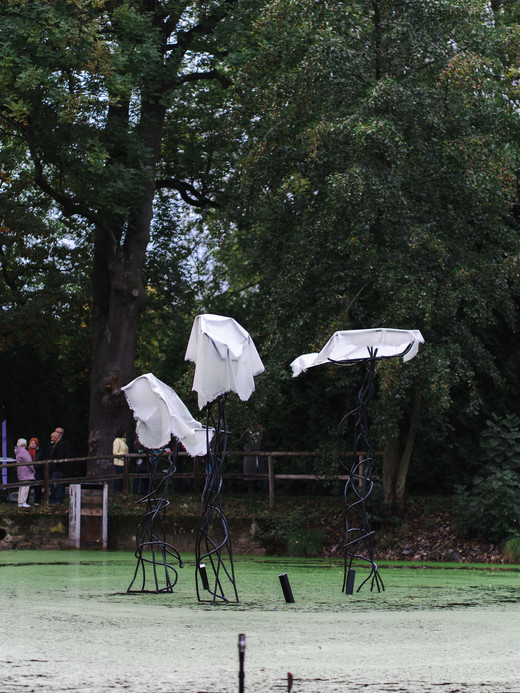
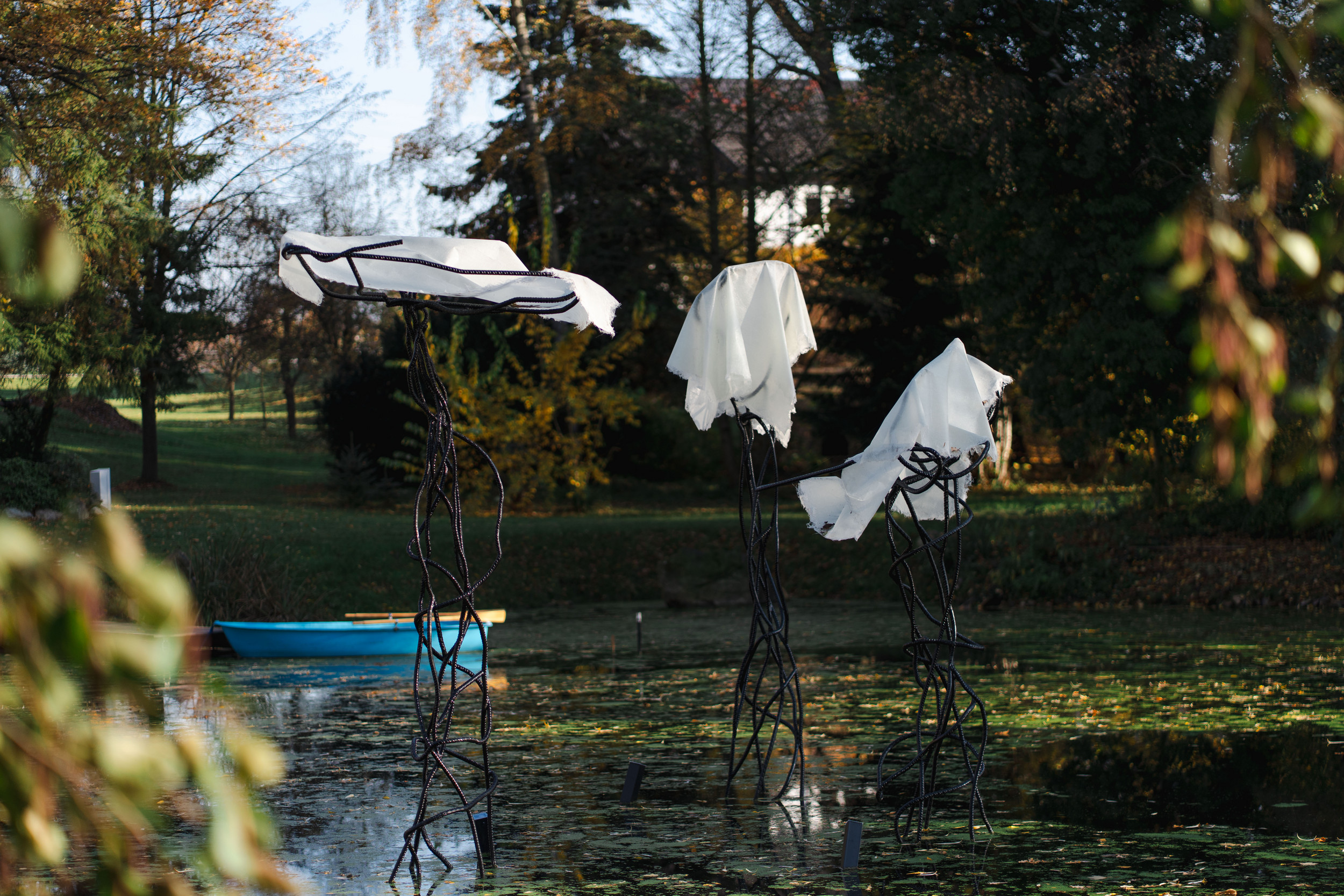
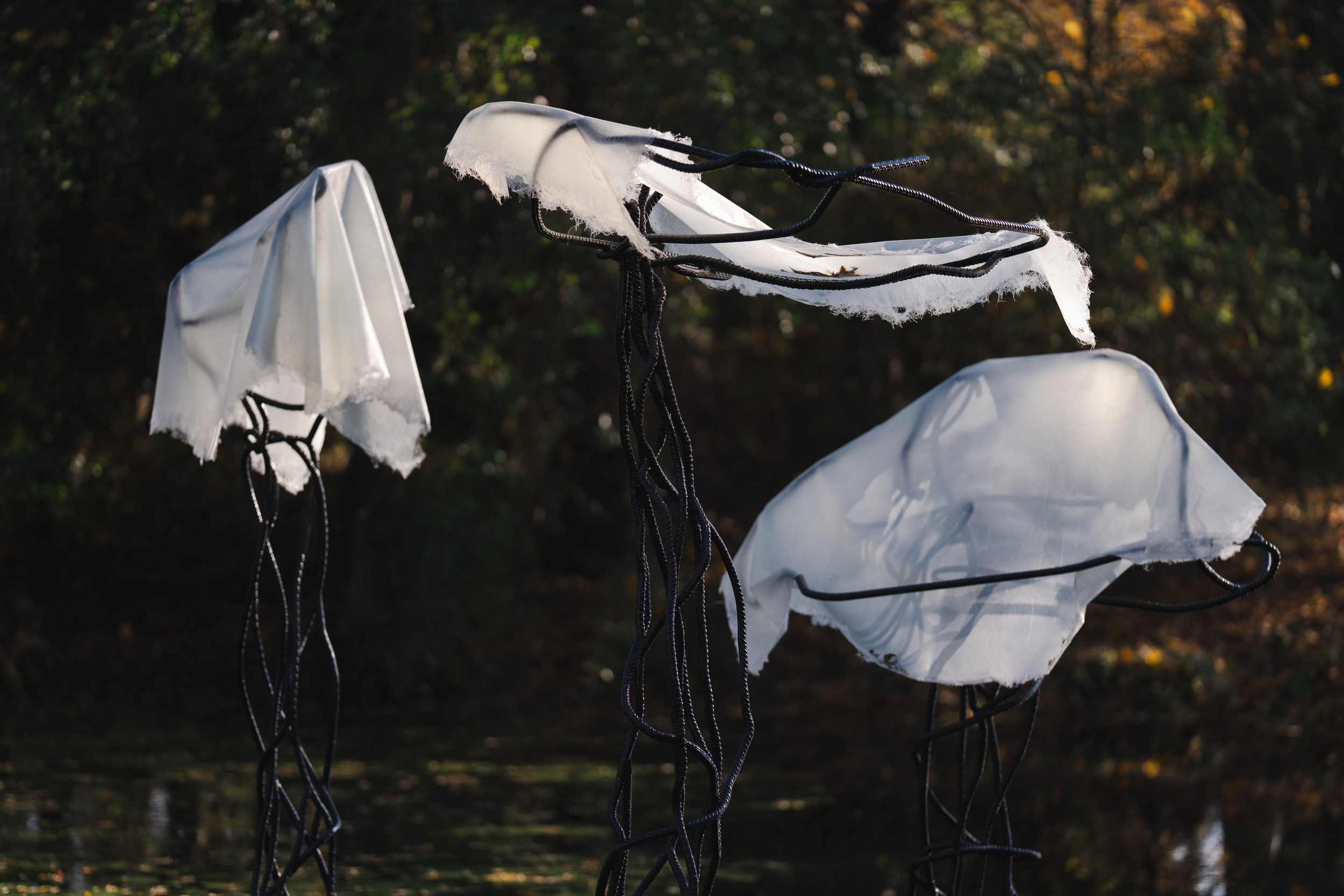
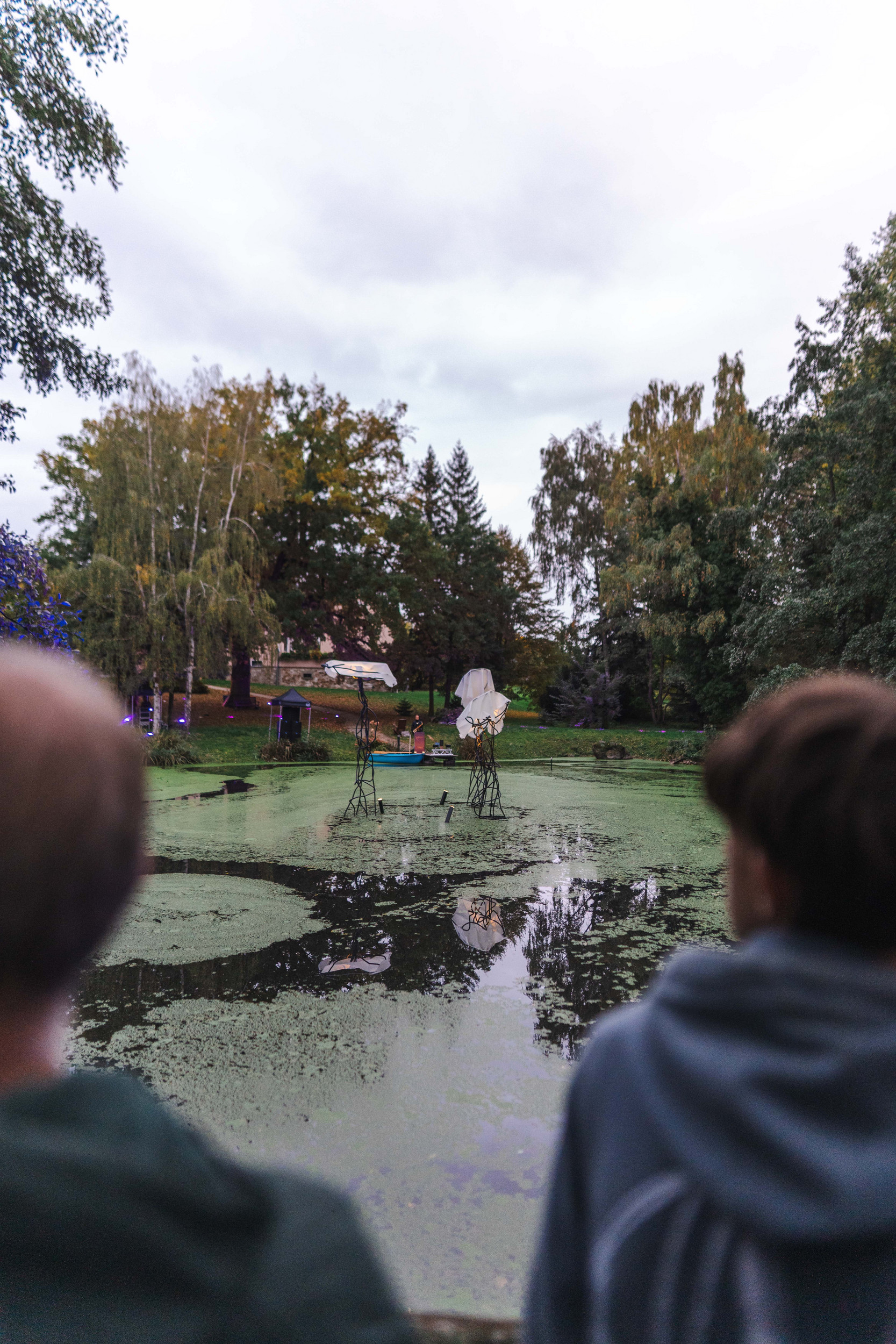
Three delicate figures float above the pond at Callenberg. Their bodies consist of twisted, powder-coated reinforcing steel, which rises from the surface of the water like a hastily sketched drawing and seems to lift a veil-like gauze illuminated from below. The sculptures ‘Ghosts’ by Polish artist Monika Sosnowska (born 1972, Ryki, Poland) create a sense of transience that contrasts with the heaviness of the material. From the diffuse depths of the pond, thoughts or memories manifest themselves as subtle, seemingly dancing figures that symbolise both familiarity and transience. Sosnowska's ‘Ghosts’ blur the line between invention and reality. Technical materials borrowed from architecture and vehicle construction, such as steel reinforcement or epoxy resin-reinforced fibreglass, are transformed into fragile-looking constructions. They raise questions about the legacy of modernism and its promises, about permanence and its failure – and about what remains of it in our present day.
On the one hand, the work evokes the mining of rare minerals such as crocoite, nickel and red lead, which were extracted at Callenberg until 1990, and on the other hand, it also evokes industrial hosiery factories, whose tradition is now only continued by a few small businesses.
(Text: Alexander Ochs / Ulrike Pennewitz)
Monika Sosnowska
Ghosts (2025)
Material: Construction reinforcement, round steel, galvanised and powder-coated, fibreglass reinforced with epoxy resin
Set up with the support of the municipality of Callenberg.
Address:
Anlagenteich Callenberg
09337 Callenberg
to the location on Google Maps
Callenberg – a village of generations between nickel, nature, and purple fields
When approaching Callenberg from the A4 motorway, you can see the rolling hills, wide fields, and dense forests that characterize the municipal area. It is a cultural landscape typical of western Saxony with its village character, nestled between the towns of Hohenstein-Ernstthal, Limbach-Oberfrohna and Waldenburg.
Seven villages – one community
The municipality of Callenberg consists of seven districts, whose cohesion is even reflected in the coat of arms: seven oak leaves symbolize the seven villages that joined together in 1999 to form a strong administrative community. This cooperation across generations shapes the self-image of the districts of Callenberg, Falken, Grumbach, Langenberg, Langenchursdorf, Meinsdorf, and Reichenbach.
The official slogan “Village of Generations,” as it appears on the Callenberg website, sums it up perfectly: young and old, long-time residents and newcomers live here in close proximity, connected by agriculture, trade, and craftsmanship. Although the municipality has lost around 1,000 inhabitants since 1990 due to structural change, the decline has slowed (as of 2024: approx. 4,600 inhabitants). New houses are being built here, old farms are being restored, and several kindergartens and a primary school have been preserved.
Above all, it is the clubs, initiatives such as choirs and house groups, sports fields, and adventure playgrounds that bring people from the districts together. Whether it's the fire department festival and harvest parade, pyramid pushing, mulled wine festival, or senior citizens' Christmas party—the year is truly rich in events that allow you to experience the community in Callenberg.
From nickel to nature experience
In its recent history, Callenberg has undergone an astonishing transformation that only becomes apparent at second glance. For decades, the area was a center of nickel mining. In 1952, mining began in five open-cast mines. At times, it was the most important nickel mining area in Central Europe. Mining transformed the landscape, excavators tore deep wounds into the earth and piled up large spoil heaps.
In 1990, the last mine was closed and work began to renature the area and dismantle the mining facilities. Today, only a few traces remain of this era, such as the remains of the former mine railway(Grubenbahn). But people's awareness of their own history remains alive. An exhibition at the Reichenbach Cultural Meeting Place commemorates the era of nickel ore mining.
Where open-cast mines, conveyor belts, and spoil heaps once stood, there are now meadows and forests, with hiking and cycling trails crisscrossing the landscape. The area has become a popular nature reserve and recreational area. The Oberwald reservoir in particular—once the Callenberg Süd I open-cast mine—attracts swimmers and camping enthusiasts in the summer.
Purple fields and wide horizons
In recent years, the bright purple poppy fields have become a distinctive feature of Callenberg. They lend the landscape an almost poetic colorfulness and have long since become the town's trademark. This attracts day trippers, hikers, and photographers from near and far.
Visitors and locals alike appreciate this brief period of intense color in early summer, when the roofs and church towers of the villages stand out against the delicate colors of the sea of poppies. Breathtaking light effects are created against gray storm clouds or during sunsets on long June evenings. Agriculture was and remains a central part of community life – down-to-earth and rooted in the region.
Nature, cultural history, and recreation
At the edge of the fields, towards Hohenstein-Ernstthal and Limbach-Oberfrohna, quiet forests and nature trails await exploration. And little cultural and historical surprises, such as the Karl May Cave. It is reminiscent of the youth of the famous “Winnetou” author, who is said to have once hidden here when he was wanted by the police for criminal offenses.
Although the cave is not accessible, it is still a popular destination for families and hiking enthusiasts. The large forest area directly adjacent to the Oberwald reservoir is a source of tranquility. You will quickly be captivated by nature as you roam through it.
Shaping the future: a typical mindset in western Saxony
Innovation and a sense of tradition, openness and immigration have always ensured survival in western Saxony. All of this is evidence of many transformation processes that date back far into history and, in some cases, continue to this day. The region has always been in flux. People came and went with the economic ups and downs, reinvented themselves culturally, and developed crafts and technology. This is still the case today.