Olaf Holzapfel: Zwei in ein ander Gewobene
Amtsberg

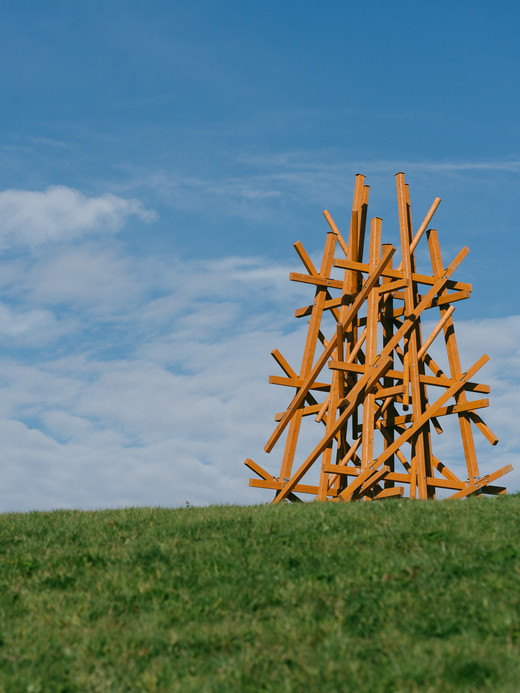
The conceptual artist Olaf Holzapfel, born in Dresden in 1967, places a sculptural-constructive work in the open landscape of the Dittersdorfer Höhe as a reminiscence of a childhood observation. Outer elements are evenly arranged around an inner structure of soaring square beams like a protective mesh. The two interlocking constructions are reminiscent of the wooden or steel towers that were erected in Saxony's turbulent landscape precisely above fixed points and served as surveying stations in the network of the Royal Saxon Triangulation [sic!] in the 18th century for mapping the kingdom. These stations, visible from afar, were constructed in such a way that the areas for people and for technical instruments functioned separately, as the measurement results were to be recorded as undisturbed as possible by heat, vibrations or the weight of human bodies.
As symbols of the ambivalent relationship between technology and nature, Holzapfel's work conveys the dogma of scientific objectivity to detach things from nature to such an extent that they become part of a system of signs devised by man. Paul Alsberg, the secret mastermind of philosophical anthropology, described this principle as the elimination of the body, as a prerequisite for the intelligent use of technology in an environment perceived as hostile. With this mechanism of alienation, nature has now been transformed into semi-finished products (Vilém Flusser), into a thoroughly synthetic, man-made reality.
The triangulation towers, which over the decades have also been used for other purposes such as transmitters or antennas, have completely disappeared from today's landscape in Saxony. Holzapfel, for whom triangulation was already the theme of his contribution to documenta 14, erected his approx. 14-metre-high wooden tower on the Dittersdorfer Höhe in the immediate vicinity of a Royal Saxon Triangulation Column erected in 1869. With his work, he not only creates a reminder of the technical revolution of earlier generations, he also makes us aware that we are looking from there into a cultural landscape that has been surveyed and shaped by humans.
(Text: Alexander Ochs / Ulrike Pennewitz)
Olaf Holzapfel
Zwei in einander Gewobene
Amtsberg / district Dittersdorf, Dittersdorfer Höhe
Material: Timber frame sculpture
Size: 6 x 6 x 14 m
Acquired with the support of the Leinemann Stiftung für Bildung und Kunst. Set up with the support of the municipality of Amtsberg.
Adresse:
Dittersdorfer Höhe
Höhenweg 2
09439 Amtsberg
to the location on Google Maps
There is a lot to discover at the PURPLE PATH! Experience tips presented by the Tourismusverband Erzgebirge e.V.
↗Recommendations for Olaf Holzapfel's ‘Zwei in ein ander Gewobene’


Amtsberg - New landscape mapping
Amtsberg lies in the gentle hill country south of Chemnitz, between the Zwönitz and Zschopau rivers in the Ore Mountains. The rural municipality was formed in 1994 by merging the four districts of Weißbach, Dittersdorf, Schlößchen and Wilischthal.
Weißbach
Weißbach traces its origins back to a medieval forest village that was settled in the 12th century. The lower village was dominated for centuries by agriculture and farming while the textile industry began to establish itself in the upper village from the 17th century onwards. The long-standing tradition of hosiery production and linen weaving, along with early industrialisation of weaving and knitting from the 18th century onwards, still lives on in the cultural memories of its residents.
“Mini-Weißbach", a miniature exhibit, showcases typical buildings of the community in detailed and colourful settings. Some of the model structures, such as the mill, even feature moving mechanisms. During the Advent season, the miniature village is illuminated for Christmas in line with the tradition of the Ore Mountains, with members of the Heimatverein Weißbach e.V. (Weißbach Heritage Association) maintaining the display.
Dittersdorf
Dittersdorf was also originally a forest village settled by immigrants from Franconia in the 12th century, who established farms and wove linen here. In 1694, an iron hammer mill was built in the village, and later converted into a felt factory. The 19th century brought industrial textile operations such as spinning mills and hosiery factories. The Evangelical Parish Church, a Baroque hall church from the early 18th century with a richly carved wooden pulpit altar is particularly worth seeing.
Schlößchen und Wilischthal
In the Schlösschen/Wilischthal area, a former manor house dating from the latter half of the 16th century denotes the origins of this region. Remnants of the original agricultural estate include a courtyard with three buildings and the Renaissance-style gateways. The Wilischthal district was home to a large paper factory until 1995, which had evolved out of a textile spinning mill founded in 1856. The paper mill, having been an East German state-owned enterprise, was re-privatised in 1992, but ultimately struggled to stay competitive. Amtsberg has many transformation stories like this.
Even though the textile companies and the paper mill ceased to be mainstays of the economy three decades ago, the four rural communities continue to move forward as a collective, establishing themselves as appealing places to live, offering space for artistic creativity (link: Cluster 4), with interesting tourist attractions in the beautiful landscape and new, innovative companies.
Dittersdorfer Höhe: Triangulation 1869
From Amtsberg’s highest point, the 554-metre Dittersdorfer Höhe, you can gaze out over the endless green of the Ore Mountains. Though tourists today enjoy stunning views, a chapter in the history of surveying was once written in this place. The great survey of the state of Saxony, the “Royal Saxon Triangulation”, was undertaken in 1869. The initiative was led by Professor of Geodesy Christian August Nagel (1821-1903) from the Technische Bildungsanstalt Dresden, now known as the Technische Universität Dresden (Dresden Technical School).
A triangulation point was installed on the prominent Dittersdorfer Höhe. This fixed point was identified by a sturdy marker set on a stone pillar. From this position, it was possible to calculate the distances to other prominent elevations in the landscape.
The angles between three elevation markers forming a triangle were measured, and exact distances calculated using bearing discs or theodolites. The surveying system included a total of 158 such survey points and stations to enable the landscape to be accurately mapped. Many of these stone surveying pillars with inscriptions are still in existence today and are considered technical monuments.
Later, wooden trigonometric survey towers were often built at these survey points, which could be used to aim at; they were often equipped with viewing platforms. Olaf Holzapfels artwork “Zwei in einander Gewobene” (two interwoven structures), part of the Purple Path on Dittersdorfer Höhe, is reminiscent of these trigonometric towers.
Altars to kneel before: Parish churches in Dittersdorf and Weißbach
The Evangelical parish church in Dittersdorf is a typical Baroque hall church (1730). Its richly-carved pulpit altar dates back to the time of its construction. The design includes a depiction of the Last Supper, elaborate decorative features such as the large pillars, figures of angels on the pulpit and a crown-like attachment with an exotic pelican and its young.
Weißbach also has records of a medieval church, which was expanded in 1782 into a rectangular hall with galleries and a hipped roof. This church also had a wooden pulpit altar. Even the baptismal font from the old church, featuring four 17th-century figures of children, was preserved when the church was renovated.
The Purple Path sound: Jehmlich organ in Weißbach parish church
A notable feature of the church in Weißbach is an organ crafted in 1828 by Saxon organ builder Carl Gottlieb Jehmlich. Jehmlich Orgelbau left its mark on music-making throughout Saxony for more than 200 years. The Jehmlich family’s organ-building tradition began in 1808 with brothers Gotthelf Friedrich, Johann Gotthold and Carl Gottlieb in the Ore Mountain village of Cämmerswalde. Ralf Jehmlich, the 6th generation of the family, has run the company in Dresden since 2006. This makes Jehmlich Orgelbau the oldest ongoing organ-building company in the world.
Shaping the future: a typical Erzgebirge mindset
Innovation and a sense of tradition, openness and immigration have always ensured the survival of the Erzgebirge mining region. All of this bears witness to many transformations that stretch far back into history, some of which are still continuing today. The region has always been in motion. People came and went with economic ups and downs, reinventing themselves culturally and advancing craftsmanship, technology, art and culture. This dynamic spirit continues to this day.
Graphic designer and print artist: Thomas Ranft (*1945)
Born in Thuringia, Thomas Ranft studied at the Academy of Visual Arts in Leipzig from 1967 to 1972. After graduating, he moved to Karl-Marx-Stadt, now Chemnitz, where he gained wider recognition. In 1977, he co-founded the artist group and producer gallery CLARA MOSCH (1977–1982), together with Michael Morgner (LINK: Freiberg), Carlfriedrich Claus, Dagmar Ranft-Schinke and Gregor-Torsten Schade in Adelsberg, a district of Karl-Marx-Stadt/Chemnitz.
The official GDR art establishment disregarded and ignored their art. However, their activities attracted the attention not only of the art community but also of the Stasi. Despite surveillance, threats and intimidation, their boundless and occasionally subversive creativity remained unstoppable. From 1986 to 1989, Ranft taught at the School of Applied Arts in Schneeberg Since the 1990s, he has exhibited his graphic and print art throughout Germany, Switzerland and the USA. Thomas Ranft lives and works in the Amtsberg district of Dittersdorf.
Entrepreneur Rainer Hollnagel: Flexiva automation & Robotik GmbH
Flexiva has been designing and producing customised automation solutions for various industries since 1990. The company headquarters are located in a former hosiery factory that was restored in 1998. CEO Rainer Hollnagel and his partners gradually expanded the company, specialising for example in electrical and pneumatic planning of control cabinets and robotics solutions. The company thus undertakes engineering, series production and custom equipment manufacturing. With over 90 employees, Flexiva provides engineering, manufacturing and programming services. An especially innovative department at Flexiva develops and manufactures new ways of powering commercial vehicles such as trams using alternative energy sources. The focus here is on hydrogen technology, fuel cell systems and electrical storage solutions.
Flexiva is also well positioned in terms of its own sustainability, with e-charging stations for company electric vehicles, a rooftop photovoltaic system on the energy-efficient production hall and a reversible heat pump for winter heating and summer cooling, powered by an on-site wind turbine. The large butterfly meadow behind the factory building provides a habitat for many insect species.
Entrepreneur Mandy Haase: Emes Kabelbaum Konfektions GmbH
Flexibility - this is the first word you read when you visit the website of cable manufacturer Emes Kabelbaum Konfektions GmbH. Not only do the cables themselves need to be suitable for a range of uses, the people of this region have had to demonstrate flexibility too, particularly in response to the structural changes that followed German reunification in 1990, which demanded new ways of thinking and learning. But as always in the Ore Mountains, when one industry is no longer thriving, everyone works together to develop a new one.
Women have often been the catalysts for such transformation, as is the case with Barbara Uthmann, a 16h-century mining and textile entrepreneur from Annaberg. Strong female entrepreneurs remain a hallmark of the Ore Mountains region to this day. Founded by Mandy Haase in Hohndorf in 2001, Emes now employs more than 70 people. It all began with wiring harnesses for the traditional East German motorcycle brands MZ and Simson.
In 2007, the company reorganised itself, acquired new customers and grew steadily, enabling the construction of a new and larger production site in Amtsberg in 2014. This success story earned Mandy Haase the title of “Saxon Entrepreneur of the Year” in 2016. Thanks to innovative and diverse production, another new production hall was built in 2020. Mandy Haase and her team are currently working on the digitalisation of production processes and workspaces.