Osmar Osten: Oben-Mit
Chemnitz

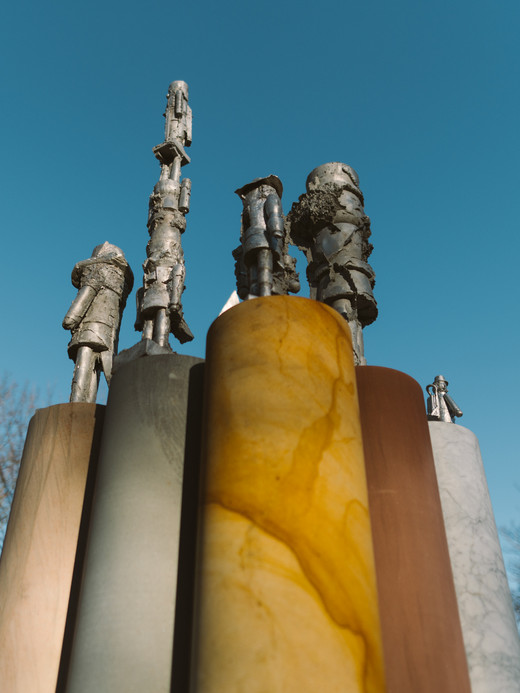
Slim, elegant, and towering, Osmar Ostens' 3.60-meter-high sculpture stands on Chemnitz's Schillerplatz. Delicate-colored columns made of Saxon natural stone, such as yellow Posta sandstone, nestled together and playfully complemented by marble steles, form the support for a whole bundle of figures cast in silver-colored aluminum. Depictions of Erzgebirge nutcrackers, angels, and miners, as well as incense smokers, stand side by side and, in some cases, head to head. The rough seams and casting burrs deliberately left during production make the figures appear like mythical spirits spreading out before the eyes of the viewer. Thus, the "good spirits
of my homeland,“ as Osten ambiguously expands the title of the group of figures ”Oben-Mit," can be understood both as a loving homage to the Ore Mountains and as a distancing from tourist and commercial appropriations of local identities. With the clash of content and visual contradictions thus depicted, the artist sets in motion an open process of speculation about the meaning of his works.
The painter, graphic artist, and object artist Osmar Osten, who was born in Karl-Marx-Stadt (GDR), now Chemnitz, in 1959 and still lives and works in the city today, has developed an unmistakable style between Art Brut and satirical art. In his works, the artist repeats his recurring cast of characters, including stick figures, black snowmen, nutcrackers, and human-animal figures, commenting on or contrasting them with Dadaist-style humorous sayings and words. The themes that Osten addresses oscillate freely between the poles of seriousness and satire, with associations that are as harmless and humorous as they are biting and provocative, which can change spontaneously or contradict each other depending on one's perspective and horizon. With his “numerous tactics against the profundity of art and the frivolity of life” (Ulrike Lorenz), Osten's art always hits the mark, only to change color at the same moment.
(Text: Alexander Ochs / Ulrike Pennewitz)
Osmar Osten
Oben-Mit (or: Ein Denkmal für die guten Geister meiner Heimat)
In: Chemnitz, Schillerplatz
Material: Aluminum, natural stone
Dimensions: 3.6 m
Set up with the support of the city of Chemnitz.
Adress:
Schillerplatz
09111 Chemnitz
to the location on Google Maps


Chemnitz – Locomotive of Saxon Industry
Schillerplatz, the location of Osmar Osten's sculpture Oben-Mit, tells us a lot about the last 200 years of the city's history. The square itself and key buildings in its architectural surroundings bear witness to urban development as striking milestones. Schillerplatz was once the largest urban green space in Saxony. It was laid out in 1858, one year before the 100th birthday of the poet Friedrich Schiller. It was a time of profound change in the urban topography, as Chemnitz had been growing at a breathtaking pace since the 1830s with the advent of industrialization.
The age of machines
Textile goods and textile machinery manufacturing, machine tool construction, and locomotive manufacturing in particular led to an extraordinary increase in production. Favorable conditions were created by Germany's accession to the German Customs Union in 1834, the development of coal mining in the Lugau-Oelsnitz and Zwickau regions for steam engine drives, and the construction of the Saxon railway from 1850 onwards.
In 1826, Carl Gottlieb Haubold began building spinning machines. His Saxon Machine Building Company (1836) is considered the nucleus of industrial machine building in Chemnitz. The city acted as a magnet for inventors and entrepreneurs. Johann Zimmermann, a locksmith who moved from Hungary in the 1830s, founded the first machine tool factory. In 1840, Louis Schönherr, a designer from Plauen, succeeded in factory-producing the mechanical cloth loom with his inventions.
Technical education and mobility
From then on, there was a great need for skilled workers, who were trained at the Royal Trade School, now the Technical University, from 1836 onwards. Its main building is located east of Schillerplatz on Straße der Nationen. In 1848, Richard Hartmann, who had immigrated from Alsace, built the first locomotive and became the main supplier to the Royal Saxon Railway. By the end of the 1920s, almost 4,700 locomotives had been delivered worldwide. Chemnitz railway station, a few minutes' walk east of Schillerplatz, was opened in 1852. The current station building, in the historicist style, dates from 1872.
Factories, prosperity, and culture
To the north, Schillerplatz is bordered by the Chemnitzer Aktienspinnerei, built in 1858. It was once considered the most modern and largest factory in Saxony: architecturally, because it was built entirely of stone and iron; industrially, because it had enormous production capacity. By 2020, a core section had been renovated and now serves as the home of the university library and archive (Universitätsbibliothek und -archiv).
Between 1870 and 1914, Chemnitz was one of Germany's largest industrial metropolises, growing from 100,000 to 320,000 inhabitants. In terms of population and tax revenue, it was considered the wealthiest German city. Growing prosperity created a cultural milieu in the city: newspapers and libraries, associations for history, science, art, and literature, singing academies and secondary schools, civic lectures, exhibitions, and collections. A prime example of this is Theaterplatz, which adjoins Schillerplatz to the south: with the Central Theater (1906-1909), an opera house since 1925, flanked by St. Peter's Church (1885-88) and the King Albert Museum (1898-1908), now the Municipal Art Collections.
City of Modernity
These developments continued into the 1930s and beyond Schillerplatz and its surroundings to other parts of the city, establishing Chemnitz's reputation as the “City of Modernity”:
- from 1855: Production of bicycles, milling machines, typewriters, and calculating machines at the Wanderer Works
- 1860-1930: Neo-Romanesque, Neo-Renaissance, and Art Nouveau styles in the Gründerzeit district of Kaßberg
- 1903: Henry van de Velde builds Villa Esche for a textile entrepreneur
- From 1905: Expressionist avant-garde art by Karl Schmidt-Rottluff, Edvard Munch, and Otto Dix in the art collections
- 1927: Architect Erich Basarke designs an industrial complex for Schubert&Salzer, today's Wirkbau
- 1930: Architect Erich Mendelsohn builds the Schocken department store, now the State Museum of Archaeology
- 1930: Architect Fred Otto designs the new Sparkasse building, now the Gunzenhauser Museum of 20th Century Art
Chemnitz – Karl-Marx-Stadt and back: Two new beginnings
Today, Schillerplatz is no longer a park covering the entire area, but is divided. The bus station is located in its northern section. It was built in the 1960s when the GDR decided to rebuild the city center, which had been 90 percent destroyed in World War II in 1945, with socialist architecture.
Since 1953, Chemnitz had been called Karl-Marx-Stadt and was to be transformed into a socialist metropolis, as evidenced by the prefabricated buildings from the 1970s and 1980s located west of the square. The Straße der Nationen, which runs along the eastern edge of Schillerplatz, leads to the city center with its modern GDR buildings. The monumental 40-ton bronze head of Marx by Lew Kerbel (1971) is also part of this redesign.
With German reunification in 1990, the city began to reinvent itself. A referendum resulted in the city being renamed Chemnitz. For three decades, there has been a lot of construction, gaps left by war damage have been filled, and architectural monuments have been restored. A new city center has grown up around the 12th-century Red Tower, attempting to form a link between the old (1496-98) and new town halls (1907-11) and the socialist buildings Hotel Congress and city hall (Stadthalle), dating from 1969-74.
In anticipation of the Capital of Culture year, the city council decided in 2023 to upgrade the landscaping of Schillerplatz, which is close to the city center. Osmar Osten's sculpture, part of the Purple Path that symbolically connects Chemnitz as the Capital of Culture with the region, is an important step in this direction. The rich historical tree population is to be preserved and the path network renewed.
The city's roots in the 12th century: Benedictine monastery and Red Tower
Visitors to Chemnitz today will find few reminders that the city's history dates back several centuries further than the boom years of industrialization and modernity. A document from the Staufer Emperor Conrad III dating from 1143 attests to the granting of market privileges to a Benedictine monastery. This was located in a place “called Chemnitz” (Latin: “locus Kameniz dictus”). The monastery, we learn, had already been founded by his predecessor, Emperor Lothar III.
The earliest parts of the monastery church (today: castle church) date from the 1160s. With the imperial market rights, a settlement established itself around the monastery, traces of which archaeologists have been able to prove and date to around 1200. An old rent register recording the settlement's taxes to the monastery confirms this finding. From the 1250s onwards, there are documentary records of the parish church of St. Jakobi, which stands next to the Old Town Hall (15th century) on the market square. The foundations of the Red Tower in the center of Chemnitz, part of the city fortifications, also date from this period.
This is how the early cornerstones of the imperial city of Chemnitz in the Middle Ages can be outlined. Economically, the city must have established itself quickly. From the 14th century onwards, we know for certain that there was extensive linen weaving and a bleaching privilege (1357). As a result, the regional value chains became dependent on the Chemnitz textile market for many centuries.
The flow of money into Chemnitz aroused envy, which made the city a pawn in various interests. Emperors, abbots, and the Margraves of Meissen fought for influence for two centuries. It was not until the emergence of Saxon rule in 1423 that the city came permanently under the influence of the Wettin dynasty, but it retained its freedoms and privileges.
The Schloßberg Museum is worth visiting to learn about the early history of the city.
Early capitalism and new beliefs: the textile industry, mining, and the Reformation
Bleachers and cloth merchants did a roaring trade in Chemnitz. The textile industry remained the dominant sector for centuries, establishing early industrial manufacturing as early as the 18th century. With the boom in mining in the Western Ore Mountains, money was also invested in the mining industry. We know of investments in mines in nearby Geyer, of a smelting works (1471) that smelted copper and silver from ore, and of a copper hammer mill (around 1470) in the Chemnitz area.
The citizens of Chemnitz developed a high level of self-confidence and attempted to emancipate themselves from the monastery in the second half of the 15th century, both economically and religiously. Wealthy citizens founded a Franciscan monastery in the city, cultivated new forms of piety, and refurbished the city's churches. The tax policy, lifestyle, and understanding of service of the Benedictines on the mountain above the city had come under criticism. All of this was a harbinger of what we now refer to in historical retrospect as the Reformation.
Late Gothic church building, summer residence, and art collection
Abbots Heinrich von Schleinitz (1484-1522) and Hilarius von Rehburg (1522-40) attempted to counteract these developments. Apparently in order to send out a new signal of change, the Romanesque church was extensively rebuilt into a three-nave hall church with late Gothic elements (choir consecrated in 1499): tall, slender pillars support an ornate ribbed vault.
The sacred art is also worth seeing: St. Catherine's altar (1499, on permanent loan from Großenhain), north portal with figures by Master HW (1525), four painted panels from a former altar by Lucas Cranach the Elder (1518/20), and the famous oak scourging column by Master HW (1515).
In 1539/40, the Reformation was introduced and the Benedictine monastery was dissolved. Duke Heinrich the Pious converted the area into a residential palace in 1548/49, hence the area's current name: Schloßberg (palace hill). Today, it is home to the Schloßberg Museum. The reconstructed monastery rooms (cloister, refectory, chapter house, and parlatorium) house an important collection of sacred art with works by Master HW, Hans von Cöln, as well as the extraordinary Holy Sepulcher and Meissen-Saxon panel paintings.
With the kind support of Sparkassen-Finanzgruppe and NILES-SIMMONS-HEGENSCHEIDT Group