Sean Scully: Coin Stack 2
Schneeberg

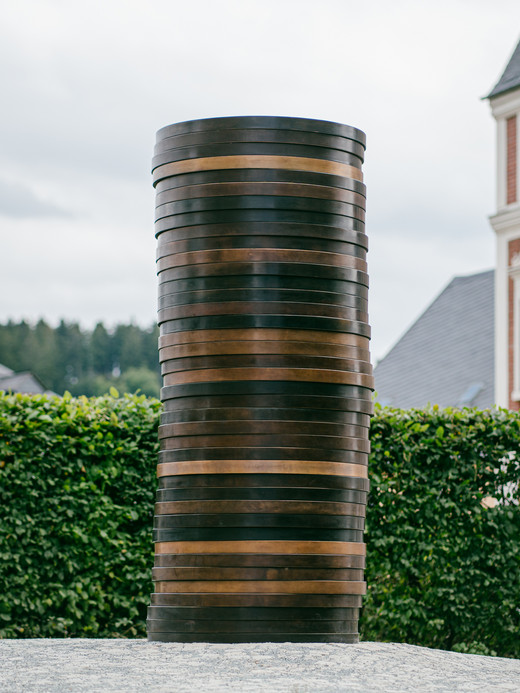
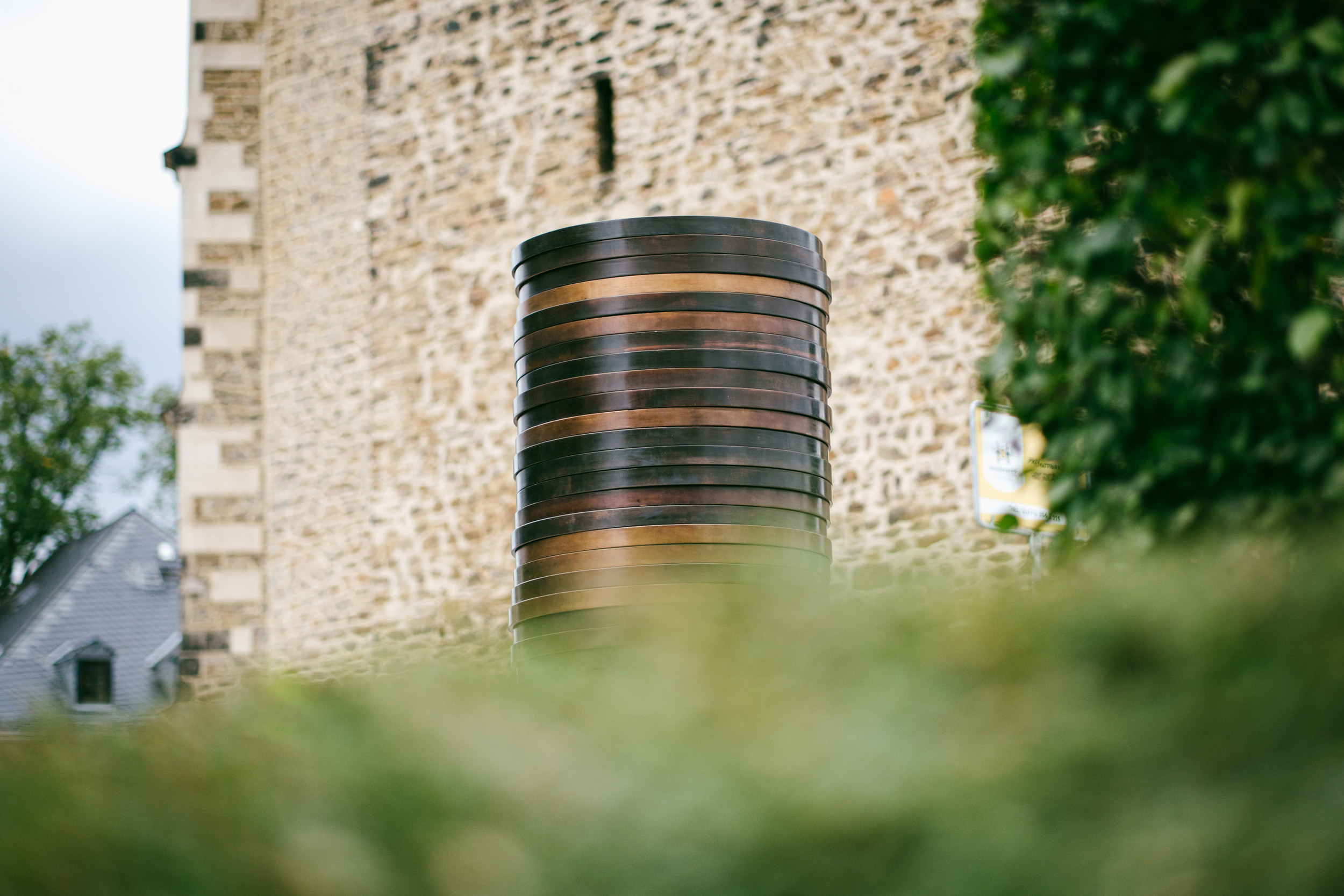
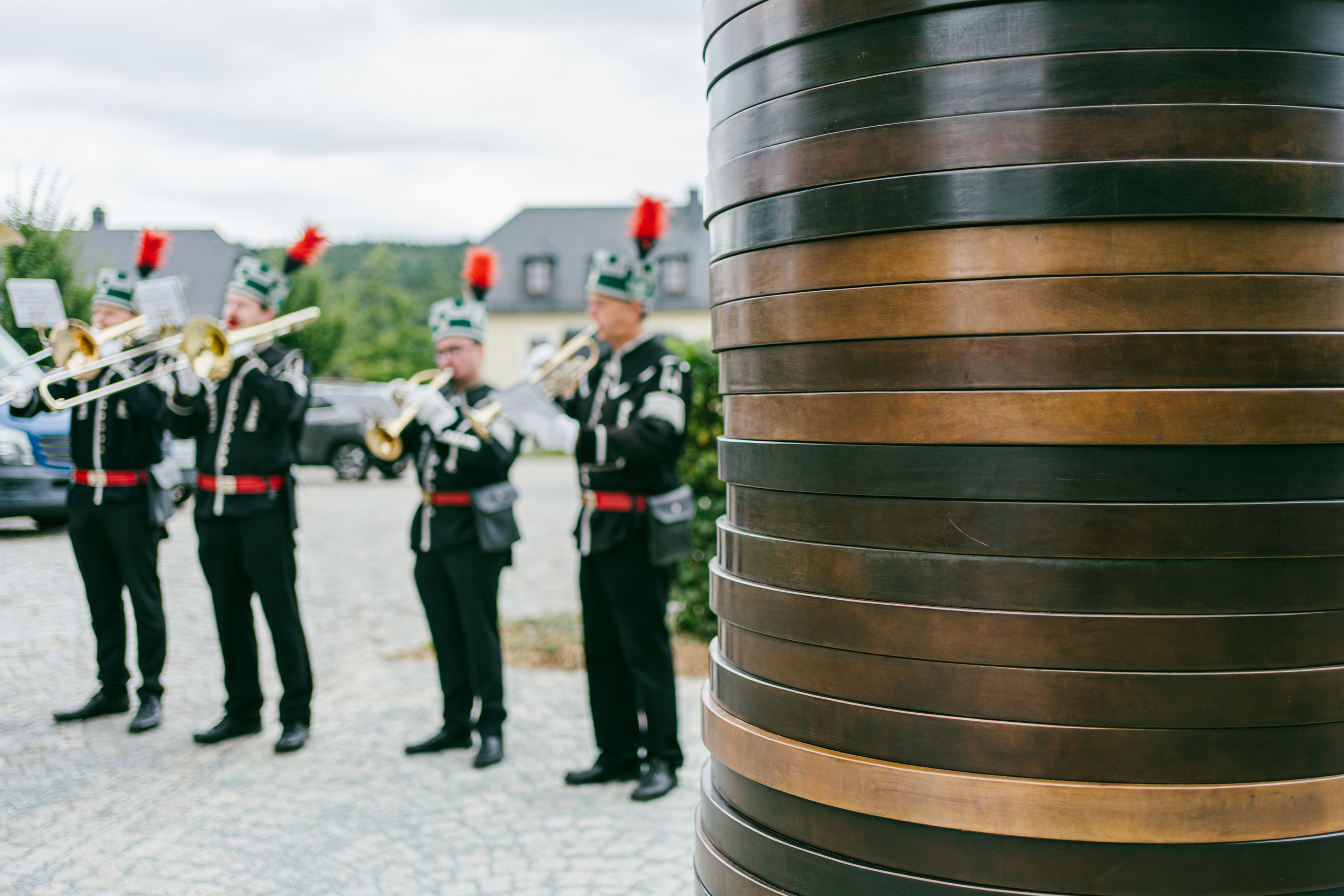
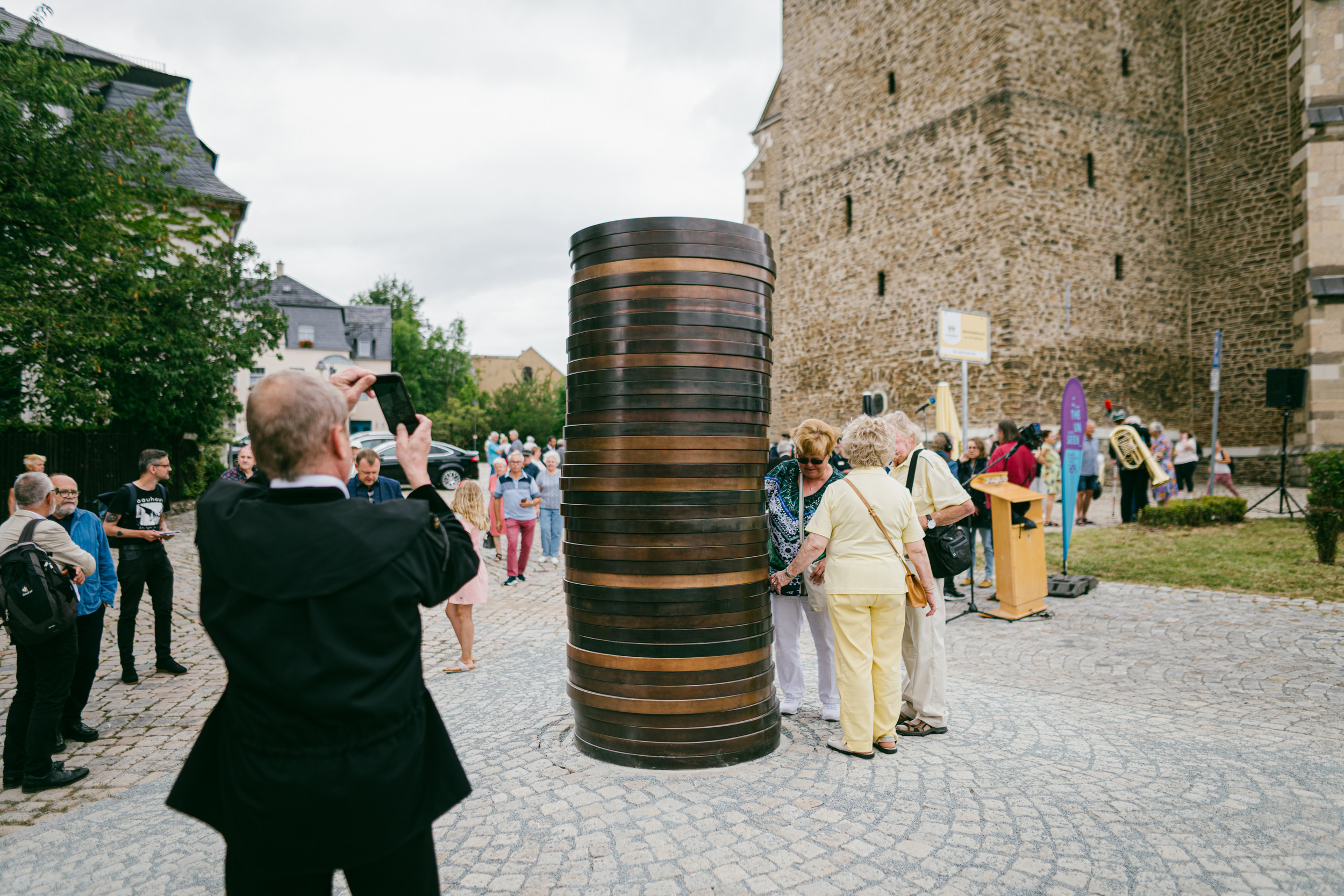
A stack of coins is one of the most impressive childhood memories of the painter and sculptor Sean Scully, who was born in Dublin, Ireland, in 1945. After his family moved to a working-class neighbourhood in south London, Scully grew up in modest circumstances and watched his father, who worked hard as a hairdresser, arrange the tip into a small, irregular column after work, saving up his children's pocket money week after week. Scully, who has won numerous international awards, translated his memory of this into a series of bronze sculptures entitled Coin Stack . The round shape of this series has so far been a special feature in his painterly and sculptural work, which is characterized by geometric stripes and angular blocks. Coin Stack consists of 40 round discs, whose differently colored surfaces are reminiscent of the father's coin stack. Slightly offset and arranged on top of each other around a concentric center, they reach a height of 2.40 meters.
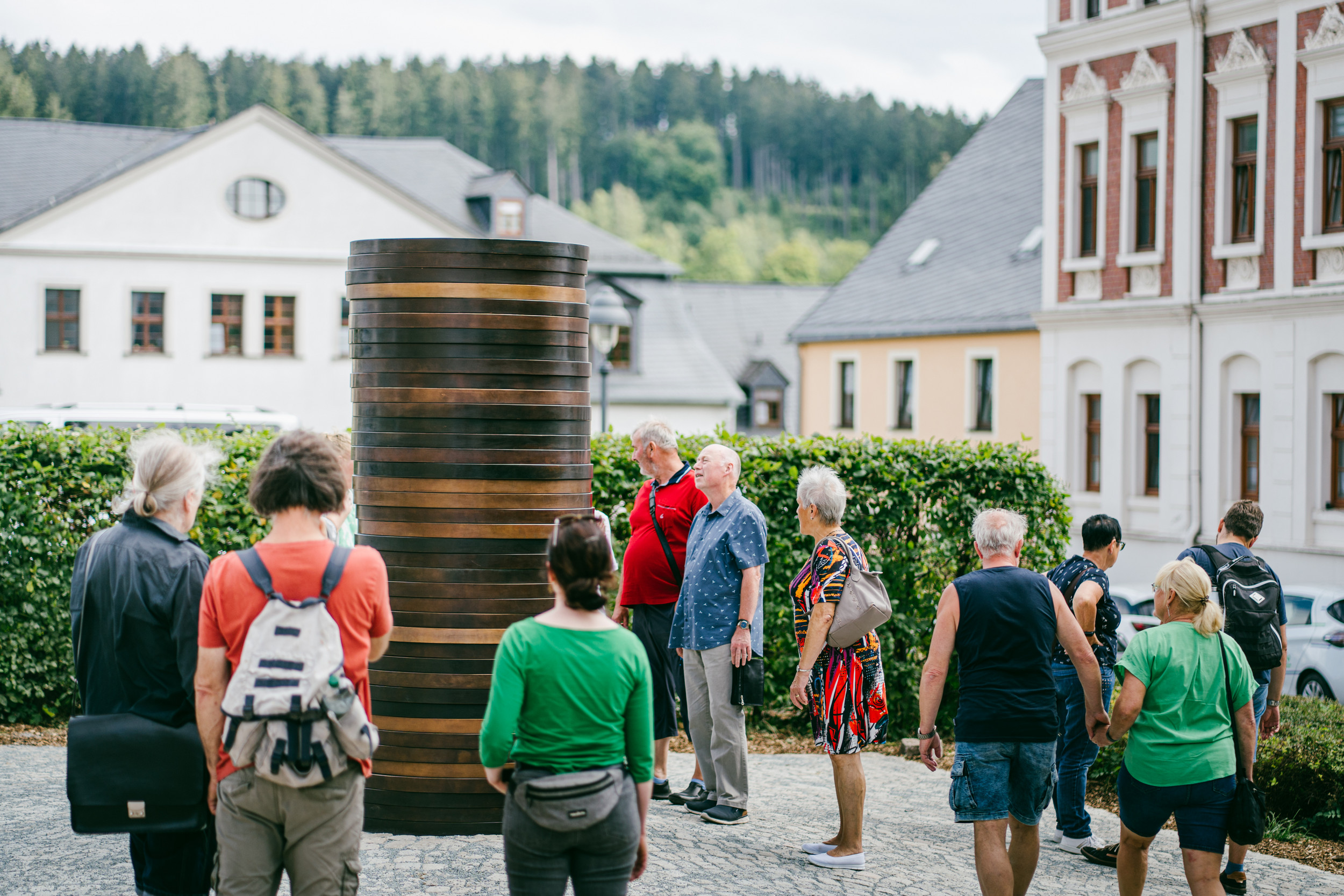
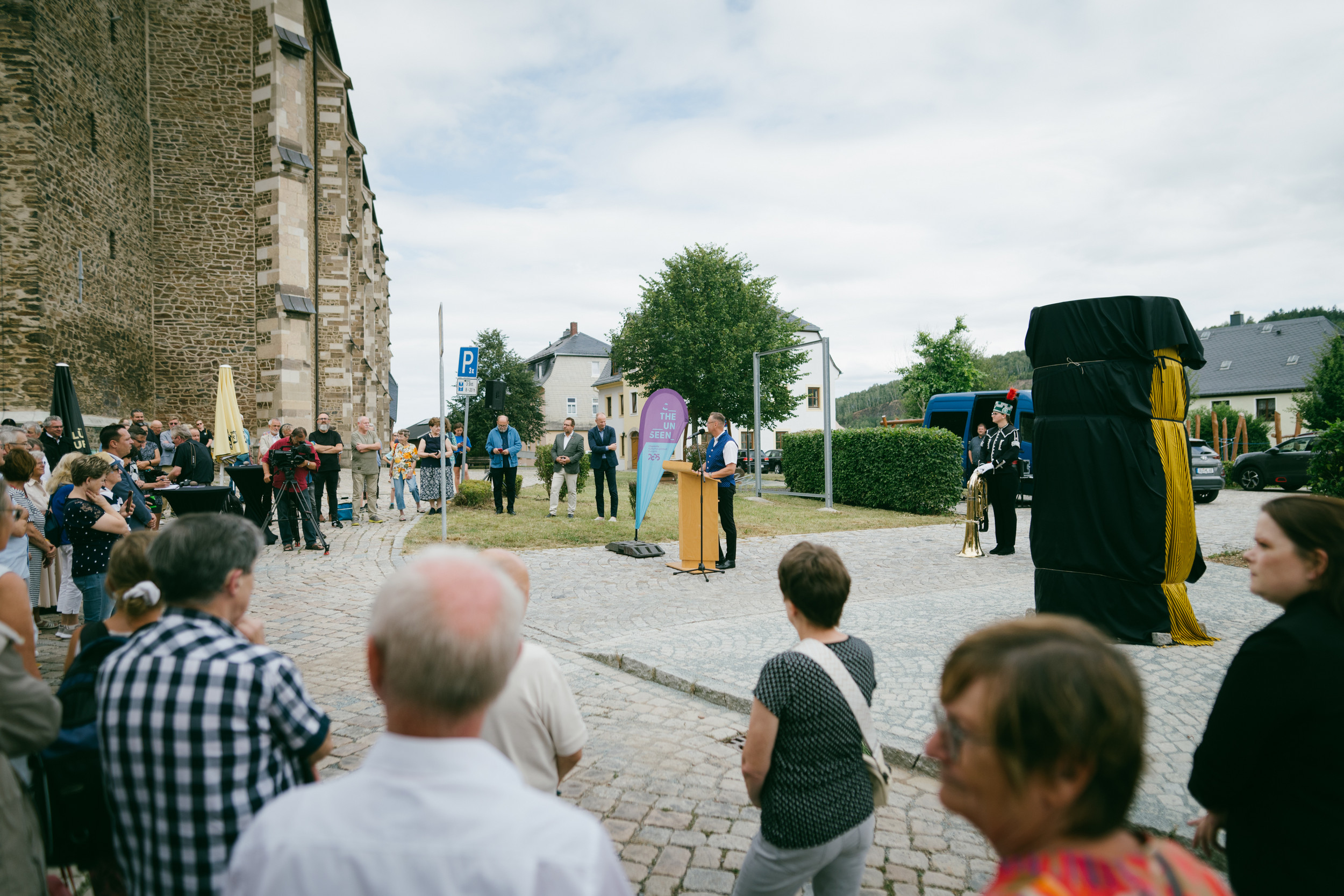
As you approach the late Gothic St. Wolfgang's Church, also known as the "Miners' Cathedral", the church square opens up between its long south side and a row of beautiful multi-storey town houses. At the end of the square, the stack of coins seems to grow out of the stone-gray pavement. And here the sculpture also associates the legendary story of the successful labor struggles of the Schneeberg miners in the years 1496 and 1498. After a good 25 years of intensive silver mining, the deposits became fewer and it meant greater efforts to exploit them. In order to keep profits high, the employers intended to 'break' a penny each of the workers' weekly wages. The proud and well-organized miners successfully pushed back the project and so today we can speak of what is probably the first workers' strike of the early modern period.
(Text: Alexander Ochs / Ulrike Pennewitz)
Sean Scully
Coin Stack 2
In Schneeberg, church square at St Wolfgang's Church
Material: Bronze
Size: 1.4 m x 2 m
Set up with the support of the town of Schneeberg.
Address:
Church square at St Wolfgang's Church
08289 Schneeberg
to the location on Google Maps
There is a lot to discover at the PURPLE PATH! Experience tips presented by the Tourismusverband Erzgebirge e.V.
A dispute over coins.
The “Zweite Berggeschrey” (second mining rush)!
Large silver deposits were discovered around Schneeberg in the 15th century. The deposits were so rich that Schneeberg was designated a free mining town (1481) to attract more people. After the “Ersten Berggeschrey” (first mining rush) in Freiberg in 1168 a “second mining rush” began. People flocked to the town, seeking to make their fortune in ore mining. An outstanding building of this period is the late Gothic hall church of St. Wolfgang (1516-1540) with its Lucas Cranach altar from the Reformation era.
The church, also known as the Miners’ Cathedral, is the destination of the annual mining parade on “Miners’ Dispute Day” (22 July): since 1498, the mining associations have commemorated successful strikes against wage cuts. Today, Schneeberg is known as the “Baroque town of the Erzgebirge”. After the great fire (1719), the town was rebuilt and became the world's largest cobalt mining area at the time.
The first miners’ strike in Germany
From a day of struggle to a festival that is still celebrated today
In 1496 and 1498, the mood switched from rush to resistance. Rising operating costs resulting from mine drainage and ore smelting led the Schneeberg mine operators, mostly external investors from Zwickau and Nuremberg, to try to lower the miners’ wages. At that time, wage cuts were a tried and tested method of increasing the profits of mining and smelting companies when the yield in the mines decreased.
But the miners’ guild in the Schneeberg district fought to maintain their wage levels through two strikes. These were the first recorded organised strikes by a professional guild in Germany. The miners’ collective industrial action was successful, and the wage cuts were reversed. Since then, the people of Schneeberg, along with the entire Erzgebirge region, celebrate this day of struggle on 22 July, regardless of the day of the week it falls on. The miners’ associations proudly present themselves to the region and celebrate their customs.
Miners’ parade and miners’ church service on Bergstreittag (miners’ dispute day) in Schneeberg
The Landesbergmusikkorps Sachsen (Saxon State mining music corps) and the mining guilds from all over the Saxon and Bohemian-Czech Erzgebirge parade up the hill from the market square to the St Wolfgang miners’ cathedral. The Evangelical Lutheran church, built during the Reformation, fills with parishioners and visitors.
All eyes are then on Pastor Meinel and the altar with its painted triptych. This is a major Saxon work of art whose significance for the history of art in the Reformation extends well beyond the region. The work was commissioned from Lucas Cranach the Elder in 1531/32 by Saxon Elector John the Steadfast.
Old and young, all generations come together in the church for the highlight of this special day. It has always been this way. This is why the tradition, culture and community of the miners in the Erzgebirge have lived on for centuries. They still do. And they’re certain to live on into the future. The tradition includes the famous Steigerlied (foreman’s song), which was recognised as UNESCO Intangible Cultural Heritage in March 2023.
Rosina Schnorr: a strong woman in the world of mining
The stories of the people who lived from and with mining tell not only of lucky ore discoveries, rich yields and technical innovations, but also of hard labour and tough competition, the struggle for wages and social justice.
They tell of a courageous woman in 17th century Schneeberg, who became an entrepreneur overnight: Rosina Schnorr (1618-1679). But not entirely of her own free will, as her husband, the successful mining and smelting entrepreneur Veit Hans Schnorr the Elder, was abducted from the Leipzig Spring Fair (which had been held since 1497) in 1648 and taken to Russia. The tsar was probably interested in his ore processing expertise. For years, Rosina Schnorr knew nothing about her husband’s fate. Nobody had any idea where he was.
She took over the family business and had to show great courage, asserting herself in what was then a tough, male-dominated world. With great skill and forcefulness, she managed the Blaufarbenwerk cobalt works and the Auerhammer iron works . The latter is still in operation today, making it the oldest ironworks in Germany. Shrewd contracts with other entrepreneurs, such as the cobalt contract she initiated in 1653, secured Rosina Schnorr the monopoly on cobalt, with the support of Saxon Elector Johann Georg I.
It was only in 1664 that Veit Hans Schnorr the Elder managed to escape from Russia. The family received a letter, indicating for the first time in 16 years that he was alive. But Schnorr never reached his homeland, as he died in Vienna on his way home. In 1665, Rosina’s son Veit Hans Schnorr d.J. took over the business. Rosina Schnorr also did a great deal for the community in her home town of Schneeberg. She donated 2,000 guilders to the mining town to enable a new orphanage to be built in 1677.
The art of ore processing: wet stamp mills for cobalt extraction
Schneeberg still has a memorial to the technology from the time of the cobalt monopoly (16th-19th century): the Siebenschlenhener stamp mill, which is part of the UNESCO World Heritage Site and can be visited .
Here, the cobalt ore was crushed by water-driven stamping hammers to grains of 3 to 5 mm in diameter and simultaneously washed with water. This ensured a better yield when the ore was later smelted in the furnace.
The idea originated with Saxon mine owner Sigismund von Maltitz, who in 1507 was the first to introduce wet stamp mills in his mines near Dippoldiswalde in the eastern Erzgebirge. The ore was now crushed under a constant flow of water, which made it easier to remove unusable lighter waste rock and reduce ore losses due to dust. This process spread around the world and revolutionised ore extraction in Cornwall, England, which is also a UNESCO World Heritage Site.
Maker: Franziska Heinze and Trubel in der Poche e.V.
The cultural association led by Franziska Heinze aims to open the stamp mill on a permanent basis for lovers of culture. The intention is to establish this charming area as a place where people can meet, creativity can flourish and that promotes dialogue between tradition and modernity. In addition to regular workshops, an annual art and culture festival takes place every July: this is a colourful summer celebration with creative activities, live music, delicious food and a curated arts and crafts market.
From lace-making to textile design
The mining town of Schneeberg is not only associated with innovation in silver and cobalt mining and ore smelting technology. The city has another creative gene in its pioneering DNA: the design and creation of textiles and wood art. Both materials are closely linked to the history of mining: through forestry and woodcraft as well as textile production.
The Königliche Spitzenklöppelmusterschule Schneeberg (royal lace-making design school) was founded in 1878. In 1992 it became the Faculty of Applied Arts at the West Saxon University of Applied Sciences Zwickau. Here, students can train their creativity and craftsmanship in the fields of wood design, fashion design, textile art/textile design, and musical instrument making (in Markneukirchen/Vogtland).
The spread of specialist lace-making and braid knitting in the Erzgebirge was also the result of the courage and skill of an entrepreneur from Annaberg-Buchholz: Barbara Uthmann (1514-1575). Her husband Christoph ran the Saigerhütte smeltery in Grünthal near Olbernhau from 1550 , which extracted copper and silver. When her husband died in 1553, Barbara Uthmann and her sons took over the business and continued to run it successfully.
They were awarded the copper monopoly and the success of the smeltery was a thorn in the side of many a competitor. The Saxon Elector August exploited the machinations of fierce competition to his own advantage, revoking Barbara Uthmann’s copper privileges in 1553. In 1567, she was forced to sell the Saigerhütte to the Elector.
She invested some of her economic gains to establish a putting-out system for ribbon weaving, employing up to 900 women as home-based textile workers. This thus enabled miners’ wives to contribute to their families’ incomes and give families financial stability in the context of the risks associated with mining.
Young makers in Schneeberg: Nils Bergauer
Nils Bergauer represents a rich tradition of craftsmanship and textiles . Since 2012, he has been running a workshop that custom-makes fine leather gloves. The family business has been running since 1876. His work, he says, is characterised by the use of traditional tools, a love of the raw material of leather, a creative, playful approach and fashionable detailing. Gloves can be made to measure upon request.
Donata Wenders: Ode an das Handwerk
Ode an das Handwerk (ode to craftsmanship) by artist Donata Wenders is a wonderful declaration of love to Saxon craftsmanship. It’s much more than this, too: projections onto ten screens highlight crafts that are characteristic of the rich traditions of this region, including Nils Bergauer’s glove workshop and some crafts, such as artificial flower making, that are at risk of dying out.
More space for makers: Maker Hub in the Härtel house in Schneeberg
In the centre of Schneeberg, at Fürstenplatz 2, stands one of the town's most beautiful Baroque edifices. Built in 1722, the listed building once belonged to Schneeberg-born music publisher Gottfried Christoph Härtel (1763-1827). In 1795, he became a partner in the music publishing company of Bernhard Christoph Breitkopf (1695-1777), who left a year later. Härtel continued to run the company alone, becoming one of the most important publishers of Ludwig van Beethoven. The famous music publishing company of Breitkopf & Härtel is still in operation today.
The building has been vacant since 1995 and is now being converted into a maker hub in a joint project between the Capital of Culture Chemnitz 2025 and the Faculty of Applied Arts in Schneeberg: a student club, workshops, spaces for start-ups and exhibitions, and flats for artists in residence. A plan for how best to use the building is being developed in consultation with the neighbouring Schmeil house, which serves as a visitors and tourist information centre.
UNESCO World Heritage and music: Erzgebirge traditions have been resonating for 500 years
For 850 years, mining in the Erzgebirge shaped a society with its own customs and traditions. This culture is still alive today and is maintained with great dedication. Miners’ processions, Mettenschichten ceremonies (the last shift worked before Christmas), song culture and folk art are all part of the unique tradition of the mining region.
The Steigerlied (foreman’s song): UNESCO Intangible Cultural Heritage
The traditional Steigerlied was added to UNESCO’s Intangible Cultural Heritage list in March 2023. Now Simply Saxony., the official image campaign of the Free State of Saxony, has launched a special project with musicians and singers from different genres, to honour the importance of this traditional miners’ march.
There will be a variety of renditions of the “unofficial anthem of Saxony”. The first Steigerlied clips have been produced and it is planned to produce more by the end of 2023, including classical pieces for large orchestras, jazz, organ, folk music and choirs. They are being published directly on the Simply Saxony. channels with a view to going viral.
The history of the Steigerlied
The roots of the Steigerlied (foreman’s song) can be traced back to an old songbook that was printed in nearby Zwickau in 1531. Many entrepreneurs in the Schneeberg district came from Zwickau. Especially in and around Schneeberg, there are many historical testimonies to the long continuity and creative development of the Steigerlied and other miners’ songs. Heino Neuber, Chairman of the Saxon State Association of Miners’ and Smelters’ Associations, recounts the fascinating story in his book.
Recommended reading:
Heino Neuber: “Glück Auf! Der Steiger kommt.” Allerlei zur Geschichte und Bedeutung eines sächsischen Volksliedes (Good luck! The foreman is coming. The history and significance of a Saxon folk song) (Series on mining and smelting in Saxony). Freiberg 2020
With the kind support of the Savings Banks Finance Group