Uli Aigner: One Million, Items 3501 + 3502
Lößnitz

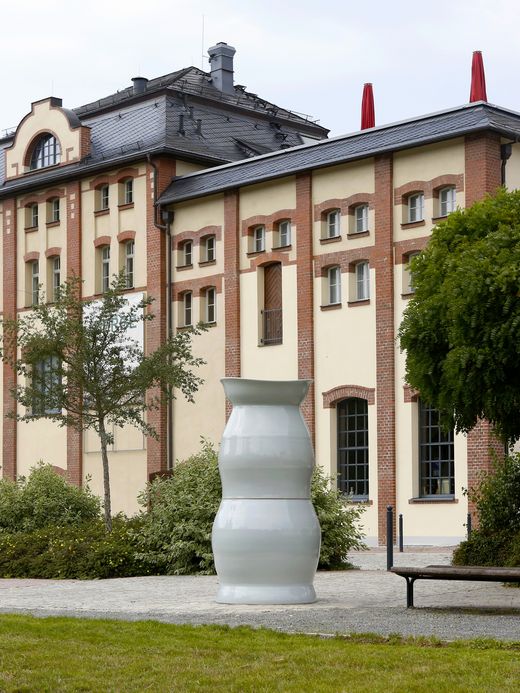
The artist Uli Aigner, born in Austria in 1965 and now living in Berlin, began her magnum opus One Million in 2014, creating it with just her bare hands and a potter’s wheel. The artist, who completed a pottery apprenticeship and then studied product and digital image design, collaborates with others and draws on dialogue to create a wide variety of porcelain vessels, ranging in size from tiny to gigantic. Aigner carves a sequential number into the moist clay on each of her Items, 8000 of which have been produced so far, and fires the porcelain with a transparent glaze. Once complete, each piece is added to the overall project. A world map on the artist’s website shows the locations of her exhibits, and the ever-changing designs are listed in a global archive.
These two monumental pieces from the series, numbered 3501 and 3502, were created in 2019 in collaboration with potters in Jingdezhen, China – the world capital of porcelain and formerly the hub of production for the legendary Ming dynasty. Weighing around 800 kilograms, Item 3502 was unable to withstand the forces of nature and collapsed during the manufacturing process. The apparently broken item was included by Aigner alongside its “intact” counterpart in the One Million series, representing different forms of existence under her “Porcelain Code”.
Lößnitz followed the example of the mining towns of Schneeberg and Aue-Bad Schlema. The entrepreneurial Schnorr family from Schneeberg mined cobalt as early as the seventeenth century. The St. Andreas Zeche Weiße Erde (St. Andrew’s White Earth Mine), a source of kaolin (Sprungmarke: Cluster 3), the raw material for the “white gold” of porcelain, followed in 1708. Until this point, the ruling houses of Europe had imported fine porcelain from China, but in 1710, the first Meissen porcelain factory was established. The Erzgebirge provided the base material for Meissen porcelain (Sprungmarke: Cluster 3), which was then decorated in blue, in line with the Chinese fashion.
(Text: Alexander Ochs / Ulrike Pennewitz)
Uli Aigner
One Million Item 3501 and 3502
Material: Porcelain
Size: 1,00 m x 2,40 m
During the winter months, the artwork is covered and therefore unfortunately not open to the public.
Set up with the support of the town Lößnitz.
Address:
Old Schwartz Steam Brewery
Niedergraben 11
08294 Lößnitz
to the location on Google Maps
There is a lot to discover at the PURPLE PATH! Experience tips presented by the Tourismusverband Erzgebirge e.V.
↗Recommendations for Uli Aigner's ‘One Million Item 3501 und 3502’


White gold.
Lößnitz: mining town since 1382
Due to increasing ore discoveries in the 14th century, Lößnitz was declared a mining town in 1382. One historical site that can still be visited today is the Reichenbachstolln visitor mine in Kuttengrund. From 1500, miners extracted silver, copper, galena and arsenopyrite here.
The ore raw materials were processed in the nearby smelting works. Arsenopyrite, for example, was needed for the processing of nickel and was produced in the neighbouring Niederpfannenstiel blue paint works from 1720 to 1927. This belonged to the entrepreneurial Schnorr family from Schneeberg. Lößnitz was thus firmly integrated into the supply chains of the Schnorr empire in the Westerzgebirge.
Veit Hans Schnorr the Younger was a major entrepreneur of his time. As the owner of numerous mines, hammers, smelters and blue paint works, he acquired the rights to the "Weiße Erden Zeche St. Andreas" in Aue, a neighbouring town of Lößnitz. From 1700 onwards, kaolin had been discovered there while searching for ore. A lucrative coup, as it soon turned out. The mineral became the basic material for Meissen porcelain.
Lößnitz' stone with tradition: black slate
In the middle of the 19th century, slate mining was an important industry in Lößnitz, Affalter, Dittersdorf and the surrounding area. The leading company was the "Sächsische Schieferbruch-Compagnie". It built "Spellhütten" (splitting huts) in which the slate was split and processed. One such hut was once located where the nature hostel with room for 30 guests stands today. Slate can still be seen on many buildings today, including the Lößnitz art church of St George and the cemetery.
Kaolin: from Schnorr's clay to Meissen porcelain
The Saxon Elector Augustus the Strong was fascinated by the idea of being able to produce his own porcelain. Chinese porcelain was all the rage and, as a luxury item, brought not only artistic enjoyment but also high profits in trade. It was also an attractive source of income for the state, which Augustus wanted to see in Saxony.
The fathers of Meissen porcelain: Tschirnhaus, Böttger and Schnorr
The Elector commissioned Ehrenfried Walther von Tschirnhaus and Johann Friedrich Böttger to research the recipe and process of porcelain production. Originally, Böttger, an alchemist, was to attempt to convert other ores and metals into gold. After many trials and errors, the first European porcelain was successfully produced in 1709. the Meissen Porcelain Manufactory was founded in 1710.
The question now arose as to which raw material would be best suited to the recipe found. Augustus the Strong ordered kaolin samples to be taken from all over Saxony and the Ore Mountains and brought to the Meissen manufactory. The tests revealed that the kaolin from the "Weiße Erden Zeche St. Andreas" mine in Aue was of the best quality. As a result, mine owner Veit Hans Schnorr the Younger was granted the kaolin monopoly for the "Schnorrsche Tonerde" by the Elector in 1711.
St George's Hospital Church in Lößnitz becomes an art church
The first documented mention of a hospital chapel in Lößnitz dates back to 1283. Over the centuries, several fires destroyed it in the town. The people of Lößnitz rebuilt their hospital church again and again. Most recently, again after a fire, the church was rebuilt in 1858-61 in the neo-Gothic style. The church's roof, covered in black Lößnitz slate, is striking. This traditional building material can be found on many buildings in the region.
A dedicated group of parishioners and creative minds led by cemetery manager Ralf Günther now want to transform the church into an art church. Cemetery, town and cultural history as well as art exhibitions form the beginning. The many culturally and historically significant gravestones made of Lößnitz slate are remarkable. A material that still symbolises the identity of the town today.
Makerhub Lößnitz: a new think tank
The former dairy farm (Marktplatz 14, 08294 Lößnitz) has been extensively renovated and is now a Makerhub. As a project of the Capital of Culture Chemnitz 2025, it is one of eight Makerhubs being built around Chemnitz. The thematic focus of the Makerhub Lößnitz is future technologies and media expertise. The vision of the dedicated people around the Makerhub is to create a place in Lößnitz where innovative products are developed from ideas and where digital technologies are tested and learnt. The centre offers a platform for communication and exchange as well as networking between schools, art, companies and creative people.
City of apple trees: new project launched
Lößnitz has a long tradition of orchards and avenues. With the apple project, the organisers around initiator Anja Markert want to plant new apple trees in all districts of Lößnitz and preserve existing fruit trees. Tree sponsorships from private individuals, children's facilities or companies are intended to promote this. In October 2023, the 1st Lößnitz Apple Market was held to raise awareness of the project, among other things.
Max Jankowsky: Press tool construction for world-class cars
The Lößnitz foundry is a company that could not be more typical of the Ore Mountains: Tradition since 1849 in the foundry trade, developed as a downstream industry of mining, family business in its 3rd generation. Anyone who thinks that this is a "dirty industry" is very much mistaken. The foundry is located in the centre of the town, surrounded by greenery, and is highly accepted by the people of Lößnitz thanks to its very high environmental standards.
The customer list reads like a who's who of the automotive industry: Aston Martin, Bentley, BMW, Daimler, Lamborghini, Porsche. "World-class cars are born here in the Ore Mountains," says Jankowsky proudly. Each car requires thousands of tonnes of castings for press tools, which are used to shape all the body parts. These castings are produced in Lößnitz and then finalised in toolmaking companies such as Porsche Werkzeugbau, Pockauer Werkzeugbau Oertel and AWEBA Werkzeugbau in Aue.
With the kind support of the Sparkassen-Finanzgruppe