Via Lewandowsky: Television / All weather
Burgstädt

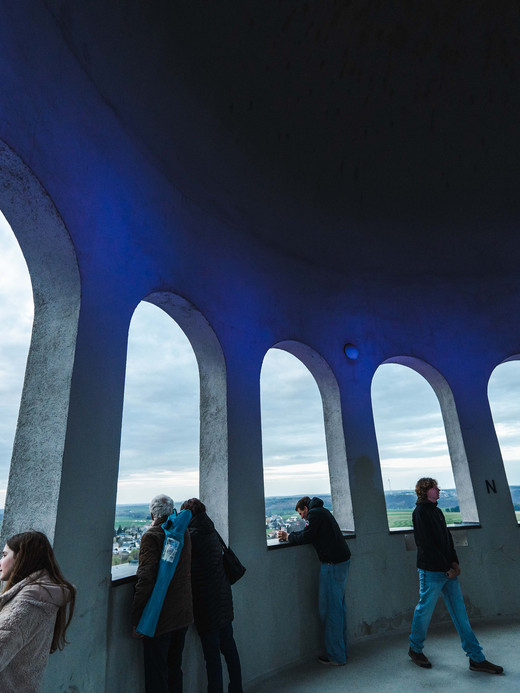
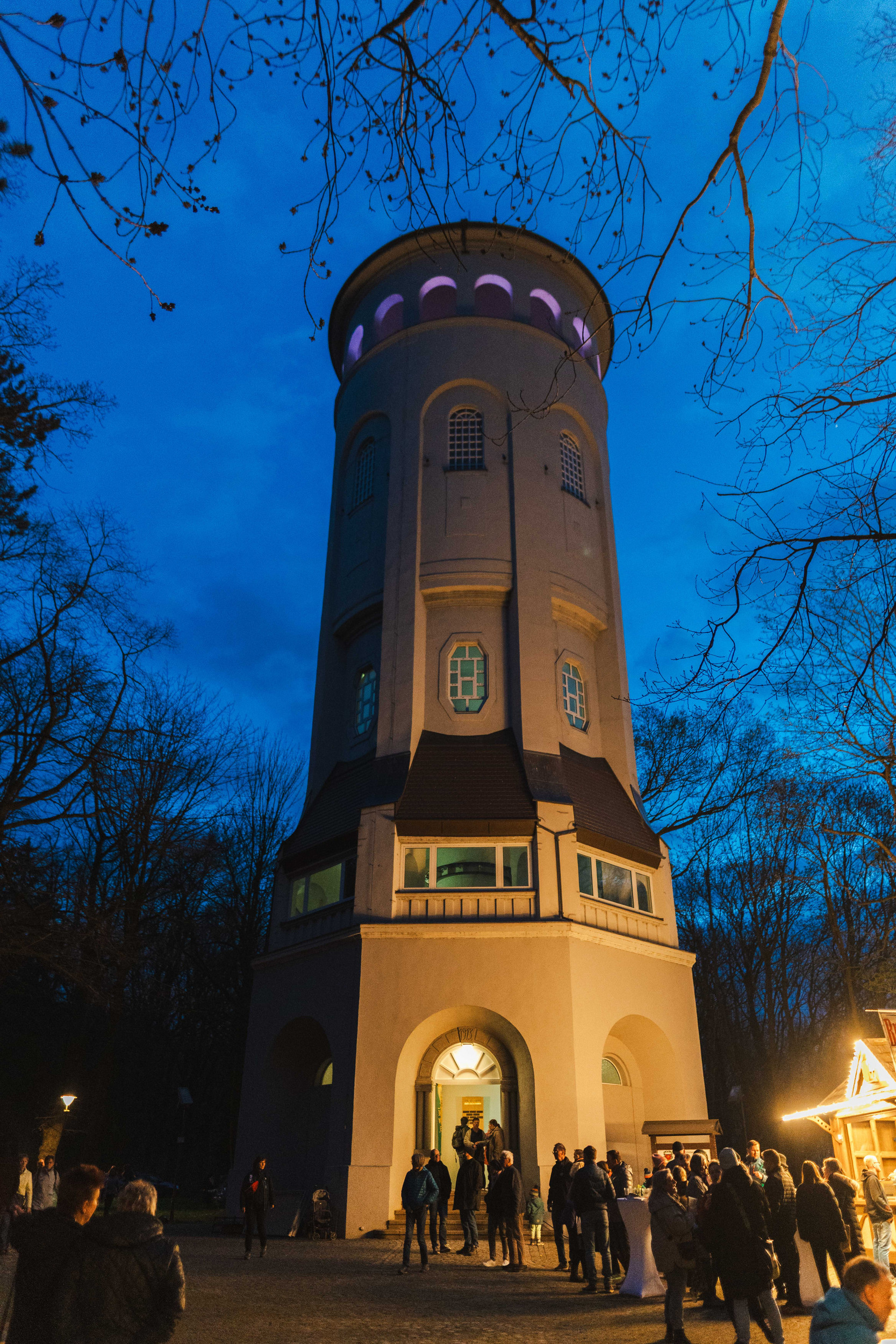
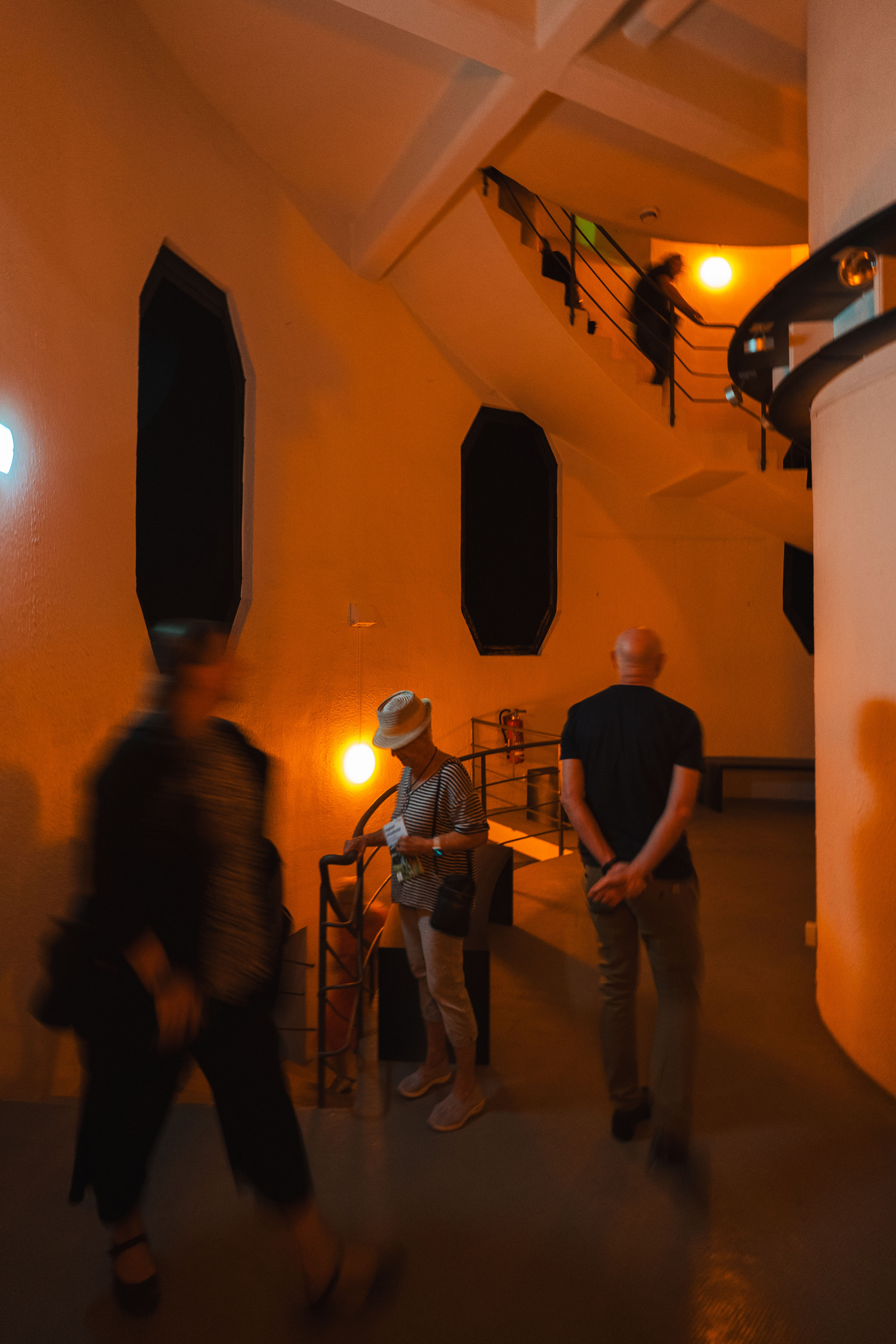
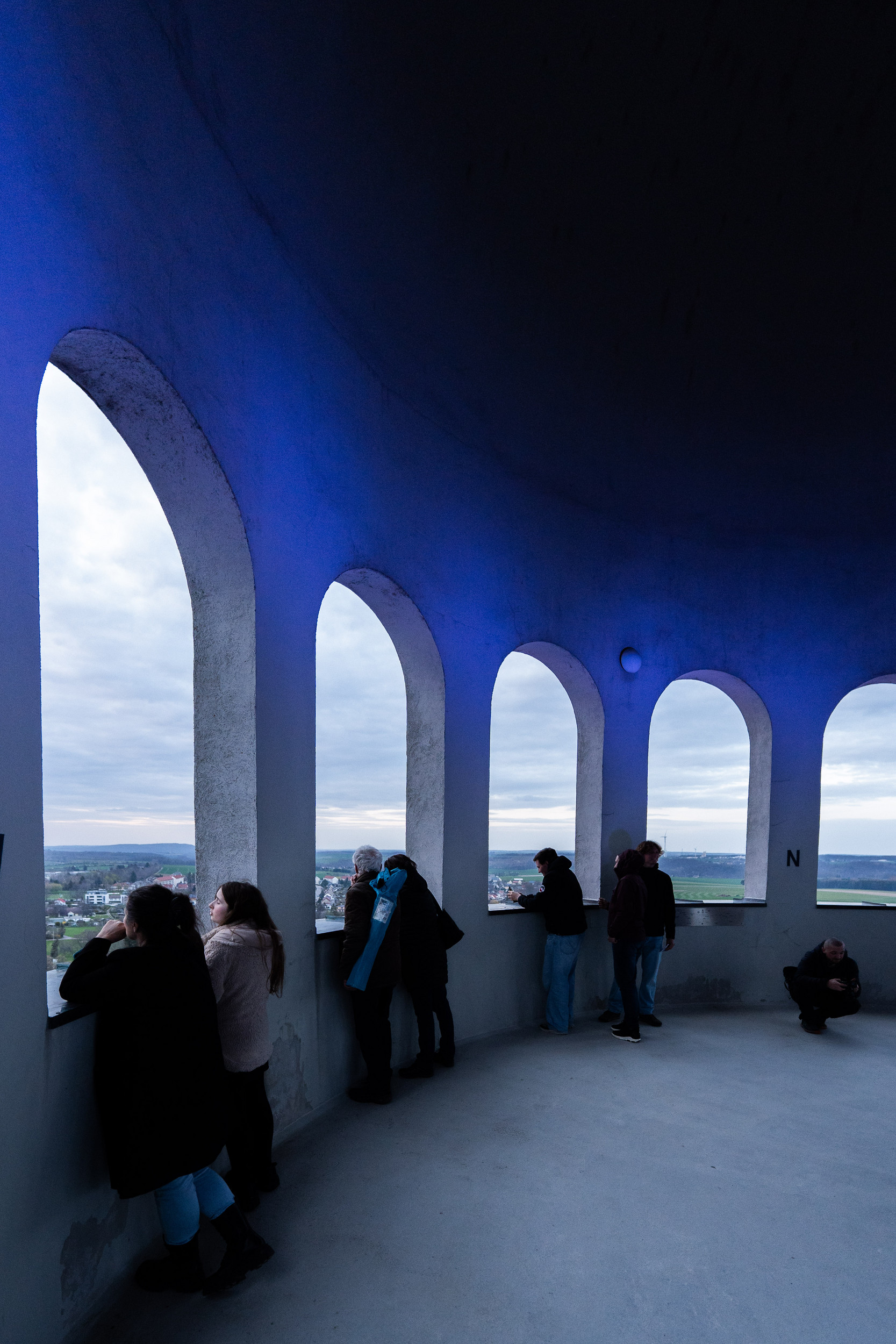
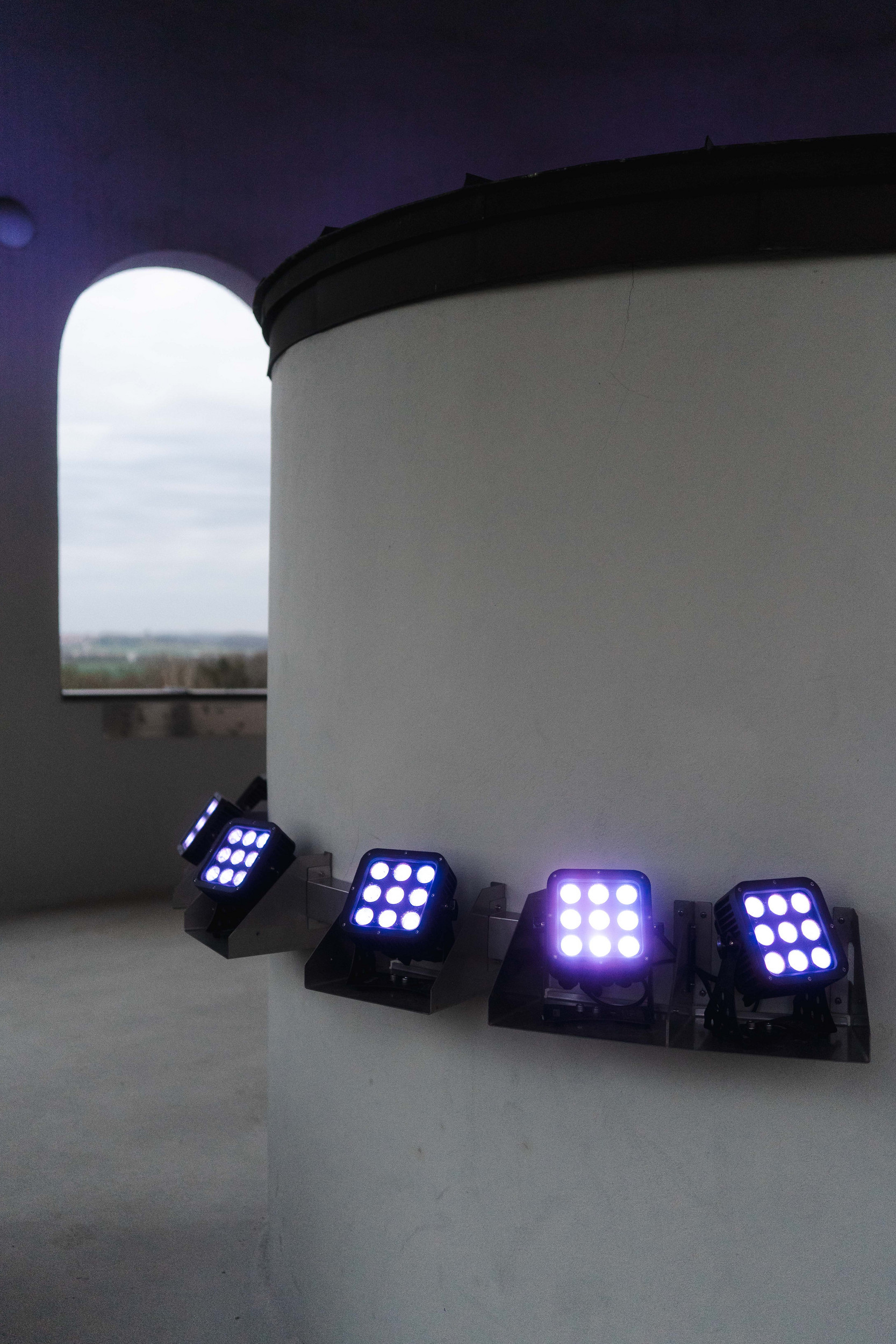
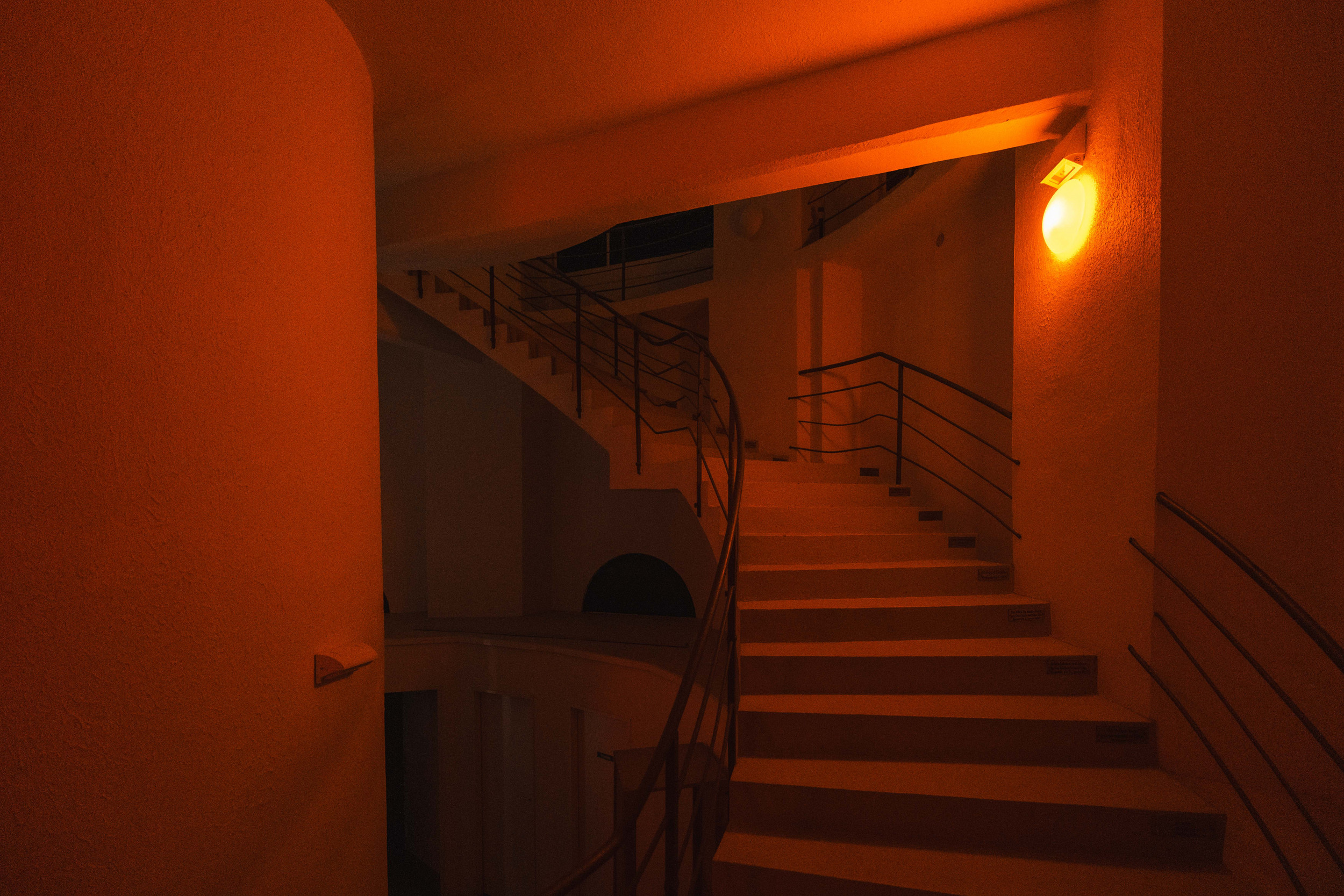
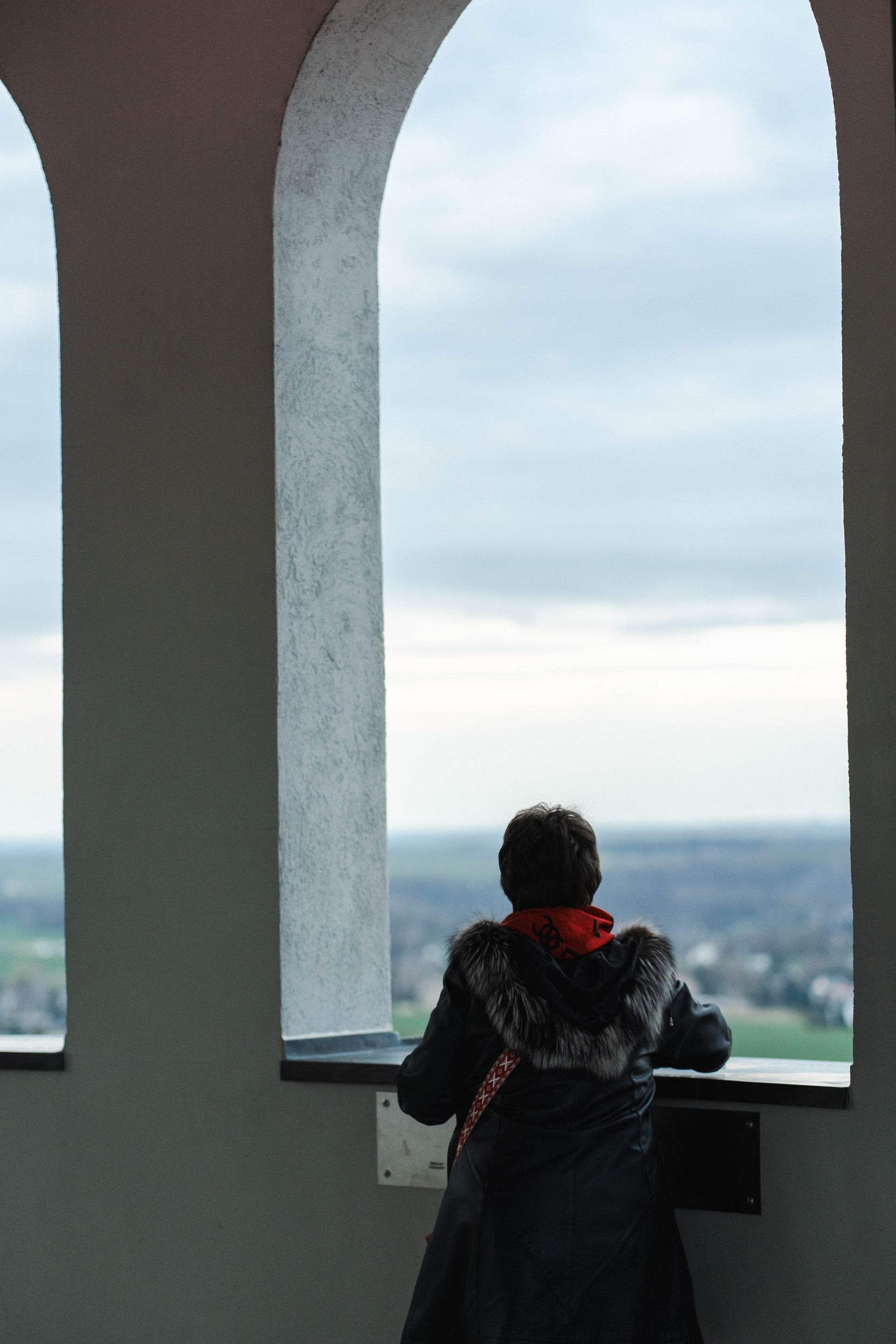
At night, coloured, irregularly pulsating light can be seen flickering from afar from the upper room of the dark Taurastein Tower, which was built in 1912 as a lookout and water tower in Burgstädt. The flickering light from the tower's 16 arched windows was generated by multimedia artist Via Lewandowsky, who was born in Dresden in 1963 and now lives in Berlin, from sequences of feature films and documentaries that can be suggested via the website. Reduced to average values of colour temperature and brightness, at night 16 LED lamps emit a medial weather glow across the treetops of the Wettin Grove that is detached from the filmic narrative. During the day, the light installation is transformed by a sound collage. A four-digit numerical code, which is randomly generated on a display above the entrance to the tower, conveys a mysterious message to visitors as they enter the tower. The climb up the 163 steps into the lantern room is accompanied by coloured light and sounds: Sometimes it grumbles and trickles quietly, sometimes it thunders and cracks loudly. The sounds penetrate from a brick and tiled water tank, which was used as an elevated reservoir until 1996 and is now empty, via eight channels into the 39 metre high tower. The artist recorded and technically modified them underground in the former tin mine of the Ehrenfriedersdorf show mine, one of the oldest mining sites in the Erzgebirge mining region, some 40 kilometres away. They are now reflected in sound above ground at the height of the tower.
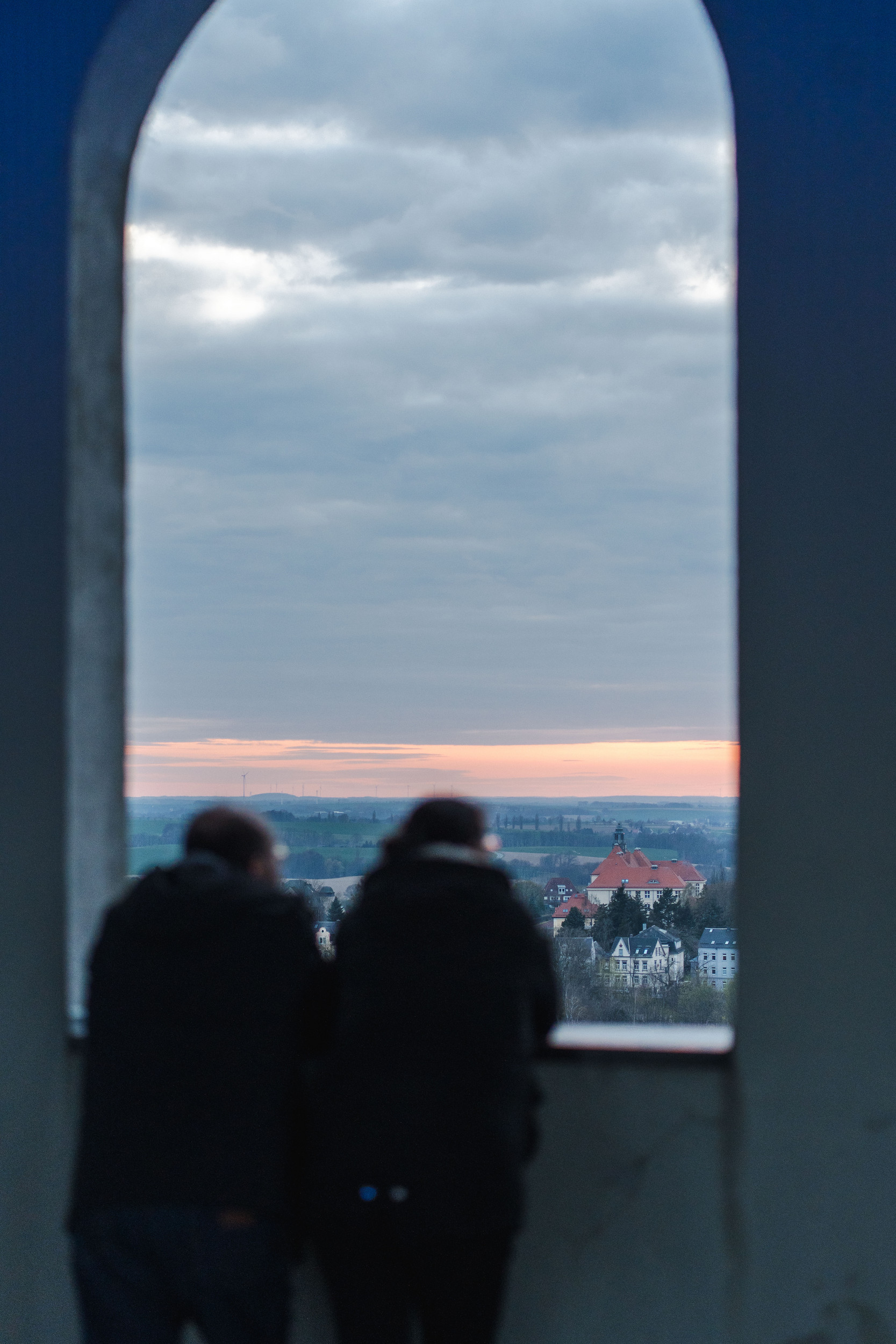
Lewandowsky's site-specific and conceptual light-sound installation is itself to be understood as a kind of spatialised film that can be experienced via many channels, levels and paths when entering the tower, climbing the steps, "watching television" from the viewing platform and also when looking at the flickering light at night. Stories and history, places and times of regional and media history are interwoven in such a way that the structure of sound and light creates an almost organic whole that communicates from head to toe and with all the senses of the visiting guests in the elongated body of the Taurasteintum.
(Text: Alexander Ochs / Ulrike Pennewitz)
Via Lewandowsky
Fernsehen (2025)
In Burgstädt, Taurastein Tower
↗ Aktueller Film auf fernsehen.chemnitz2025.de
Film suggestions can be sent to fernsehen(at)vialewandowsky.de.
Set up with the support of the town of Burgstädt.
Tuesday to Sunday
11:00 a.m. to 4:00 p.m.
Closed on Mondays
Pre-booked visits outside opening hours and registration for guided tours are possible at:
Tel.: 01725277907
Email: taurasteinturm@stadt-burgstaedt.de
Further information on the ↗ website
Address:
Taurastein Tower
Am Taurastein 5
09249 Burgstädt
to the location on Google Maps
With the installation Alle Wetter , Via Lewandowsky's intervention at the Taurastein Tower in Burgstädt is being expanded into an immersive experience that can be visited during the day when the tower is open.
The light installation Fernsehen / Wetterleuchten has been visible above the treetops of the Wettin grove at night since April. From a distance, it looks as if someone is watching television high up in the tower - in fact, it is a local and international, participatory "television channel" that gives everyone the opportunity to share personally meaningful films with each other.
With Alle Wetter, the multimedia artist, who was born in Dresden in 1963 and now lives in Berlin, has developed the tower into a Gesamtkunstwerk. Upon entering, visitors are greeted by an enigmatic light panel and the ascent up the 163 steps is accompanied by pulsating sounds and colours. Sometimes it trickles and crackles softly, sometimes it thunders and crashes, it feels as if it is coming from far away and yet your own body also resonates.
The sounds come from the former tin mine of the Ehrenfriedersdorf show mine, around 40 kilometres away, one of the oldest mining sites in the Erzgebirge mining region. Recorded underground and technically alienated, they are reflected upwards in the tower: an echo from the depths that can be experienced anew here at lofty heights.
The Taurastein Tower, built in 1912 as a water and observation tower, has always been more than just a functional building. Strengthened from the outset by civic engagement, it has a special atmosphere with its strangely wide interior spaces and almost maritime feel. Via Lewandowsky takes up this peculiarity, contrasting and exaggerating it at the same time. In this way, the tower (according to Ulrike Pennewitz) becomes a "spatialised film" in which stories and history, light and sound, mountain and sea, personal experience and artistic intervention merge.
All weather wants to be experienced with all the senses, always ready for a friendly, ironic self-reflection - a touching experience that takes in the tower from the foundations to the dome.
Burgstädt - a town of flavours
The name and origins of Burgstädt are quickly explained: it was established as a market town in the 13th century on the land of seven farms that belonged to the rule of the Rochsburg Castle belonged. The castle lies to the north of the town in the valley of the Zwickauer Mulde and is now a popular destination for excursions. Today, the former textile town, which is only 15 kilometres from Chemnitz and connected to the City railway is part of the district of Central Saxony.
From the 18th century onwards, weaving, spinning and dyeing dominated people's work and lives. The main products were once cloth gloves, which were produced in great variety and numbers. The Leipzig-Chemnitz railway line brought the town an upswing from 1872, which lasted for many decades. With the structural change after 1990, the textile industry disappeared and instead a medium-sized economy characterised by trade, crafts and industry has successfully established itself.
The Taurastein Tower: landmark, viewing tower, art gallery
The history of Burgstädt's landmark is also linked to the milestones of this economic development: the Taurastein Tower. The 39 metre high landmark of the town towers over the Wettinhain, a park with ponds and fountains, an open-air stage and adventure playground. built in 1889 as a wooden observation tower during the Wilhelminian era, it has been a centre of attraction for the people of Burgstadt ever since.
in 1913, it was rebuilt in stone and converted into a water tower. With the construction of a modern drinking water network after German reunification, the Taurastein Tower lost this function, was renovated and reopened in 1997 as a viewing tower and gallery for art exhibitions. From the platform at a height of 28 metres, visitors can enjoy a beautiful view of the landscape.
To help finance the restoration, the 163 steps of the tower were symbolically auctioned off to Burgstadt residents. Since then, other campaigns and art events have raised funds for ongoing maintenance. Due to its history and the close connection people have with their Taurasteintrum, it made sense to also make it a waymark on the Purple Path on the Purple Path. Via Lewandowsky installed his artwork 'Seele', a light and sound installation, here.
Tasteful & cultivated: International gourmet festival Burgstädt 2025
Another attraction is the annual gourmet festival in Wettinhain (15 September 2024). The event runs under the motto "Culinary delights, show cooking and live music". As part of the European Capital of Culture Chemnitz, it will take place in September 2025 as the International Gourmet Festival. Restaurateurs and traders will present regional and international cuisine. The German-French Society Chemnitz e.V. also supports the cause of international encounters.
Also taking part are the Burgstädter Nudelmanufakturthe Reinhardt coffee roastery and the Chocolate manufacturer Choco Del Sol at Rochsburg Castle.
Making the future: A new way to enjoy a city
Handmade & creative: Burgstädter Nudelmanufaktur
Diana and João Grincho are a pair of restaurateurs. They run the "Trattoria da Nino" in Chemnitz. When their Italian restaurant was unable to serve guests for months during the coronavirus pandemic, they had plenty of time to think about the future. A long-cherished idea matured in their minds for weeks and was now within reach: a pasta factory.
The Grinchos have lived in the Burgstadt neighbourhood of Taura for over 20 years. New commercial space had been created here in the community centre. They were the first new tenants to move in and open their pasta factory. Using sustainably produced ingredients from the region, Diana and João create classic pasta such as spaghetti, fusilli and tagliatelle. More and more creative shapes are being added, e.g. hearts, rabbits and even regional landmarks such as Kriebstein Castle.
To enjoy these pasta works of art, the range naturally also includes tasty sauces and high-quality oils - all of which are also produced in-house. The products are available in shops, online or in the local Manufaktur shop.
Gentle & sustainable: Reinhardt coffee roastery
The company history of owner Maik Reinhardt began in 1991 with the founding of a service company for commercial kitchens and coffee machines. Over the years, the range of brands serviced has grown. Manufacturers and customers came to trust his craftsmanship, so that sales were also added. Since 2001, he and his 10-strong team have even been providing customer service on river cruise ships.
There was only one thing missing from this extensive spectrum for the family business: coffee. in 2013, the time had come and Maik Reinhardt set up the coffee roasting plant. The Burgstadt-based company now refines many varieties from 40 coffee-growing countries around the world. Roasting is mainly the job of son Jan Reinhardt. He takes his time, because the gentler the roasting, the better the quality.
Maik Reinhardt is increasingly buying the raw materials directly from farmers in South America and Asia in order to guarantee the best quality and fair trade in the long term. There are also 15 types of coffee on sale that are certified organic, as well as 10 varieties that have been certified by the Rainforest Alliance. These coffee beans grow on farmland that must not be enlarged by clearing trees.
Happy & fair: Choco Del Sol
Those who set out to discover new horizons see the world with different eyes. This is how the story of Peggy and Patrick Walter's chocolate factory began - with a bicycle tour around the world. In Central America, they encountered the centuries-old cocoa tradition of the Maya and their descendants. This inspired them to buy this original, non-industrially processed cocoa directly from the farmers and import it to Germany.
The high-quality cocoa is used to make Choco Del Sol at Rochsburg Castle choco Del Sol at Rochsburg Castle produces chocolate that Peggy and Patrick promise will simply make you happy. You can enjoy these products piece by piece with a clear conscience, because the ingredients are fairly traded, processed with love and combined in a deliciously flavoursome way. The Walters are looking forward to presenting their chocolates at a major event in 2025: As part of the European Capital of Culture Chemnitz, from 1 to 3 August 2025, the Euro Bean Chocolate Festival will take place.
Unique monument: Rochsburg Castle
The 800-year-old Rochsburg Castle stands on a high rocky spur above the Zwickauer Mulde. The medieval castle complex with outer bailey and main castle is still preserved, although the buildings were remodelled in the late Gothic (15th century) and Renaissance (16th century) periods. It is considered one of the most important architectural monuments in Saxony due to its dual appearance as a medieval castle and Renaissance palace. The architectural elements made of red Rochlitz porphyry tuff are a striking design feature.
Once upon a time, the fortunes of Burgstädt were also controlled by its rulers, the von Schönburg family. Today, Rochsburg Castle is a popular excursion destination in the region. Situated in a fantastic river landscape, it offers a museum worth seeing (furniture, art, crafts and 1000 years of fashion history), an architecturally richly decorated castle chapel and great events and concerts throughout the summer.
Rochsburg Castle can also be reached on foot from Burgstädt via a beautiful hiking trail. It starts in the listed old town centre at the market square, leads across the forest cemetery, fields and through the romantic Brausebach valley to the Zwickauer Mulde.
→ Tip: Hike from Burgstädt to Rochsburg Castle (8 km)

With the kind support of the Sparkassen-Finanzgruppe