Wilhelm Mundt: Trashstone 689
Freiberg

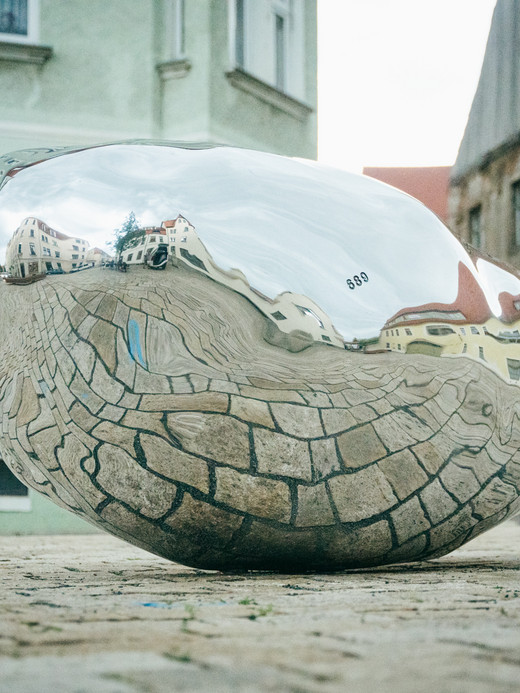
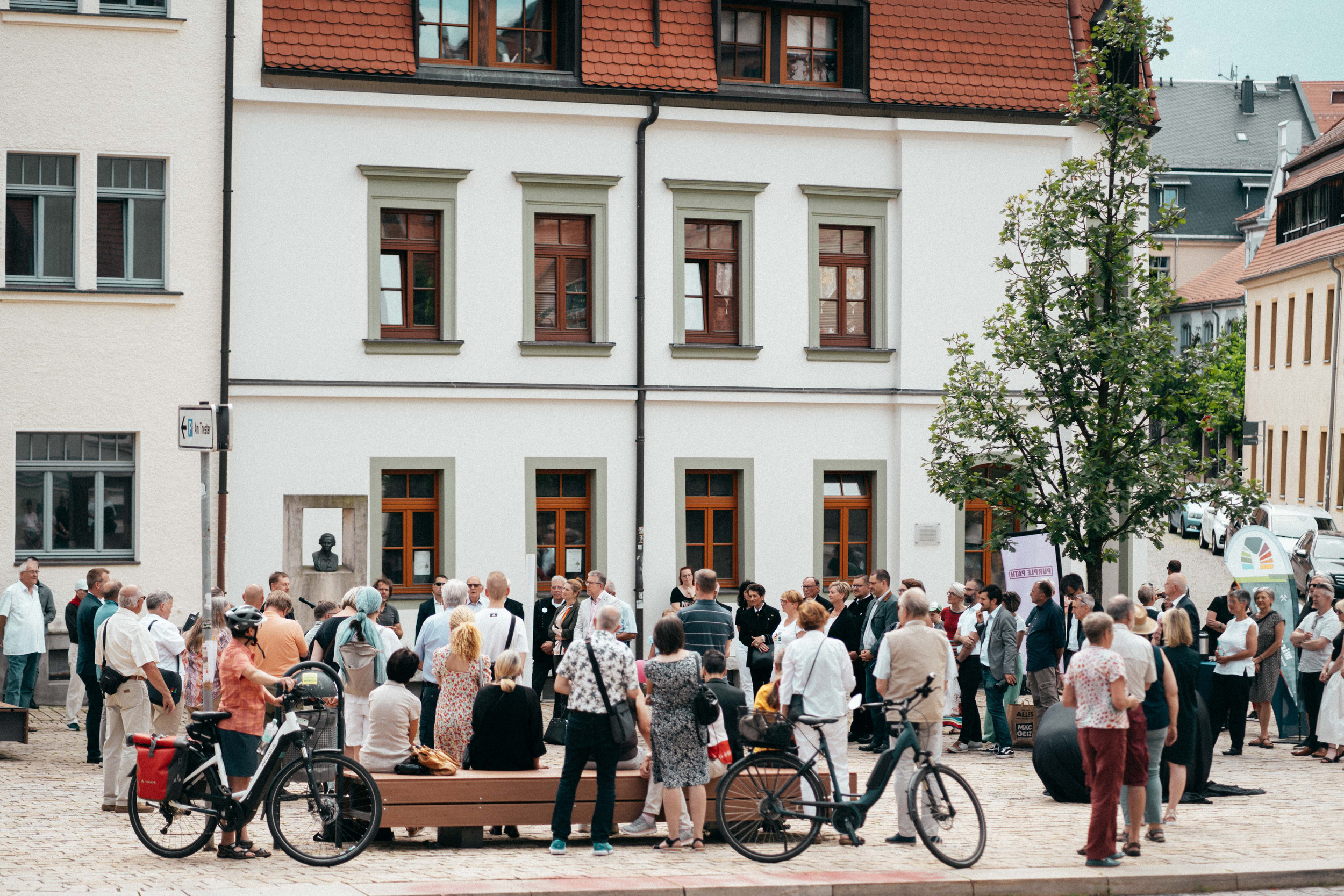
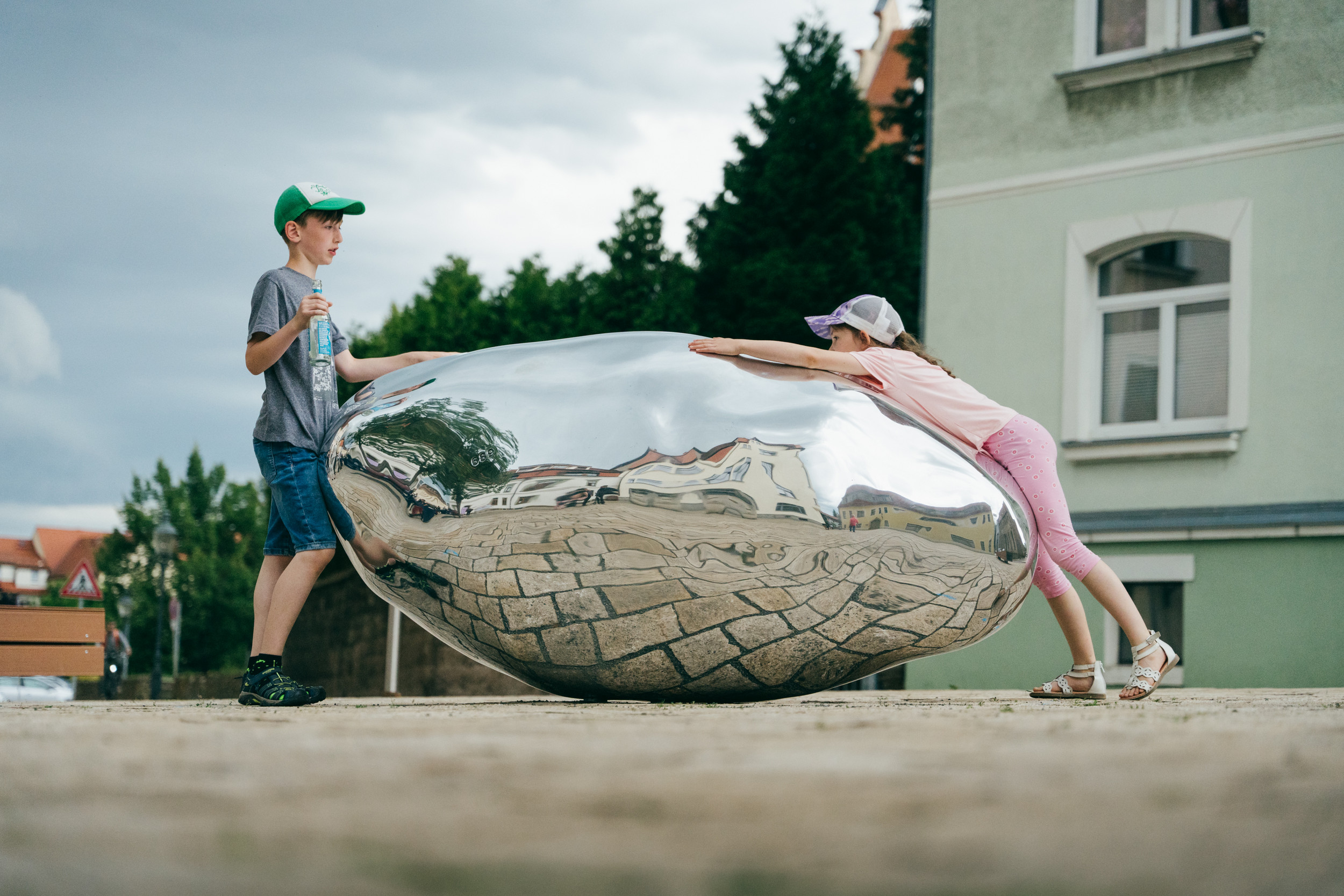
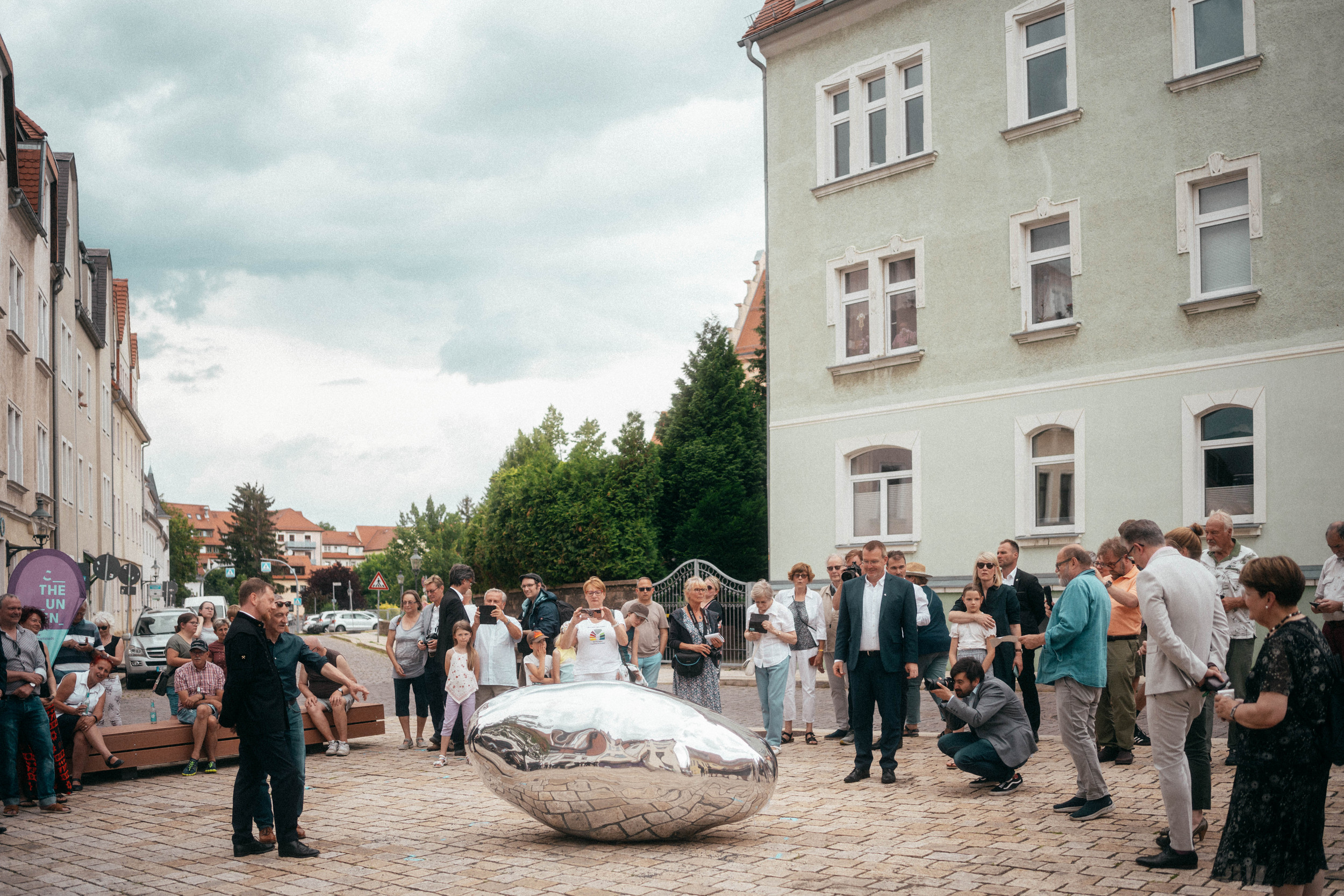
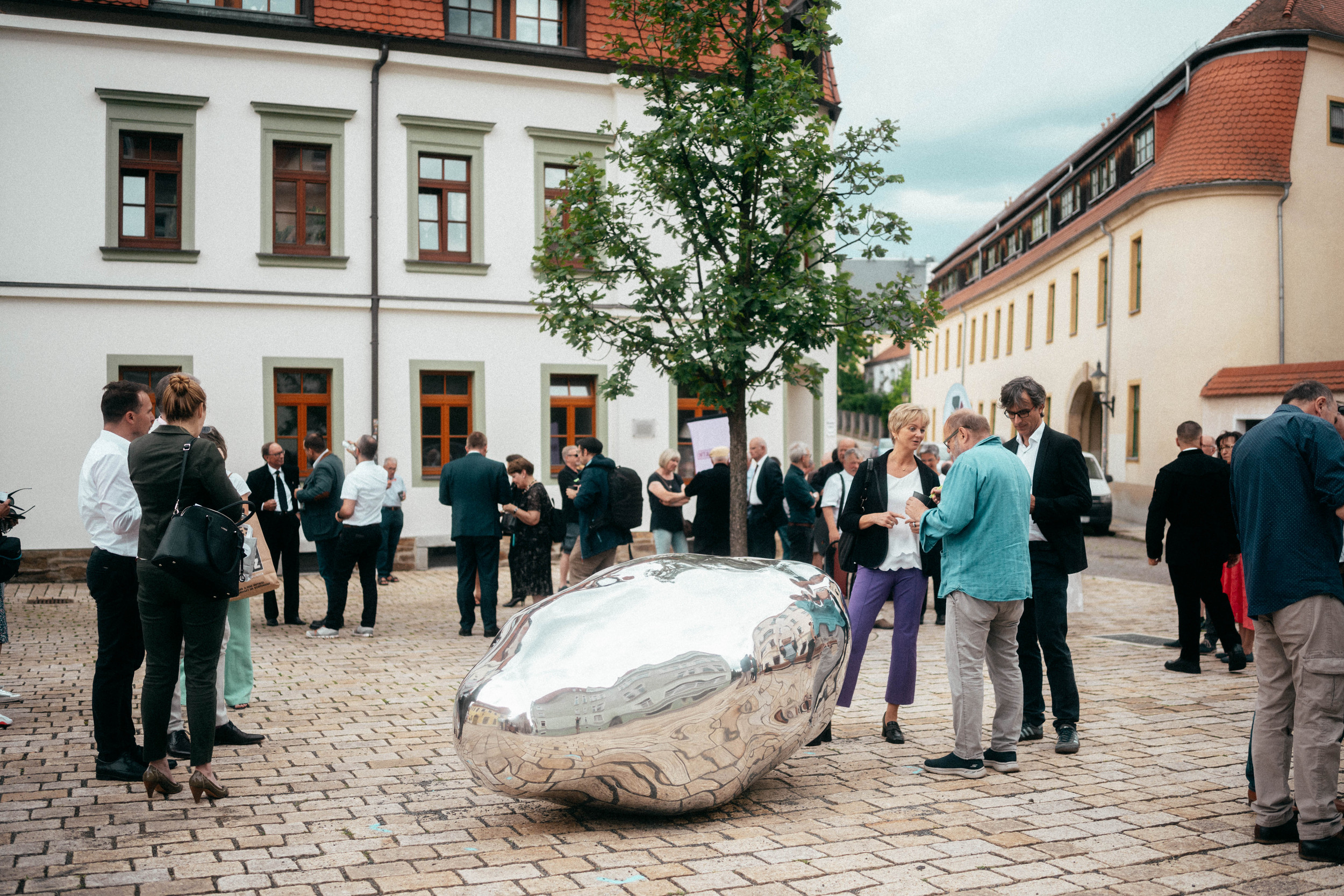
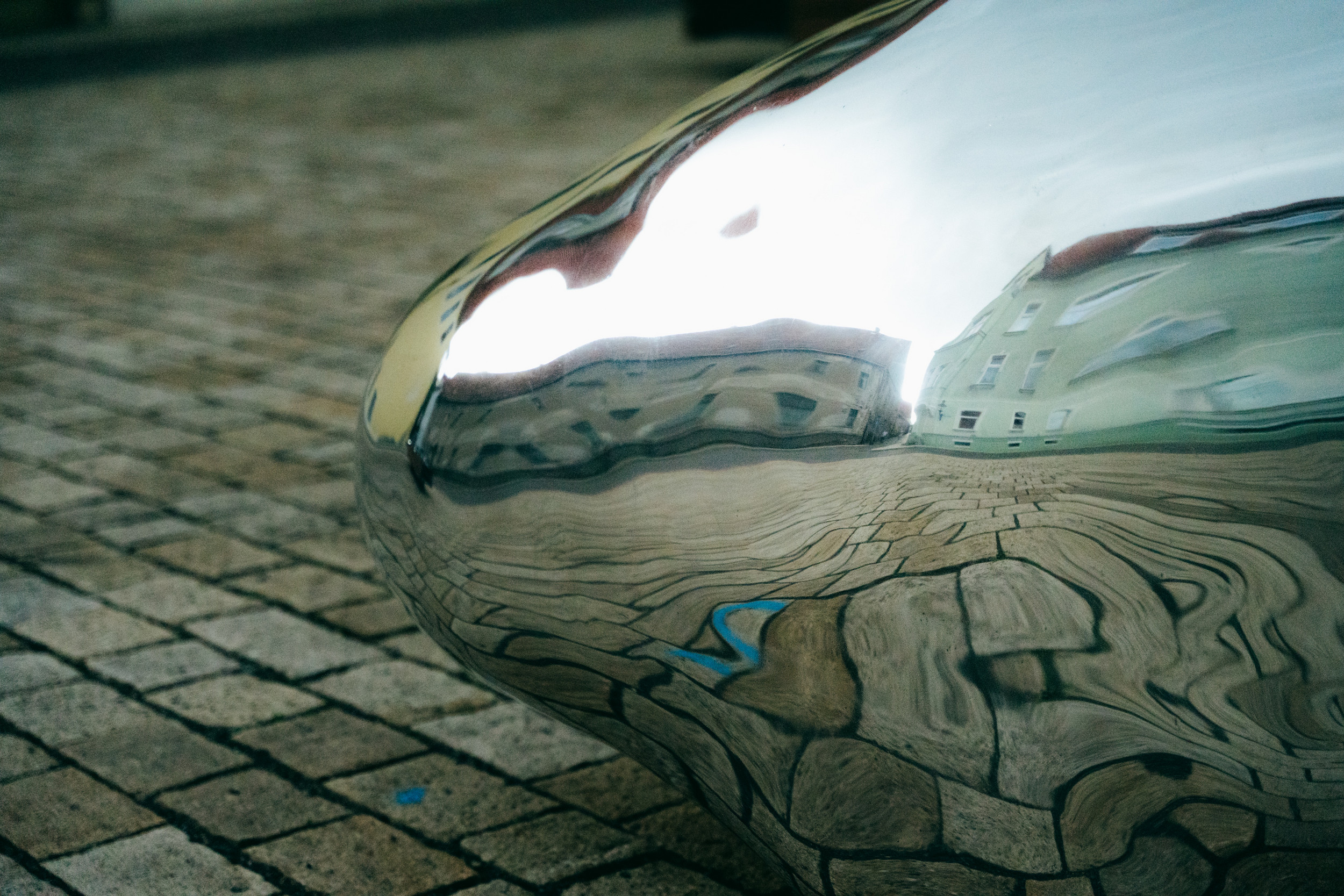
A silver lump lies erratically on Freiberg's Lomonossowplatz like a glacial relic. The sculptor Wilhelm Mundt, who was born in Grevenbroich in 1959, works in Rommerskirchen and teaches at the Dresden University of Fine Arts, has placed one of his iconic sculptures from the Trashstone series in the silver city. The elegantly reflective aluminum surface of the sculpture encloses a hermetic inner world, which, according to the artist, consists of production residues from the studio, but remains hidden from the viewer.
In the processes of visually scanning the amorphous forms and reflecting on the objects inside, the sculpture reflects its surroundings and allows the viewers, who see themselves in its surface as in a distorting mirror, to become involved actors. Alongside the experience of form and material on site comes the knowledge of the transformation of waste into art. What exactly is enclosed inside the sculpture remains its secret and thus creates a myth about its existence. Mundt's Trashstone is reminiscent of the early silver discoveries in the mining region around Freiberg, which triggered the “Great Mining Scream”, the “Gold Rush of the Erzgebirge”, in 1168. In addition to new settlers, silver mining also brought artists, writers and scientists such as Novalis, Alexander von Humboldt and Mikhail Vasilyevich Lomonosov to a town with a new liberal self-image. The miners were exempt from compulsory service and taxes. Both are still reflected in the name of the town today: Freiberg.
(Text: Alexander Ochs / Ulrike Pennewitz)
Wilhelm Mundt
Trashstone 689
In Freiberg, Lomonossow-Platz
Material: Aluminum production residues
Size: 1 x 2 x 1 m
Set up with the support of the town of Freiberg.
Adresse:
Lomonossow-Platz
Corner Färbergasse / Nikolaigasse
09599 Freiberg
to the location on Google Maps
There is a lot to discover at the PURPLE PATH! Experience tips presented by the Tourismusverband Erzgebirge e.V.
Freiberg – From the great “mining rush” to the silver rush
In 1168, travelers passing through discovered a lump of silver on the surface of the earth. At that time, there was only forest where the city stands today. The sovereign, Margrave Otto of Meissen from the Wettin dynasty, proclaimed mining freedom and encouraged miners to settle there. The rich silver finds caused a veritable “mining boom,” as it was called at the time, which attracted more and more fortune seekers. People throughout the Ore Mountains were caught up in a veritable silver rush.
Margrave Otto collected a tenth of the silver yields and founded a mint and castle, a predecessor to the Renaissance castle of Freudenstein. Centuries later, Margrave Otto was given the nickname “the Rich” because of the silver discoveries and his financial policy. The settlement, which grew rapidly with the silver rush, became the first Saxon mining town: Freiberg. People from Goslar/Harz, Franconia, Bohemia, and many other regions migrated there.
See the silver city in all its glory
Approximately 80 percent of all silver found in Saxony over more than eight centuries was mined in Freiberg, totaling around 5,500 tons, according to historians. By the standards of earlier times, this was an enormous amount. It brought the margrave and later Saxon elector enormous wealth. Anyone walking through Dresden's old town with its castles and churches or visiting the art collections in the Zwinger and the Green Vault today can see a historical heritage that was created from the wealth of silver mining.
Of course, the citizens of the mountain town of Freiberg also benefited greatly from silver mining. Their houses still bear witness to their financial success and social status today. This glamour of the silver rush can still be admired because Freiberg was fortunate enough not to be destroyed during World War II. Wilhelm Mundt's Trashstone, made of shiny silver aluminum and located in the middle of the old town, could be read as an artistic metaphor for the large quantities of silver and the great “mining boom.”
The magic of the mountain: the Reiche Zeche visitor mine
People, mountains, and silver—this is a very special adventure for visitors to the silver town of Freiberg in the Ore Mountains. For over 800 years, people dug through the hard gneiss of the Ore Mountains in and around Freiberg. They found silver and many other ores and minerals. Anyone who wants to experience this and understand the history can literally get to the bottom of things in a place like Freiberg – above ground in the city as well as underground in the mine.
Beyond the precious metal glamour, working in the mines was a merciless, hard daily grind for generations of miners to earn their bread. Dust-filled air made breathing agonizingly difficult. Persistent dampness from the deep water that constantly seeped from the rock crevices wore down clothing and skin. Day in and day out, work was carried out in oppressive confinement and the eternal, fearful darkness of the tunnels.
Today, visitors can easily walk through the tunnels, protected by rubber boots, protective suits, and helmets, to explore the interior of the mountain. The “Reiche Zeche” visitor mine is only a few minutes' drive from the center of Freiberg. Until 1969, up to 2,000 miners worked here and in neighboring shafts.
Today, 14 kilometers of tunnels are still accessible, and tours last between 1.5 and 5 hours, depending on the theme. The cage descends to a depth of 150 meters, opening up a strange and exciting world. But the mine is not just for tourists; it is a fully functional research and teaching mine for the Freiberg Mining Academy, a technical university. orschungs-und Lehrbergwerk der Bergakademie Freiberg, einer Technischen Universität.
Hans Witten's Tulip Pulpit: St. Mary's Cathedral
St. Mary's Cathedral in Freiberg is an outstanding monument of Romanesque and Gothic architecture. Its “Golden Gate” (13th century) is considered the first figurative portal in German art history, created according to the French model. Other highlights include the miners' pulpit and concerts on the organ built by the famous organ builder Gottfried Silbermann.
Hans Witten's tulip pulpit is one of the most unusual works of art from the late Gothic period (around 1505). Created from Hilbersdorf porphyry tuff, the pulpit grows free-standing like plant tendrils from the ground and is reminiscent of a communion chalice in its overall form. It is believed that Master Hans Witten immortalized himself in one of the supporting figures, with stylistic elements of a miner (underground miner).
Works of art by Hans Witten on the Purple Path: “Beautiful Door” (St. Annen in Annaberg-Buchholz), “Magdalene Relief” and “Our Lady of Sorrows (Mary)” (both Schlossbergmuseum Chemnitz) and “Pillar of Flagellation” (Schlosskirche Chemnitz).
Another pulpit in Freiberg Cathedral, where religious sculptures are complemented by miners' figures, is the Miners' Pulpit (1638 by Hans Fritzsche). The pulpit basket is carried by a miner, the stairs by a foreman (supervisor in the mine).
Altars to kneel before: Contemporary art in St. Mary's Cathedral: Michael Morgner
On Ash Wednesday 2023, as part of the PURPLE PATH Capital of Culture project, Chemnitz-born artist Michael Morgner (*1942) covered the altar of Freiberg Cathedral with a large Lenten veil (10.0 x 5.00 m). “I had the idea of displaying this huge cloth in a huge hall where it would be gently moved by the breeze,” said Morgner during the installation.
In 1977, Morgner founded the artist group and producer gallery CLARA MOSCH (1977–1982) in Adelsberg, a district of Karl-Marx-Stadt/Chemnitz, together with Carlfriedrich Claus, Thomas Ranft, Dagmar Ranft-Schinke, and Gregor-Torsten Schade. Their art found no recognition or place in the official art world of the GDR. Their actions attracted attention not only in the art scene, but also from the Stasi. They were spied on, but all the threats and intimidation could not curb their boundless and sometimes subversive creativity.
The soundtrack of the Purple Path: Gottfried Silbermann
In 1711, a man arrived in Freiberg who, purely by chance, had silver in his name and whose work made Freiberg internationally famous in the world of music. That was the year Gottfried Silbermann opened his organ workshop at Schlossplatz 6. Today, the Silbermann House is home to the Silbermann Society, the tourist information office, and a small museum dedicated to the work of Central Germany's most famous organ builder.
The Gottfried Silbermann Society has been preserving the legacy of the world-famous Saxon organ builder since 1990. It keeps the fascination of the Silbermann organ alive with concerts, excursions, conferences, and a wide range of projects for children and young people. Since 2010, the president has been Albrecht Koch, a native of Dresden, who has also been the cathedral cantor at St. Mary's since 2008 and is the artistic director of the renowned Silbermann Days and the International Gottfried Silbermann Organ Competition.
Thirty-one of Silbermann's original 50 handcrafted and musical organ masterpieces are still preserved in the region. Silbermann's decision to settle in Freiberg was, of course, influenced by the mining industry. Here he could buy high-quality metals and good wood for his instruments, as well as find skilled craftsmen. Visitors can gain an impression of his work from the reconstruction of an organ workshop in the Silbermann House.
But visitors can best experience the fascination of the organ as an instrument live at one of the many concerts, such as the evening music in Freiberg Cathedral. It takes place every Thursday at 8:00 p.m. Artists from all over the world come to the city especially for this event and then let the 2,674 pipes, ranging from 1 centimeter to 4.50 meters in height, resound melodiously.
The cathedral organ is considered one of the most famous Baroque organs in the world and is Silbermann's greatest work of art. For musicians, it is an honor and a privilege to be allowed to play this fantastic instrument; for every music lover, it is a musical delight when this unique instrument fills the entire cathedral with clear, powerful tones. Other Silbermann organs on the Purple Path can be found in: St. Peter's Church in Freiberg, St. James' Church in Freiberg, St. George's Church in Glauchau, and the town church in Oederan.
The world's oldest municipal theater: civic culture in Freiberg
In 1790, Johann Gotthelf Engler, a master cutler from Freiberg, initiated the construction of a civic theater. Until then, the world had only known theaters built by aristocratic patrons in their residences. But then Engler acquired a town house on Buttermarkt. And since then, the stage has been at home here. This makes it the oldest municipal theater in the world. Among other things, the first opera by the barely 14-year-old Carl Maria von Weber, “Das Waldmädchen” (The Forest Maiden), premiered here in 1800.
The inscription on the entrance façade of the building reads: “Art belongs to the people.” Although this quote originally comes from the communist Lenin, it is read in a different context today. Civic engagement, openly accessible art, and democratic culture are also central values of the European Capital of Culture Chemnitz 2025.
Innovations in the Ore Mountains mining region: polymaths, romantics, geniuses.
Ore mining landscapes: silver, tin, cobalt, uranium, iron
Silver, tin, cobalt, uranium, and iron represent the five ore mining landscapes that characterize the UNESCO World Heritage Site Ore Mountains/Krušnohoří mining region. Each one gives visitors an insight into mining and processing in different eras and illustrates their significance from a global perspective.
From Freiberg to the world: Mikhail V. Lomonosov (1711–1765)
Looking to the future of mining and technologies for extracting and processing raw materials has always been part of life here in Freiberg. The city was not only at the cutting edge of its time, but also a pioneer in scientific and technological developments. That is why the mining town always attracted the best minds. Among them was the Russian polymath Mikhail V. Lomonosov. As an envoy of the Academy of Sciences in St. Petersburg, he came to Freiberg in 1739 for ten months, where he worked in the laboratory of mining engineer Johann Friedrich Henckel, focusing primarily on metallurgical chemistry, mine surveying, and mineralogy.
This stay had far-reaching consequences for science in Russia: Lomonosov went on to have an impressive academic career. Today, he is considered the co-founder of the sciences of metallurgy, geology, and chemistry in Russia. The University of Moscow bears his name in his honor. Lomonosov died in 1765, the year the Freiberg Mining Academy was founded. Just a few years later, in 1773, a mining institute modeled on Freiberg was founded in St. Petersburg. This gave rise to today's National University of Mineral Resources “Gorny” St. Petersburg.
The universal scholar: Alexander von Humboldt (1769–1859)
On June 14, 1791, a 21-year-old man enrolled at the Mining Academy who, in the course of his later research career, would establish himself as one of the greatest scholars of the first half of the 19th century: Alexander von Humboldt. Within eight months, he had eagerly studied the fundamentals of natural sciences and mining. It is also reported that he inspected several mines in Freiberg. In addition, Humboldt undertook geological and mining excursions to the Eastern Ore Mountains and Bohemia. In Freiberg, he invented what is now known as the “Humboldt light holder,” a mine lighting device that continues to emit light even when there is a lack of oxygen underground. This brought him full circle to the Freiberg school of thought, which is based on the trinity of education, research, and application.
After his time in Freiberg, he became a mining assessor in the state of Prussia in 1792 and found employment in the mining district of Naila, Bad Steben, and Wunsiedel, places that today belong to the state of Bavaria. He worked here for several years. It was not until 1797 that he resigned from this position to become a private scholar and explorer. He is probably best known for his great expedition to South, Central, and North America (1799-1804). In addition to regional studies and botany, his main focus was on geology.
The Romantic: Friedrich Freiherr von Hardenberg (1772–1801)
From Saxony to the world—that is Freiberg's claim. But the mining town did not only delve into the depths of the rock, but also – culturally speaking – into the higher spheres of world literature. Friedrich Freiherr von Hardenberg, the famous Romantic poet, came to Freiberg in 1797. During his stay in the town, he not only studied the mining industry of his time, but also began to write poetry.
It was here in Freiberg that he gave himself his pen name, Novalis. From 1799, as before his studies, he worked at the salt works directorate in Weißenfels an der Saale, about 40 km southwest of Leipzig. In 1800, Hardenberg was a member of a commission that carried out the first geological survey of Thuringia, Saxony's western neighbor.
Shaping the future: a typical mindset in the Ore Mountains
Innovation and a sense of tradition, openness and immigration have always ensured the survival of the Ore Mountains mining region. All of this is evidence of many transformation processes that date back far into history and, in some cases, continue to this day. The region has always been in flux. People came and went with the economic ups and downs, reinvented themselves culturally, and developed crafts and technology. This is still the case today.
Bio-Mining: Prof. Michael Schlömann
Freiberg is home to the world's oldest university specializing in mining science: the Technical University (TU) Bergakademie Freiberg. This proud, tradition-steeped educational institution celebrated its 250th anniversary in 2015. But despite their conscious efforts to preserve their diverse traditions, the researchers in Freiberg are primarily focused on the future. The focus is on topics such as energy transition, resource transition, and sustainability.
Bio-mining is one of the key topics being researched here. At the Freiberg Biohydrometallurgical Center for Strategic Elements, Prof. Michael Schlömann and a large team are investigating ways of extracting germanium and indium using bacteria. Both metals are in high demand in communications technology and are usually found in very low concentrations in various ores.
The wondrous world of minerals: Terra mineralia
Freiberg has a lot to offer in terms of superlatives, both above and below ground. Not only its glorious history, but also its recent past contributes to this. For just a few years now, Freudenstein Castle has been shining with the brilliance and colors of very special works of art created by nature: the “terra mineralia” mineral collection. To this end, private donor Dr. Erika Pohl-Ströher brought her life's work, approximately 80,000 mineral specimens, to Freiberg. 3,500 of the most beautiful specimens from all over the world are on display.
Visitors embark on a mineralogical journey around the world. One can only marvel at the variety of crystals that have formed in the earth over millions of years. Young and old alike can learn all kinds of interesting facts about the importance of minerals in human life in the information areas. Together, “terra mineralia” in the castle, the Mineralogical Collection Germany in the Krüger House, and the Geoscientific Collection of the TU Freiberg represent the largest mineralogical exhibition complex in the world.
The tour of terra mineralia ends in the vault, the treasure chamber. The magnificent specimens in the collection, primarily large mineral specimens and unique items from around the world, are stored in a Renaissance vault. Here, visitors will also find a very small but very special exhibit: the delicate silver curls from Brand-Erbisdorf near Freiberg. This is a very rare crystalline form of the precious metal. Thus, the mineralogical world tour brings us back to the origins of the Freiberg silver rush.
It doesn't take much to spend several hours in “terra mineralia” and be enchanted by the eternal beauty of precious stones. The breathtaking aesthetics of the crystals make you forget to look at your watch.
The collector: Erika Pohl-Ströher (1919-2016)
Her passion for collecting developed out of love for her homeland and in memory of her grandparents Franz and Marie Ströher. They founded the Wella company in Rothenkrichen/Vogtland in 1880, which is now a leading global cosmetics group. The family had emigrated from Bohemia to Saxony as early as the 17th century. In 1945, the family was forced to leave their home in the Vogtland and Ore Mountains region because some of their factories produced armaments and employed forced laborers.
Erika Pohl-Ströher lived in the Federal Republic of Germany and Switzerland. Until 2003, she held a 23% stake in Wella AG in Darmstadt, which she then sold for €818 million. She donated her collections, which include Terra mineralia as well as wooden toys and folk art in the Manufaktur der Träume Annaberg-Buchholz, on permanent loan.