Annaberger Impuls II
Oederan

Wood and stone: artistic creation in the Ore Mountains and Central Saxony
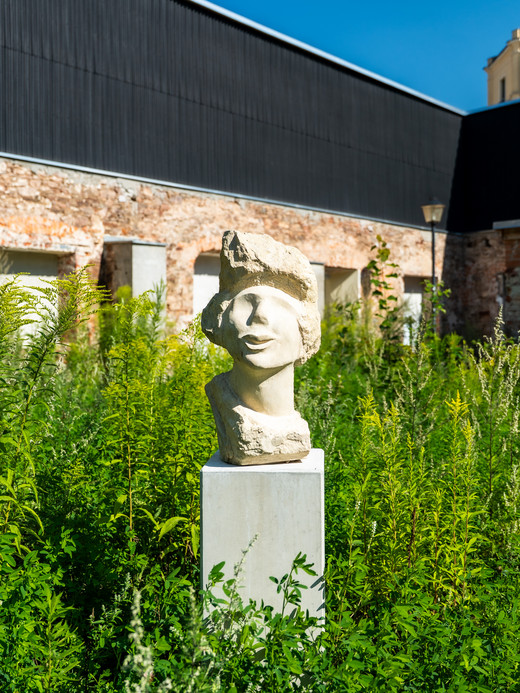
Some of them have known each other for decades, the crème de la crème of artists from the Ore Mountains and their Czech friends. They work across disciplines, in different media and materials. As the Annaberg Network, they curated sculptures for two exhibitions. You can experience works made from traditional materials, wood and stone.
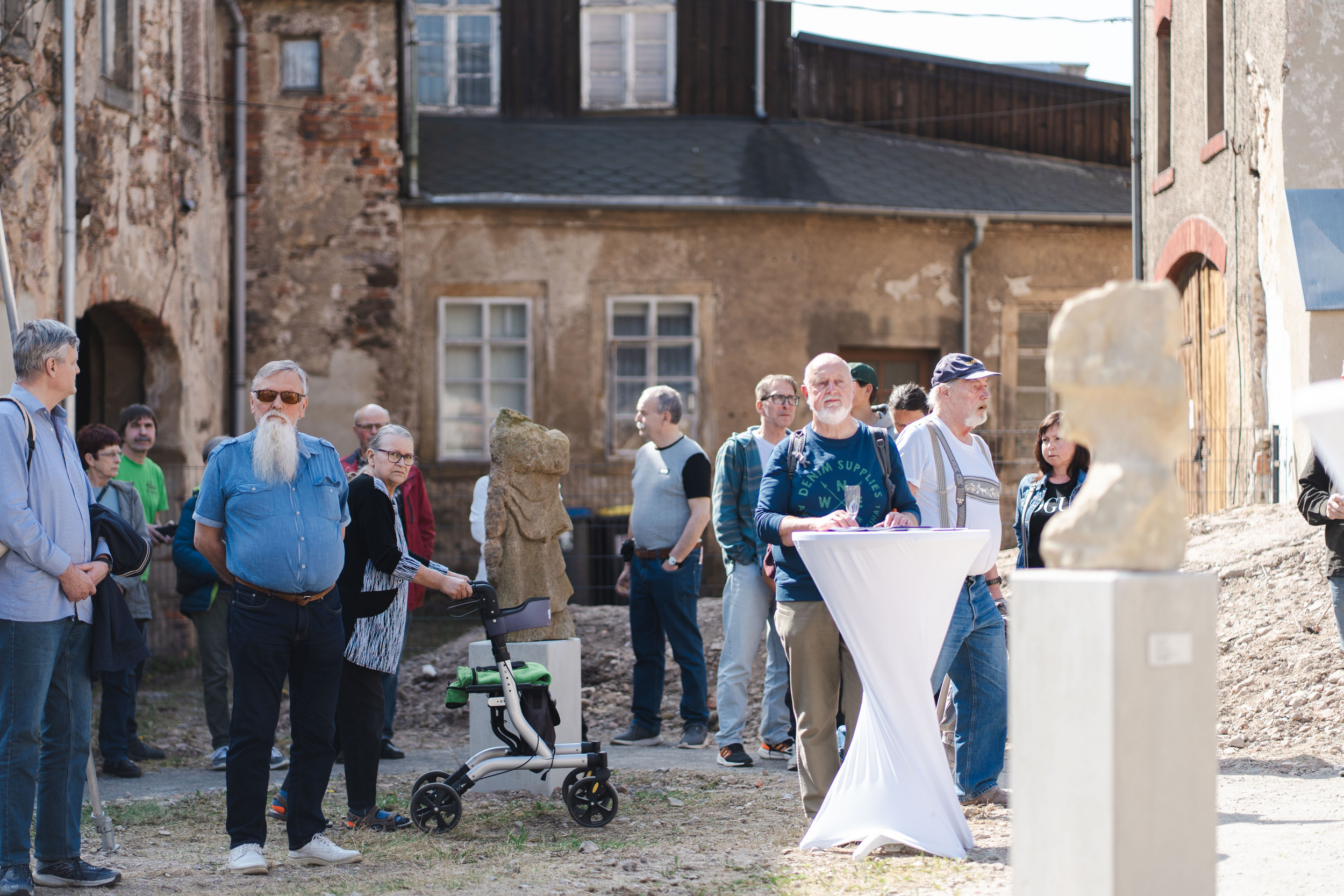
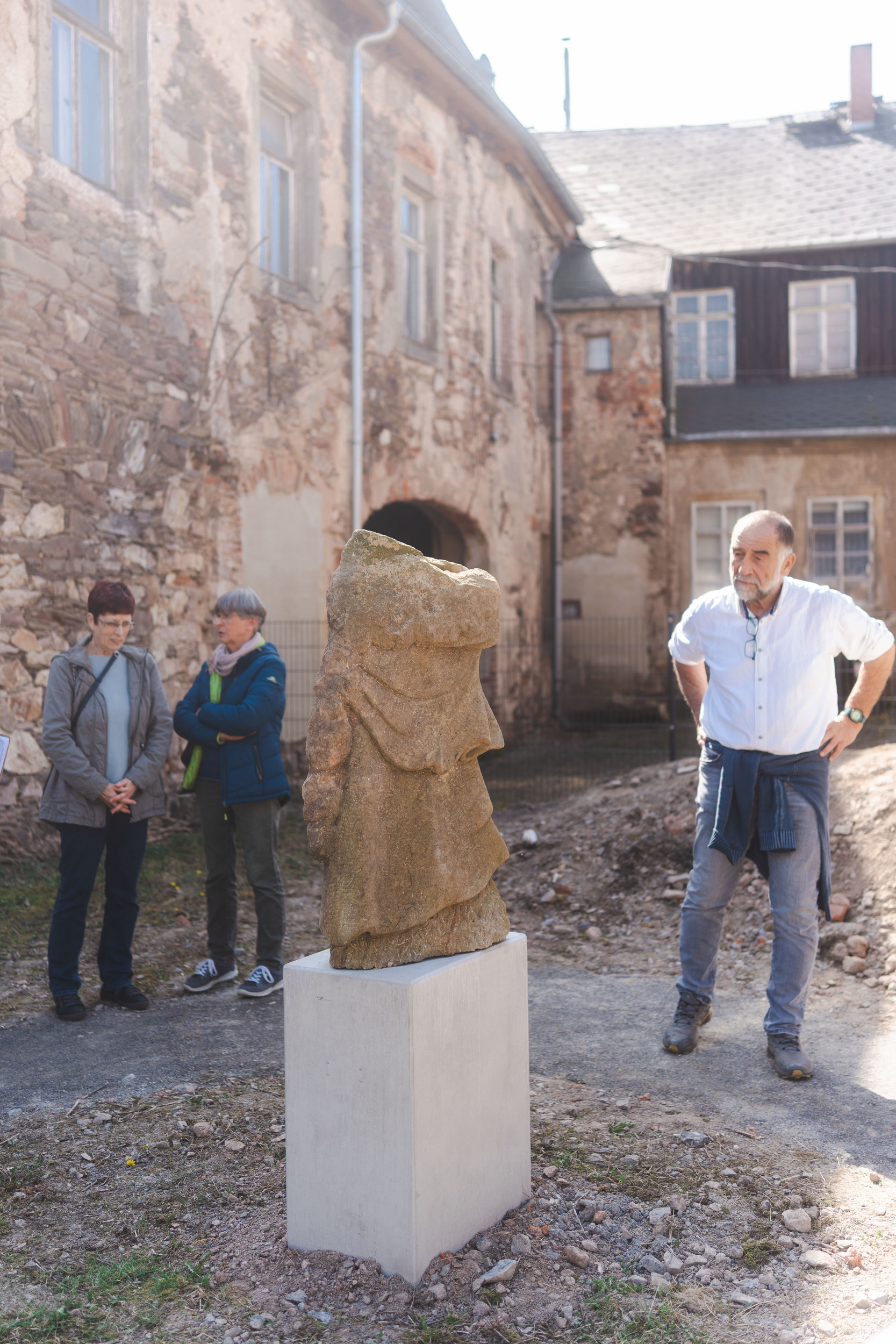
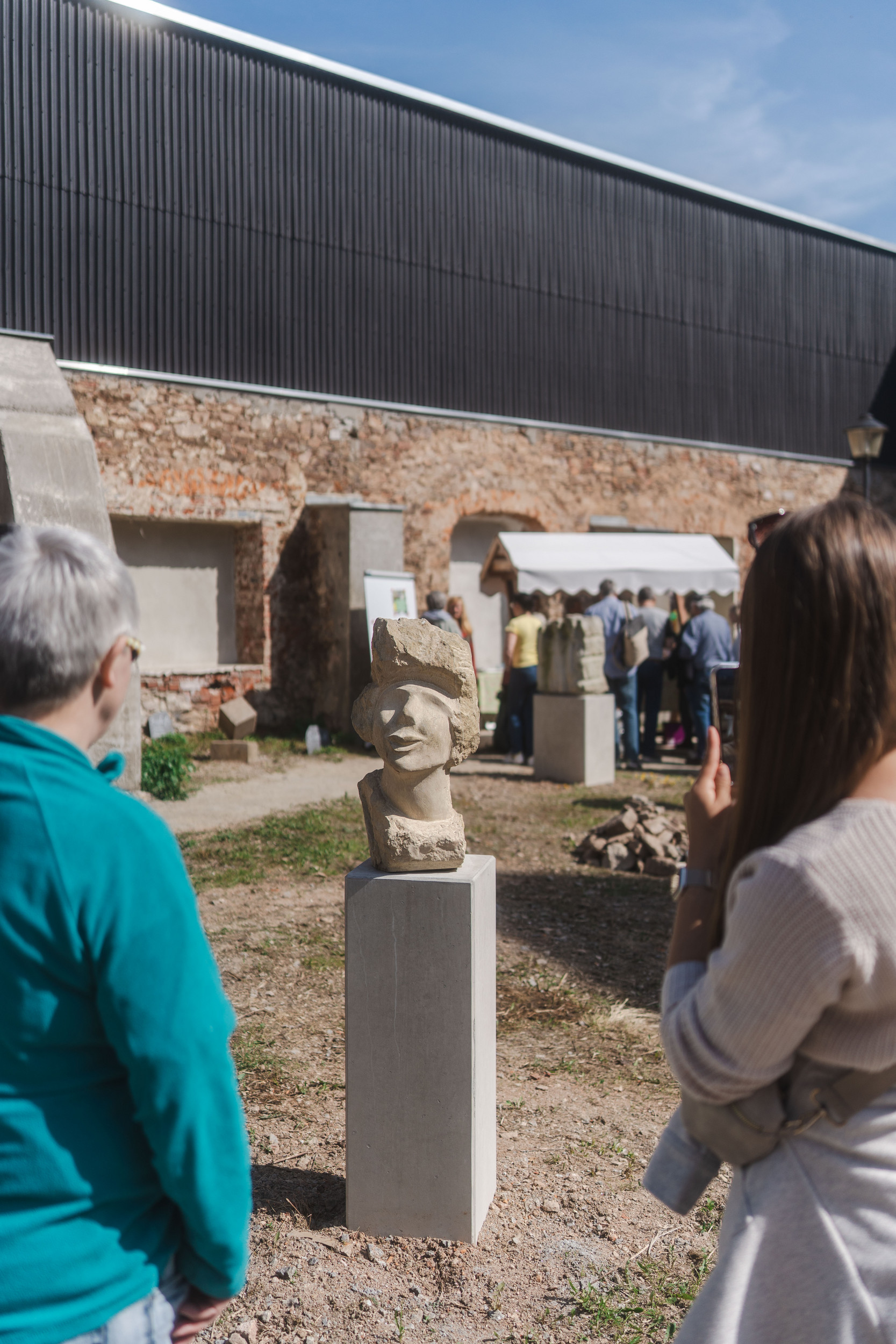
The sculpture symposium "Annaberger Impuls II" was part of the PURPLE PATH art and sculpture trail in 2023. Its narrative, "Everything comes from the mountain", also applies to the Saxon sandstone that the German and Czech sculptors used for the sculptures in the "Drei Schwanen" courtyard and in the historic centre of Oederan.
Taking part in Oederan are: Milan Bezaniuk, Paul Brockhage, Rolf Büttner, Kurt Gebauer, Steffi Getzlaff, Petr Hladký, Marcel Kabisch, Jitka Kusová Valevská, Adam Rybka, Wilfried Runst, Jörg Seifert, Josef Sporgy.
Annaberger Impuls II: Stein
Mit Werken von: Milan Bezaniuk, Paul Brockhage, Rolf Büttner, Kurt Gebauer, Steffi Getzlaff, Petr Hladký, Marcel Kabisch, Jitka Kusová Valevská, Adam Rybka, Wilfried Runst, Jörg Seifert, Josef Sporgy
Material: Sandstein
Aufgestellt durch die Stadt Oederan mit freundlicher Unterstützung von Wildes Oederan e. . und Stadtmarketing Oederan e. V.
Address:
Wild plants park of the Wildes Oederan e.V. association,
Inner courtyard of the former "Drei Schwanen" inn and the historic centre of Oederan.

Oederan - mountain, land and textiles
As with so many places in Saxony, the history of Oederan begins in the 12th century as a village of forest hooves. it was first mentioned as a town in 1282, when mining was carried out here. Although the ore yield was never particularly rich, Oederan was nevertheless granted the privilege of being a free mining town in 1583. This attracted people, but many did not make a living in mining but in the timber industry. This is why folk art from the Ore Mountains is also at home in Oederan. It is still cultivated today in the folk art school.
Oederan was located at the intersection of the medieval trade routes between Halle and Bohemia (north-south) and Franconia and Dresden (west-east). Today, the pilgrimage route Saxon Way of St James runs along the historic Franconian Road. Agriculture continued to characterise the village until the 19th century. The Gahlenz village museum gives a good idea of this.
Clothmaking (documented since 1457) and linen weaving (documented since 1507) developed into the leading trades in Oederan. The town hall at Markt 5, a mighty Renaissance building (1575), still bears witness to their economic success. Both guilds formed the basis for the development of the textile industry in the 19th and 20th centuries. Most of the historic residential buildings in the town centre, for example on Martin-Luther-Platz, also date from this period. The museum DIE WEBEREI at Markt 6 in Oederan provides an insight into this period.
Altars to kneel down to: Neo-Gothic carved altar
The Protestant town church of St Mary's in Oederan is in a prominent location, which means it visually dominates the townscape. Due to town fires and repeated remodelling, the three-nave hall church displays a mix of architectural elements and furnishings from late Gothic (15th century) to Baroque (18th century) and Neo-Gothic (around 1890). The patron saint of St Mary dates back to 1375.
Carved altars were not only created in the Erzgebirge in the heyday of the late Gothic period, but also in the 19th century. The carved altar in St Mary's was created by the sculptor Carl Förster from Leipzig with neo-Gothic stylistic features. The polygonal pulpit was also built by his hand to match. St Mary's is also a stop on the Way of St James.
The Saxon Way of St James and the Vogtland Way of St James run along the medieval Franconian Way through Saxony. Both routes are part of the European Way of St James network, which converges in St Jean-Pied-de-Port in France and leads from there to Santiago de Compostela (Spain). Marked throughout and equipped with pilgrim accommodation, the Saxon path begins in Bautzen and leads along the Frankenstraße through the silver city of Freiberg.
The sound of the Purple Path: Silbermann organ
The organ in St Mary's Church was built by Gottfried Silbermann in 1727 and was originally equipped with 24 stops, but today it has 25 stops with 1,300 pipes. During the neo-Gothic remodelling of the church interior in 1890/1892, the organ received a new case from the Ernst Weißbach cabinetmakers in Dresden. At the same time, the Jehmlich brothers from Dresden replaced two stops, and in 1902/1903 they produced the then contemporary concert pitch. Further restorations were carried out by Hermann Eurle Orgelbau from Bautzen in 1937, 1941, 1968 and 1992/1993.
Jehmlich Orgelbau left its mark on music-making throughout Saxony for more than 200 years. in 1808, the brothers Gotthelf Friedrich, Johann Gotthold and Carl Gottlieb founded the family's organ building tradition in Cämmerswalde in the Ore Mountains. Since 2006, Ralf Jehmlich has been running the company in Dresden in the 6th generation. This makes Jehmlich Orgelbau the oldest surviving organ builder in the world.
People in history: Preserve. Commemoration. Remembering.
The transformation processes in the Central Saxon Ore Mountains are associated with long-term changes in the world of work on the one hand, and with sharp political and social caesuras on the other. In some places in Oederan, the preservation of tradition, coming to terms with the experience of dictatorship and historical remembrance play a particularly important role.
Gahlenz village museum: a private initiative in GDR times
The village museum is a tourist attraction in the district of Gahlenz. The listed three-sided courtyard with its collections has even been recognised as a landscape museum. It originated from a private initiative for the 800th anniversary celebrations in 1982, one of the initiators being Peter Schönfeld, the then chairman of the agricultural production co-operative (LPG). An exhibition was to preserve the village and agricultural history of Gahlenz for future generations.
In 1985, the initiative bought an old farm (dating back to 1653) to make the exhibition permanently accessible. The renovation and conversion into a museum began in the final years of the GDR. A new era began on the farm with the official founding of the local history association in 1991. After the broad participation of many committed people, the museum was opened on 4 July 1992.
The Gahlenz village museum shows rural life, traditions and customs on the historic three-sided farm from 1850 to 1950, including a stable house, the barn, the outbuilding, the garden, a clay oven and the horse-drawn barn. The exhibition focusses on farm work and the associated craft techniques. Several times a year, guests can also experience this live during demonstrations.
The former horse-drawn gin, a machine for generating power, is the location of a work of art on the Purple Path. Polish artist Gregor Gaida installed the Polygonal Horse here.
Gahlenz roots: the artist Igor Mitoraj (1944-2014)
The internationally renowned artist Igor Mitoraj also has his roots in the village of Gahlenz. He was born here in 1944. His mother had been deported here from Poland by the National Socialists as a so-called "foreign labourer". During this difficult time of forced labour, she fell in love with a French prisoner of war. After liberation in 1945, her father returned to France and her mother returned to Poland with her one-year-old son. Igor Mitoraj grew up in Grojec, where his mother came from. The small town is located near the Auschwitz Nazi extermination camp.
From 1963 to 1968, Mitoraj attended the Academy of Fine Arts in Krakow and graduated from the painting class of Tadeusz Kantor. He then went on to study painting and graphic art at the École nationale supérieure des beaux-arts de Paris (National School of Fine Arts). During a stay in South Africa, he discovered sculpture with terracotta and bronze. This creative impulse led Mitoraj to create over 120 sculptures, which have been shown at exhibitions in Europe, the USA and Japan.
One of the main themes of Mitoraj's sculptures is the human body. However, he is not only interested in its natural beauty, but also in its fragility. In his formal language, he explores the deeper aspects of human nature in a variety of ways, attempting to fathom the influence of time and circumstances. In doing so, he often orientates himself on themes from Greco-Roman mythology, but gives them a modern accent. One of his most famous works is the Eros Bendato (German: Der verbundene Eros) on the market square in Krakow.
Jewish forced labourers: Oederan subcamp of the Flossenbürg concentration camp
Like the biography of Igor Mitoraj, Oederan's historical heritage includes the painful story of a women's subcamp of the Flossenbürg concentration camp (Bavaria). In September 1944, the SS deported more than 500 Jewish women and girls from Auschwitz-Birkenau to Oederan. 200 women came from Poland, 150 from Czechoslovakia, 60 from Hungary, others came from the Netherlands, Germany and the Soviet Union.
They carried out forced labour on the site of a former textile factory. The factory produced ammunition. It was part of the Auto Union AG Chemnitz group, where the vehicles of the famous car brands Horch, DKW, Wanderer and Audi were originally produced. The SS evacuated the camp on 14 April 1945, as the Soviet army's front line drew ever closer. An odyssey to Bohemia began for the women. They were finally liberated by the Red Army in Theresienstadt.
Today, there is a memorial plaque at the entrance building of the former subcamp for women.
Making the future: A typical mentality in the Central Saxon Ore Mountains
Innovation and a sense of tradition, openness and immigration have always ensured the survival of the Central Saxon Ore Mountains. All of this bears witness to many transformation processes that reach far back into history and in some cases continue to this day. The region has always been on the move. People came and went with the economic ups and downs, reinvented themselves culturally and further developed crafts and technology. This is still the case today.
Oederan's textile heritage: Museum DIE WEBEREI
The weaving museum "Die Weberei" displays the impressive history of the technology and working world of the weaving industry in Oederan over an area of 1,000square metres. For example, visitors can see a complete mechanical weaving mill that was in operation from 1920 to 1976. Some of the exhibits can even still be experienced in operation. Hand looms can be tried out under supervision, and textile and weaving courses are also held regularly.
The looms in the museum are still used today to produce colourful cloth, which is used to make high-quality home textiles, clothing and accessories by hand. These can also be purchased in the museum shop. The Oederan Weaving Museum has been awarded and certified as a "family-friendly experience" by the "Family holiday in Saxony" initiative of the Free State of Saxony.
Always reinventing yourself: Folk art school Oederan
Just as the town's textile heritage is preserved in the Weaving Museum, the people of Oederan cultivate the crafts of the Ore Mountains in the Folk Art School. It was founded in 1967 as a state institution for the preservation of tradition. Five specialisms were taught at the time: carving, wood design, painting and graphics, arts and crafts and textile design.
Thanks to many dedicated Oeder residents, the folk art school survived the social and political upheaval of 1989. It lives on as a positive GDR legacy and continues to reinvent itself creatively. Today there is a wood workshop, a printing workshop, a darkroom for photography and a ceramics workshop. Several flexible rooms offer space for painting, textile design and handicraft techniques, while concerts, cabaret and puppet shows take place in the large hall.
The folk art school is open to everyone and offers 35 courses for children, young people and adults in its annual programme, as well as more than 40 different projects on topics such as ceramic building, pottery, wood design, painting and graphics, textile design, model making, photography and basket weaving. The folk art school is a creative meeting place in Oederan and an active partner of the Capital of Culture Chemnitz 2025.
Look behind the façade: Sculptures in the "Drei Schwanen" courtyard
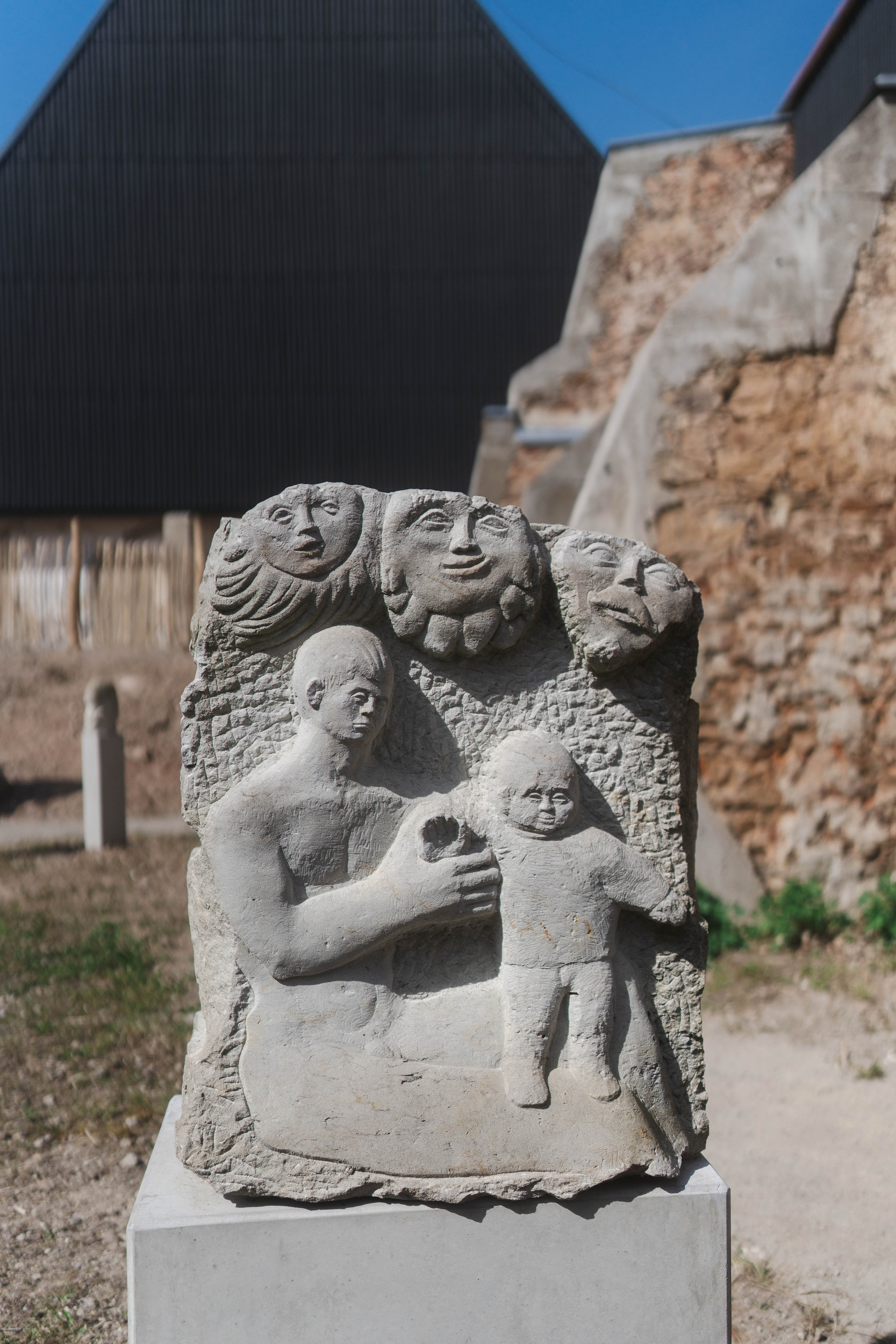
The historic "Drei Schwanen" inn is located in the town centre of Oederan, close to the market square. Napoleon once spent the night here on his campaign to Russia in 1812, and the old walls tell of its many uses: cigarette factory, nursery, fashion house, stove maker's shop and grocery shop. In recent decades, the building has stood empty and fallen into disrepair. Most of the building has now been demolished due to the risk of collapse, but it is worth taking a look behind the renovated façade. The stone sculptures of the "2nd Annaberger Impuls" artists' symposium, a project of the Capital of Culture Chemnitz 2025, will find a permanent home in the inner courtyard.