Arthur Heinrich Lippert: Labour our Blessing Source
Frankenberg

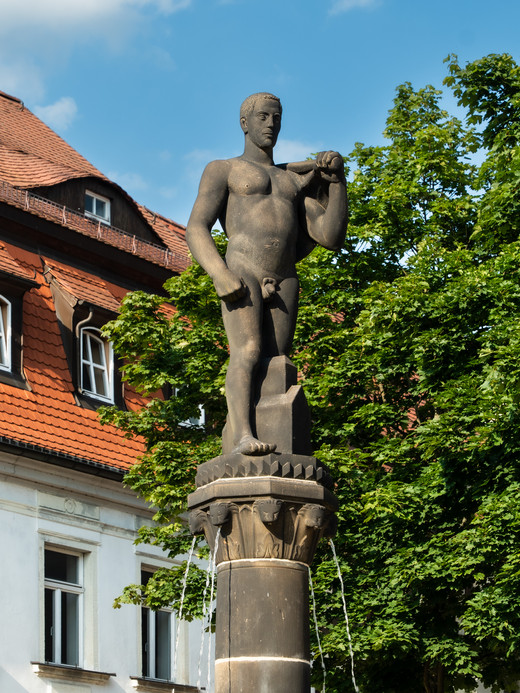
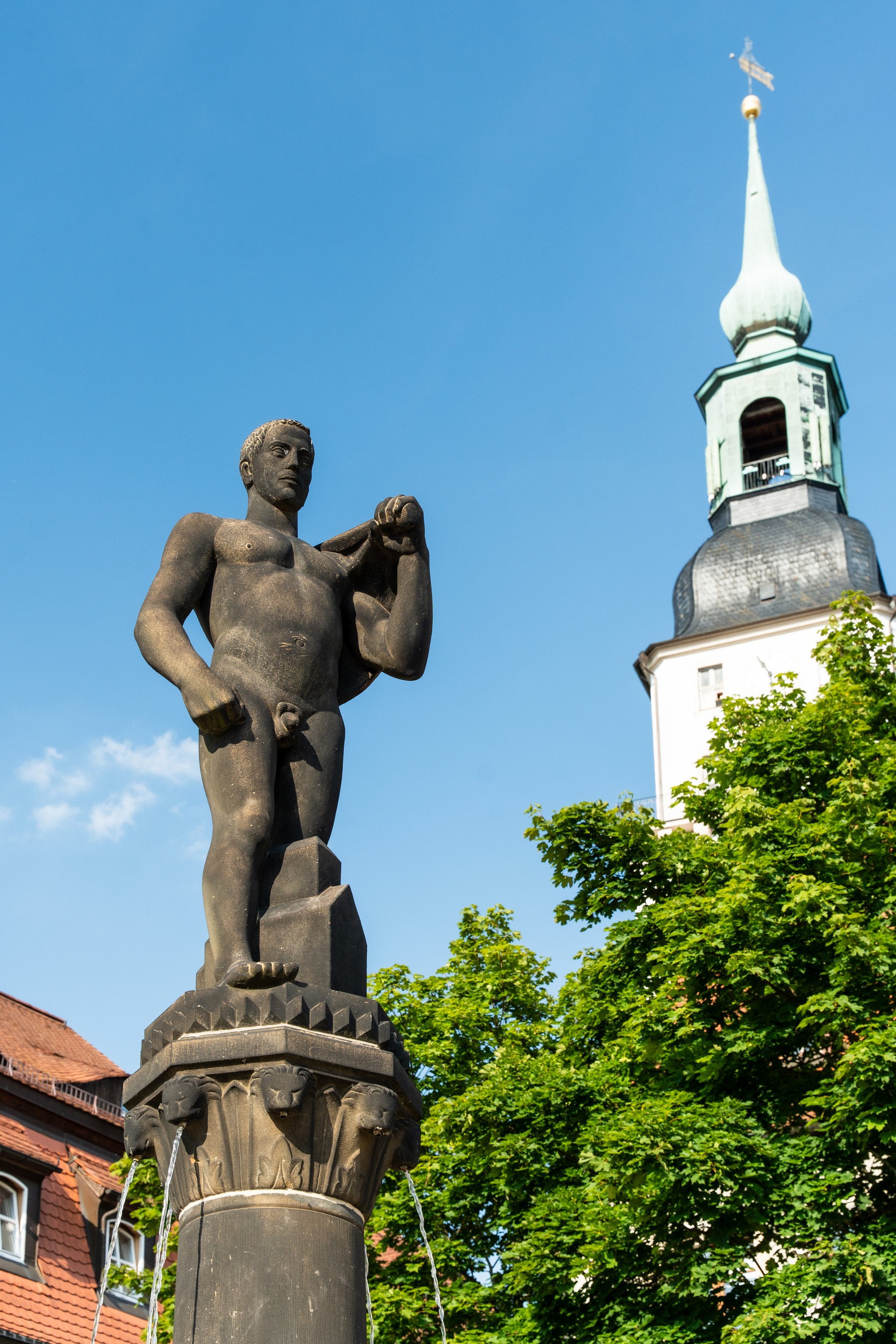
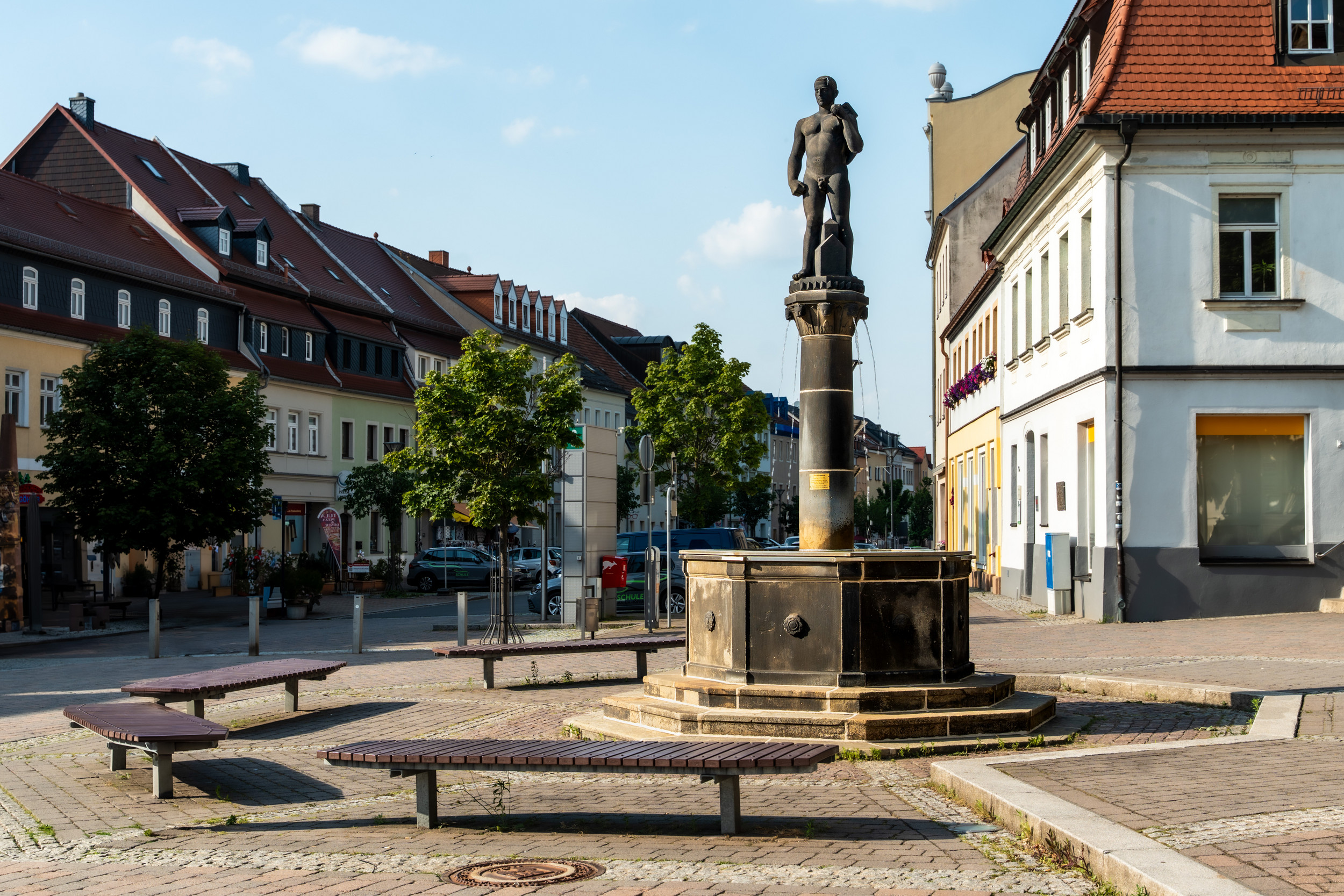
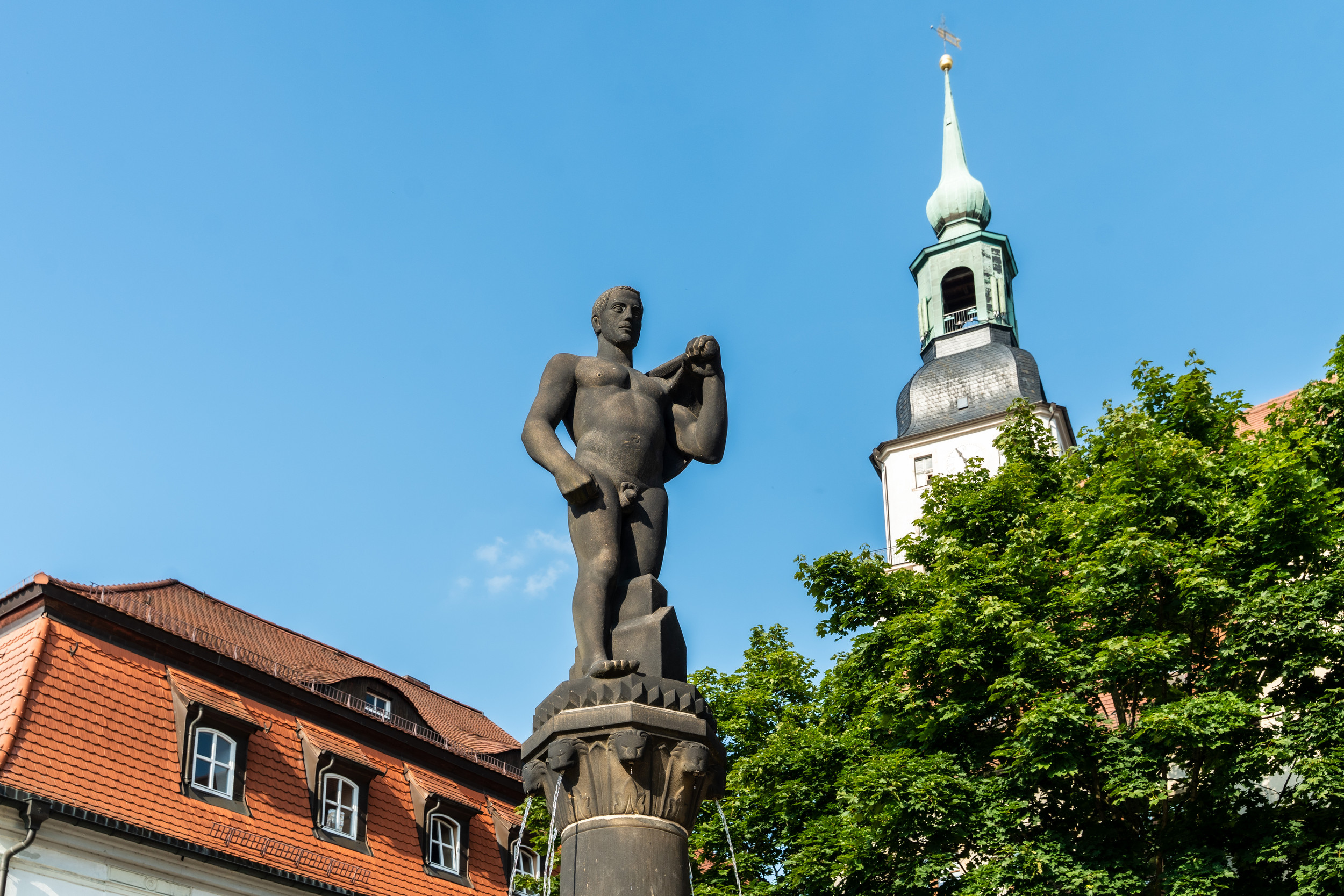
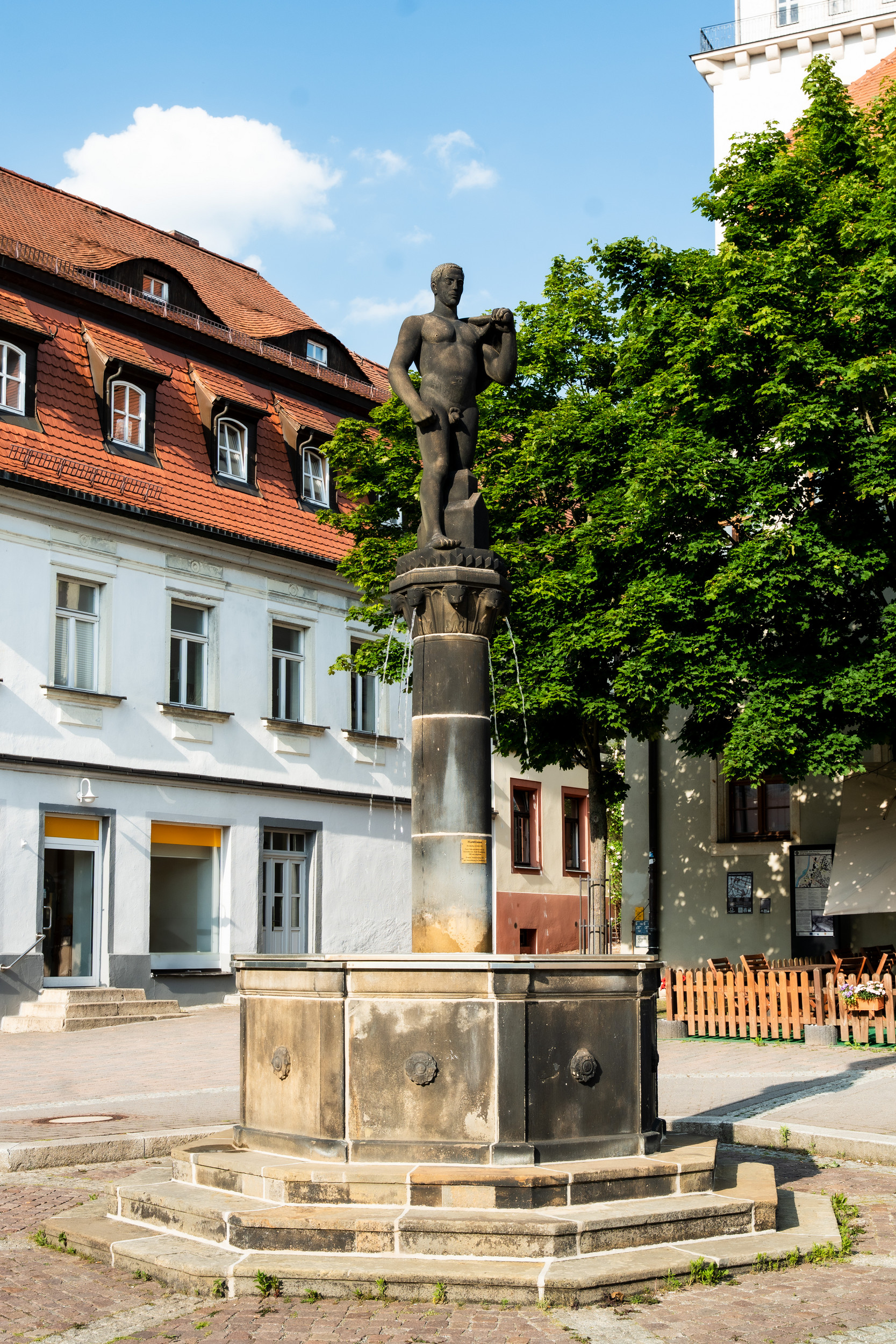
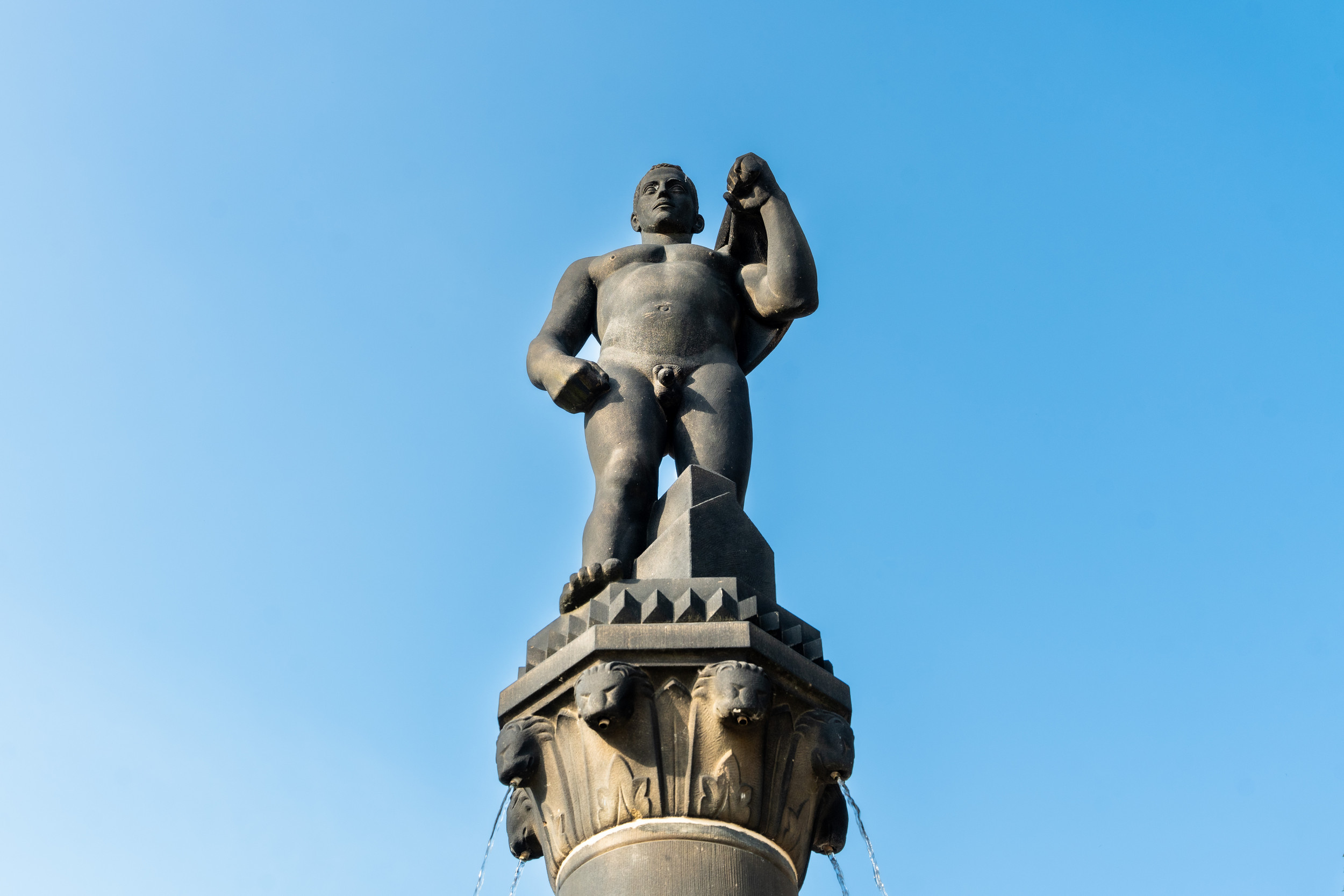
On a central, tall column in the basin of the Octagon Fountain on Frankenberg's market square stands a stylised figure of a naked man holding a hammer on his left shoulder, draped in lightly pleated fabric. A model house can be seen between the figure's legs and below its knees. Narrow streams of water flow from the column capital, which serves as the figure's pedestal. The powerful, expressionist representation, enhanced by the black-patinated Posta sandstone, was intended to reflect the working ideal of the German Empire, according to the plans of the Saxon Art Fund, which financed the sculpture. However, the project, which was to be implemented as early as 1914 at the suggestion of the Dresden Academic Council by the sculptor Arthur Heinrich Lippert, was delayed. This was because the artist Lippert, who was born in Waldheim in 1879 as the son of a chair maker and completed his master's degree at the Dresden Art Academy under the fountain sculptor Robert Diez, with whom Ernst Barlach also studied, was drafted as a soldier in the First World War at the beginning of the war in 1914. He continued to plan his sculpture for Frankenberg from the front. The hyperinflation that began in 1920 in the young Weimar Republic almost caused the project to fail again. Several appeals published in the Frankenberger Tageblatt in April 1921 raised the missing funds in a kind of municipal crowdfunding campaign, so that Lippert's work could finally be ceremoniously inaugurated on 7 August 1921.
Lippert's allegory of work survived all the divergent political systems of the 20th century, regardless of its creator's original artistic intention. While the people of Frankenberg in the 1920s saw the ‘Nakschen Mann’, as the fountain sculpture is popularly known, as a symbol of the powerful reconstruction after the end of the First World War, interpretations shifted under Nazi rule in the 1930s and 1940s to a symbol of nationalist work ideology. Lippert's work also seemed to fit in with the artistic understanding of Socialist Realism in the early GDR and its postulates of closeness to the people, partisanship and comprehensibility. After its restoration, the sculpture, which today has become the ideologically uncontested landmark of the city of Frankenberg, became part of the Purple Path: as an early testimony to communal-collective patronage and as a symbol of the shift in the interpretation of art in public space during the transition of political systems, as well as the centre of the ‘Skulpturenpfad Frankenberg/Sa.’ (Frankenberg/Sa. Sculpture Trail) initiated by the local art and culture association, featuring contemporary art.
(Text: Alexander Ochs / Ulrike Pennewitz)
Arthur Heinreich Lippert
Arbeit unser Segen Quell / “Nackscher Mann”
In Frankenberg/Sachsen
Frankenberg/Sa. in the Zschopau valley: Inventive. Memorable. Rich in experiences.
Frankenberg/Sa. was founded by Franconian settlers who immigrated here in the 12th century and founded a village of forest hooves. A so-called Hufe was a medieval unit of measurement that comprised a farm with land of a size that could support a family. As early as the 13th century, the town began to develop on a T-shaped layout, which can still be seen today in the main traffic arteries of the town centre: Schloßstraße, Baderberg and Freiberger Straße.
Clothmaking and linen weaving were already flourishing in the 14th century. The nearby river Zschopau provided the necessary industrial water and was the main supplier of energy, as the fulling mill on the Mühlgraben (16th century) shows. Today's townscape is characterised by new buildings following the great town fires of 1712 and 1788. 300 and 126 houses respectively fell victim to the flames. Frankenberg's early industrialisation also began during these times of reconstruction with the calico printing works and mechanical spinning mill.
Industrial town: textiles, printing, cigars and vehicles
Mechanics and machines determined the development of the town. in 1845, Carl Gottlob Roßbach printed the first modern newspaper on groundwood paper. More and more industries were attracted to the successful town, for example the cigar industry from 1842. During the Gründerzeit around and after 1870/71, the town grew enormously. The Wacker cigar company was the largest employer in the town at the time.
The townspeople were doing well and had money for consumption. This is why the famous brothers Salman and Simon Schocken from Zwickau opened one of their 20 department stores in Frankenberg/Sa. Around 1930, Schocken was the fourth largest department stores' chain in Germany. Under National Socialism, the building was expropriated from its Jewish owners in 1938. The building survived the war and the GDR era, but was demolished in 2015 after a long period of vacancy due to dilapidation. A work of art on the local sculpture trail commemorates this.
Place of remembrance: Sachsenburg concentration camp
Another important memorial site in Frankenberg from the Nazi era is the former Sachsenburg concentration camp, just a few kilometres outside the town. Established in an old textile factory in May 1933, it was one of the earliest concentration camps in Germany and the largest in Saxony until its closure in 1937. Kurt Müller, SPD politician and mayor of Frankenberg (1947-1950) was imprisoned here. He is the father of the famous playwright Heiner Müller, who graduated from high school in Frankenberg in 1948.
Technical pioneering spirit in the ZeitWerkStadt
For more than 60 years of the 20th century, the automotive industry was the economic engine of the town. From 1927, vans were produced under the name Framo - Frankenberger Motorenwerke. The best-known product is the Barkas B 1000, also known as the "VW bus of the East", which was manufactured in the GDR until 1991. Framo, Barkas and Roßberg's historic printing press can be seen in the ZeitWerkStadt adventure museum.
Exploring history
To explore the history of the town of Frankenberg, its people and industry, it is advisable to start in the historic old town. Guests can orientate themselves using the Industrial trail with 13 stations and the Sculpture trail with 20 contemporary and historical works of art, both of which start at the market square.
Altars to kneel at: Langenstriegis Protestant parish church
Langenstriegis is a district of the town of Frankenberg/Sa. Of particular note is the Protestant parish church, whose origins date back to the 12th century. Although it is located on Frankenberg territory, it belongs to the parish of Hainichen. The church that can be seen today is a newly built Baroque hall church from 1722, with only the Gothic choir remaining from the previous building.
During the GDR era, the church began to steadily fall into disrepair as the small parish had too little money for maintenance work. The socialist state at the time had no interest in financially supporting Christian congregations. In 2001 and 2002, the church was renovated and rebuilt thanks to a generous donation from the Rößner family from Wachwil/Switzerland.
The Gothic winged altar from 1520 is remarkable and the central figure in the altar shrine is a Pieta (Mary with dead Jesus). It dates back to around 1420 and is therefore probably the oldest work of art in the church. Further figures of saints adorn the carved altar. Paintings depicting martyrs in tempera on wood can be seen on the back of the wings.
The Langenstriegis church was part of the event series "Altar wrappings" on the Purple Path of the European Capital of Culture Chemnitz 2025.
People in the history of Frankenberg: Newspaper printers. Border crossers. Concentration camp prisoners.
The transformation processes in Central Saxony are associated with long-term changes in technology, the world of work and culture on the one hand, and with sharp political and social breaks on the other. In the 19th century, reading culture and modern newsprint were two pillars of the development of bourgeois society in Europe. Education and information were the driving forces behind a new political and emancipatory self-image. In 1845, Carl Gottlob Roßberg printed the world's first newspaper on modern groundwood paper in Frankenberg.
In the 20th century, the mass-circulation newspaper became an important instrument of political propaganda, for the Nazi dictatorship as well as for the GDR regime. The important playwright Heiner Müller and his father Kurt Müller came into conflict and became victims of concentration camp terror and cultural-political repression. In some places in Frankenberg, such as the former Sachsenburg concentration camp, historical memory and coming to terms with the experience of dictatorship play a particularly important role.
The innovative newspaper maker: Carl Gottlob Roßberg
in 1845, the world's first newspaper was printed on a new type of paper, groundwood pulp paper, at the C. G. Roßberg printing works in Frankenberg/Sa. This was an invention by Friedrich Gottlob Keller from Hainichen. in 1843, Keller succeeded for the first time in producing paper by hand from finely ground wood fibres and rags. Although it was initially only a partial run of 80 copies, this laid the foundations for modern paper production from wood fibres and fast newspaper printing.
From 1842, Roßberg published his "Intelligenz- und Wochenblattes für Frankenberg mit Sachsenburg und Umgegend" (later: "Frankenberger Tageblatt" until 1945). Initially, he printed on a wooden press that he had bought from the Brockhaus publishing house in Leipzig. On 11 October 1845, Roßberg made his first attempt at printing on Keller's groundwood paper. It was a success and became established worldwide over the next few years. In principle, this type of paper is still used for newspaper printing today. Rossberg's original printing press from 1845 can be seen in the ZeitWerkStadt adventure museum in Frankenberg/Sa.
The printing house developed in line with technological progress and introduced high-speed printing presses in 1863. It survived two world wars, the wave of expropriation during the GDR era and made the transition to a market economy with German reunification in 1990. From 1992, Christa Frohburg, née Roßberg, became the first woman in the fifth generation to manage the fortunes of the family business in the original building at Markt 8 (since 1854). In 2001, the company moved to a new building in the "Mühlbacher Straße" industrial estate in Frankenberg. in 2018, the traditional company closed its doors after 176 years.
Border crosser and playwright: Heiner Müller (1929-1995)
Born in Eppendorf/Middle Saxony in 1929, Heiner Müller spent some of his school years and early professional years in Frankenberg. His parents were social democrats, for which his father Kurt Müller (1903-1977) was imprisoned in the Sachsenburg concentration camp near Frankenberg in 1933. From 1933 onwards, the family lived in Bräunsdorf, and from 1939 to 1947 in Waren an der Müritz/Mecklenburg.
In November 1947, Kurt Müller was appointed mayor of Frankenberg. Heiner Müller completed his A-levels there in 1948. A portrait bust at the Martin Luther Grammar School shows Heiner Müller. On the Sculpture Trail Frankenberg/Sa. interested visitors can follow in the footsteps of the young Heiner Müller and other Frankenberg personalities.
Although Müller's father was a member of the SED, which was forcibly united from the SPD and KPD, he left the GDR for the West in 1950 due to political conflicts, followed by his mother and brother in 1951. Heiner Müller remained in the GDR, initially working as an assistant librarian in the Frankenberg municipal library from 1949 to 1951, before moving to Berlin as a freelance author. From 1957, he held a position as a research assistant in the German Writers' Association, Drama Department. He published his first plays at this time and received engagements at various theatres.
Between criticism, conformity and collaboration
The critical play "Die Umsiedlerin" was cancelled in 1961 and Müller was expelled from the Writers' Association. Despite ongoing critical disputes with the SED, other of his plays continued to be performed. He successfully straddled the line between social criticism and conformity and was offered a permanent position as a dramaturge at the famous Berliner Ensemble in 1970.
After signing a protest petition against the expatriation of singer-songwriter Wolf Biermann from the GDR in 1976, he was dismissed and then worked at the Berlin Volksbühne until 1982. By this time, he had already made a name for himself in West Germany with his plays, especially those that were not allowed to be performed in the GDR. After the fall of the Berlin Wall, he returned to the Berliner Ensemble (1992).
What remains of Heiner Müller are his poetic-dramaturgical border crossings and an internationally acclaimed oeuvre. What will also remain is the memory of an ambivalent biography, in which the history of the 20th century was reflected in broken form. Müller repeatedly clashed with the cultural policies of the GDR and was himself the victim of publication and performance bans. And yet, from 1979 to 1990, he worked as an "informal collaborator" for the MfS - Ministry for State Security of the GDR.
A long road to the memorial site: Sachsenburg concentration camp (1933-1937)
The Sachsenburg concentration camp near Frankenberg was the longest-running concentration camp in the early phase of the Nazi terror and camp system in Saxony. It was established in May 1933 in an old textile factory on the Zschopau river in the district of Sachsenburg. The National Socialists initially imprisoned their political opponents here, primarily Communists, Social Democrats and trade union members. It was initially run by the SA, and after the so-called "Röhm Putsch" in 1934 by the SS. From then on, it served as a training centre for the SS guard troops.
With its increasing radicalisation, the Nazi regime also had Jehovah's Witnesses, Jews, pastors of both denominations, conscientious objectors and criminals imprisoned here from 1935. When the camp was dissolved in September 1937, the inmates were transferred to the newly established Sachsenhausen and Buchenwald concentration camps. The SS guards also followed and with them the organisational principles and torture methods developed in the SS training centre.
Well-known prisoners at Sachsenburg concentration camp included:
- Kurt Müller (1933), SPD politician, mayor of Frankenberg from 1947-1950 and father of the playwright Heiner Müller
- Walter Janka (1935), active in the Communist Youth League and fighter in the Spanish Civil War, head of Aufbau-Verlag Berlin from 1953 and political prisoner in Bautzen from 1956-1960
- Bruno Apitz (1933), KPD member and writer, imprisoned in Waldheim prison from 1934-1937, then in Buchenwald concentration camp until 1945, the famous Buchenwald novel "Naked among Wolves" was published in 1958
Current research speaks of more than 10,000 prisoners during these four years, around 7,200 of whom are now known by name. Not all prisoner lists have survived. A red triangle on Sachsenburg's coat of arms commemorates the camp's political prisoners. During the GDR era, the building was once again used as a twisting mill, and since 1974 there has been a memorial room and a small exhibition. Since German reunification in 1990, various initiatives have endeavoured to reappraise the history of the site. The first complete academic account of the camp was published in 2018.
On the way to the memorial site
Sachsenburg concentration camp is an official memorial site in the Free State of Saxony, but many parts of the site are not accessible to the public due to dilapidation. The planning and construction measures for a memorial site have not yet been finalised. The Geschichtswerkstatt Sachsenburg e.V. provides information on its website with a photographic tour and documents.
Making the future: A typical mentality in Central Saxony
Innovation and a sense of tradition, openness and immigration have always ensured the survival of the Central Saxony region. All of this bears witness to the many transformations that go far back in history, some of which continue to this day. The region has always been on the move. People came and went with the economic ups and downs, reinvented themselves culturally and further developed crafts, technology and industry. This is still the case today. Vehicle production once played a major role in Frankenberg/Sa. Here, young people in particular can be inspired by the technical pioneering spirit of earlier times to come up with new ideas.
Experience museum of industrial history: ZeitWerkStadt Frankenberg/Sa.
Anyone visiting the ZeitWerkStadt adventure museum in Frankenberg/Sa. will quickly realise that Saxony has always been a land of technical pioneers. Many inventions that originated here became established all over the world. Printing technology, the textile industry, mechanical engineering and vehicle construction - many original exhibits bear witness to 200 years of industrial history. One of the exhibits is the printing press on which Carl Gottlob Roßberg printed the world's first newspaper on modern groundwood paper in 1845.
Fans of historic automobiles will be interested in the Framo and Barkas transport vehicles. Framo - Frankenberger Motorenwerke began manufacturing vans and cars here in the city in 1927. A predecessor company was Metallwerke Frankenberg, founded by the Dane Jörgen Skafte Rasmussen, who ran DKW, the largest motorbike factory in the world, in Zschopau in the 1920s.
During the GDR era, vehicle production was continued from 1957 under the Barkas brand. Between 1961 and 1991, over 175,000 units of the well-known B 1000 van were built in many variants. It was used as an ambulance by the Red Cross, as a crew van by the fire brigade and as a commercial van. This made the Barkas one of the most influential commercial vehicles in the history of the GDR.
But the ZeitWerkStadt not only has technology to look at, but also exciting hands-on and experimental stations. This is great and amazing fun, especially for children and young people. Technology and history can also be discovered in virtual worlds, for example in the Time Cube, an all-round projection with 116 monitors. Virtual characters from history accompany visitors through the exhibition and provide lots of interesting information.
With the kind support of Volksbank Mittweida eG