James Turrell: Beyond Horizons 2025
Oelsnitz

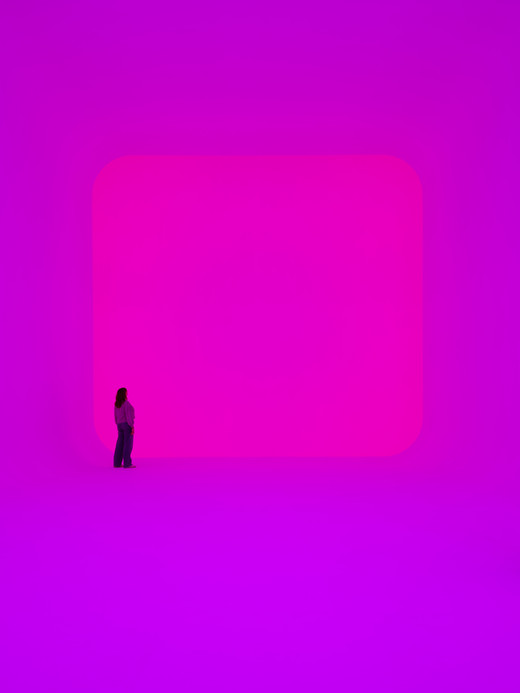
Born in Los Angeles in 1943, the "sculptor of light" James Turrell dissolved the paradigm of the physical work of art with the principle of pictorial nothingness. Inspired by the bright sunlight and colours of California's coastal landscape, the artist developed his atmospheric approach of "light-and-space" minimalism as early as the 1960s. The artist's intention was to create art that sees the entire situation, including the surrounding space and the viewer's body, as integral components, as "one". In the 1980s, Turrell expanded his principles so radically with his now famous "Ganzfelder" that not only the need for a physical object was eliminated, but also that of perspective space. Instead of art objects to be viewed, the perceptual principles of light and colour themselves became the main theme of his works. In the fields of coloured light created in this way, situations devoid of hierarchy and direction emerged that seem to level everything out and interweave the experience of emotional qualities of light, space and time into a continuum.
This is reminiscent of the romantic vision of a "path to oneself", as formulated by the Freiberg mining academic and poet Novalis in a combination of science and poetry. in 1798, he published his pantheistic-philosophical text of magical idealism "Blüthenstaub" in the journal "Athenäum" and formulated the Romantic slogan: "The mysterious path leads inwards. Within us, or nowhere, is eternity with its worlds, the past and the future."
The Oelsnitz Ganzfeld "Beyond Horizons 2025" consists of a sequence of twelve colour spaces, each of which dissolves into a stroboscopic thunderstorm and thus explodes the boundaries of perception. Turrell's light room is integrated into an outer shell made of Corten steel, which is surrounded by the restored steel frame of the former forge of the Oelsnitz mining company, painted in a vibrant green colour. The three-aisled industrial architecture, transformed by the regional office H2 ARCHITEKTUR by hendrik heine, interacts with Turrell's "Beyond Horizons 2025" to create a radically new interpretation of monument protection and thus an ambiguous Gesamtkunstwerk.
(Text: Alexander Ochs / Ulrike Pennewitz)
James Turrell
Beyond Horizons 2025
from the series Ganzfeld
The art installation is on permanent display at the Kohelwelt Oeslnitz.
Admission only after prior ticket booking:
The number of visitors is limited to around ten people per time slot to enable an intense experience of light and space.
On the first Wednesday of every month, visitors have the opportunity to book a free time slot in the mornings.
analogue to the opening hours of the Museum KohleWelt:
- Monday: closed (except on national holidays)
- Tuesday to Sunday: 10:00 - 17:00
- closed on 24 and 31 December
Please note: due to construction work, the art installation will be closed during the week of 2–8 March 2026 (calendar week 10)!
- Due to ongoing work on the lift system, the artwork is not fully accessible for the time being. After completion, barrier-free access to the artwork will be guaranteed.
- At the end of the exhibition space there is a fall edge that is not visually marked and is difficult to see depending on the light and visibility conditions.
- Access to the artwork with walking aids is not permitted. Visitors with reduced mobility can borrow a wheelchair on request. Covers are available for wheelchairs and walking frames to protect the floor of the artwork. Without these, wheelchairs and walking frames may not be taken into the artwork.
- The light installation contains stroboscopic effects that can trigger epileptic seizures at certain flash frequencies. People with epilepsy or at risk of epilepsy should stay away from the stroboscopic lighting areas.
- Further information on accessibility can be found in the house and visitor regulations:
to the house and visitor regulations of Oelsnitz/Erzgeb.
KohleWelt - Museum of Coal Mining Saxony
Pflockenstr. 28
09376 Oelsnitz/Erzgeb.
Unique experience
Anyone who enters "Beyond Horizons 2025" becomes part of the light. To ensure the intensity of the experience, the number of visitors per time slot is limited to around ten people. The feeling of time and space dissolves in a shadowless environment - silent, intense, unforgettable. The work is unique in Saxony and Germany - due to its size as well as in combination with the impressive remodelled industrial hall as an exhibition venue.
The Ganzfeld "Beyond Horizons 2025"
James Turrell's "Ganzfeld" work type refers to immersive light installations in which homogeneous, coloured light and the absence of visual boundaries create a complete dissolution of spatial orientation. The term "Ganzfeld" ("whole field" or "Ganzes Feld") originates from the psychology of perception and describes a state in which the eye no longer perceives any differences or depth information. Turrell uses this principle to make seeing itself a sensual and meditative experience and to fundamentally change the perception of light and space.
Light meets industrial culture
The walk-in light installation is located on the site of the former Karl Liebknecht Shaft in Hall 18. The three-aisled industrial hall, which was redesigned for this purpose by H2 ARCHITEKTUR by hendrik heine from Lichtenstein, represents a completely new form of monument preservation: the historic steel skeleton was removed, restored and re-erected together with the crane runway. The restored steel skeleton now encloses Turrell's fascinating world of light - a space in which colour, space and perception flow into one another.
Oelsnitz/Erzgebirge - A new look at the world of coal
From 1844 to 1971, coal determined the fortunes of the town of Oelsnitz/E. and its people. Today, there is nothing left of the black of the coal dust. The town has been transformed, particularly to the north of the town centre in the large railway station area, the former transshipment point for the coal.
in 2015, the Saxon State Garden Show "Blossom Dreams - Living Spaces" was opened here after extensive revitalisation. The large public community and family park on Bahnhofstraße is now the green lung for the people of Oelsnitz. The Oelsnitz-born writer Reiner Kunze and the Chemnitz artist Frank Maibier created a memorial to the coal industry with their art "Poetry of Energy".
The Mining Museum (since 1986) remains as a witness to coal mining. Several listed buildings from the years 1895 to 1935 have been preserved. The museum has been thoroughly restored in recent years, the exhibition has been modernised and now shines in a new light as "Kohlewelt". With the walk-in installation "Ganzfeld" by James Turrell, a new international highlight has been added in the truest sense of the word.
Significant collection of miner's lamps
Light is also an important theme of the museum exhibition. It is home to a large collection of miners' lamps from various mining eras. Heino Neuber, curator at the museum, is in charge of the collection. The development of the miner's lamp from an open light to a safety miner's lamp, which can be seen here, is a significant innovation.
It was invented in 1883 by Zwickau entrepreneur Carl Wolf. His lamp signalled the strength of the concentration of dangerous mine gas (methane) and has been a lifesaver for countless miners around the world ever since. Another great collection of these miner's lamps can be found in the Heimat- und Bergbaumuseum Reinsdorf, a few kilometres outside of Zwickau, on the site of a former coal mine.
"And it has its bright light at night "
Light once also had a symbolic meaning for the miners. Illuminated candle arches are a metaphor for the miners' longing for light. According to old mining custom, during the last shift before Christmas, the "Mettenschicht", candles were placed above the mouth of the dark mine tunnel or on the colliery house so that they formed an arc of light.
The light of the miner's lamp also plays an important symbolic role in the famous miners' song. The roots of this unofficial anthem of the Ore Mountains can be traced back to an old songbook that was printed in neighbouring Zwickau in 1531. Heino Neuber, who is also chairman of the Saxon State Association of Miners', Metallurgical and Miners' Associations, has told the fascinating story in his book.
Book tip: Heino Neuber: "Glück Auf! The miner is coming." All about the history and meaning of a Saxon folk song (series of publications on Saxon mining and metallurgy). Freiberg 2020
Reiner Kunze: Time of remembrance
The well-known writer, translator and GDR dissident Reiner Kunze was born in Oelsnitz in 1933, the son of a miner. He left the town at a young age and studied philosophy and journalism in Leipzig. kunze published his first poems in 1953. From 1962, he lived as a freelance writer in Greiz/Thuringia with his second wife Elisabeth, who came from the Czech Republic. He came into contact with the Czech literary scene through his wife. Since then, he has translated over 60 works into German.
In protest against the military suppression of the Prague Spring in 1968, Reiner Kunze resigned from the Socialist Unity Party of Germany (SED) and came under surveillance by the Ministry for State Security (Stasi). He encountered increasing difficulties in publishing his poetry in the official cultural scene of the GDR. He sometimes tried to evade publication bans by using pseudonyms.
in 1976, Kunze published the prose volume "Die wunderbaren Jahre" in West Germany. The manuscript had been secretly brought to the West. The harsh criticism of GDR conditions, the compulsion to obey and conform, led to his expulsion from the GDR Writers' Association. For Reiner Kunze, this meant a de facto professional ban, and the entire edition of his book "Der Löwe Leopold" (1976) was cancelled, even though it was ready to be sold. He applied for expatriation from the GDR on 7 April 1977 and was able to leave for the West on 13 April.
Today he lives with his wife near Passau. A stainless steel stele at the former "Vaterlandsgrube" bears Kunze's poem "Die Linde" and commemorates the connection between the town of Oelsnitz/E. and its poet.
THE LINE
We planted it
with our own hands
Now we lay
we bend our heads back
and read from it,
what we will find when it comes up,
remains in time
As if she forebodes it, she fills
the sky with blossoms
His poem "Unreal May Day" found a place on the former coal railway station, now a community and family park. It is part of the "Poetry of Energy" installation by Chemnitz artist Frank Maibier at the 2015 State Garden Show:
UNREAL MAYDAY
The cherry and must trees blossomed so much
that they turned
into white clouds
The village, bloomed,
floated away
With our white hair
we pretended to belong
and became weightless
Quotes from: Reiner Kunze: lindennacht. Gedichte, Verlag S.Fischer: Frankfurt/M. 2007, p. 21 and 28.
Frank Maibier: Poetry of Energy
The Chemnitz artist Frank Maibier created an installation entitled "Poetry of Energy" at the State Garden Show in Oelsnitz/E. in 2015. He explored the economic and artistic history of the town of Oelsnitz/E. by creating a floor mosaic from a tonne of hard coal. The result is a place of remembrance and poetry on the site of the former coal transshipment station - now a community and family park on Bahnhofstraße. The poem "Unreal May Day" by the writer Reiner Kunze is also part of the installation.
Frank Maibier was born in Werneuchen/Brandenburg in 1959 and completed an apprenticeship as a car mechanic. In 1989-91, he completed an evening course in mail art and graphics at the University of Applied Arts in Schneeberg. Maibier is involved in the Chemnitz art and culture association Oscar e.V. and in the Weltecho gallery.
Making the future: A typical mentality in the Ore Mountains
Innovation and a sense of tradition, openness and immigration have always ensured the survival of the Erzgebirge mining region. All of this bears witness to the many transformation processes that reach far back into history and in some cases continue to this day. The region has always been on the move. People came and went with the economic ups and downs, reinvented themselves culturally and further developed crafts and technology. This is still the case today. Even though mining in Oelsnitz/E. has been history for more than five decades, it has not disappeared from the cultural memory and traditions of the people.
From mine to mining museum (1844-1986)
On 7 January 1844 in Neuoelsnitz, Zwickau miner Karl Gottlob Wolf discovered a coal seam nine metres below the surface. The eventful history of the Lugau-Oelsnitz coalfield began with the founding of his mining company. the Kaiserin-Augusta shaft was opened in 1869. Rebuilt and extended several times between 1923 and 1940, it was considered one of the most modern coal mining facilities in Germany at the time.
After the Second World War in 1946, it was renamed the "Karl Liebknecht Shaft". When the coal deposits in the ground dwindled, the GDR decided to close the mine completely in 1967. In 127 years, the miners in the Lugau-Oelsnitz region extracted a total of 142 million tonnes of coal. The last shift was worked on 31 March 1971. Fortunately, not everything was demolished after the closure. The most striking surface facilities were preserved and rebuilt from 1976. The Oelsnitz Mining Museum opened on "Miners' Day" on 4 July 1986.
From mining museum to coal world: after three decades of museum operation, those responsible for the mining museum decided to make the building fit for the future. With an investment of 23 million euros, the town of Oelsnitz/E., the Erzgebirgskreis district and the state of Saxony jointly launched an all-encompassing renovation and renewal programme. The masonry, roofs, steel structures and technical installations of almost all the buildings have since been renovated.
Thanks to the latest findings in mining and regional research, the permanent exhibition and the tour have been redesigned. Many new exhibits have now been added to the museum's collection and will be made accessible to visitors. The exhibition design and the media presentation of knowledge resources are also being modernised.
In the course of 2024, the new "Coal World" is to be reopened as a large adventure museum with a wide range of offers on 1,000 years of hard coal in Saxony.
With the kind support of the Sparkassen-Finanzgruppe and Volksbank Chemnitz eG