Corina Gertz: The averted portrait
Photographs of miners from the Ore Mountains in traditional garb

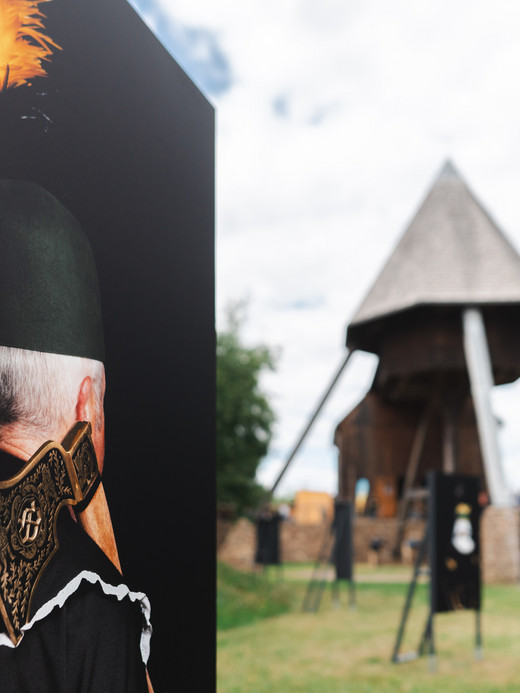
Since 2001, Gertz has been exploring clothing as non-verbal communication in her photographs - signs of class and status, group affiliations, regional identity, denomination and official function. She has been working on her series The Averted Portrait since 2010 and her work has been exhibited in international museums and galleries such as MARTA Herford, Shanghai Art Museum, National Museum of Singapore, Museo delle Culture del Mondo Genoa, and White Box Art Centre, 798, Beijing.
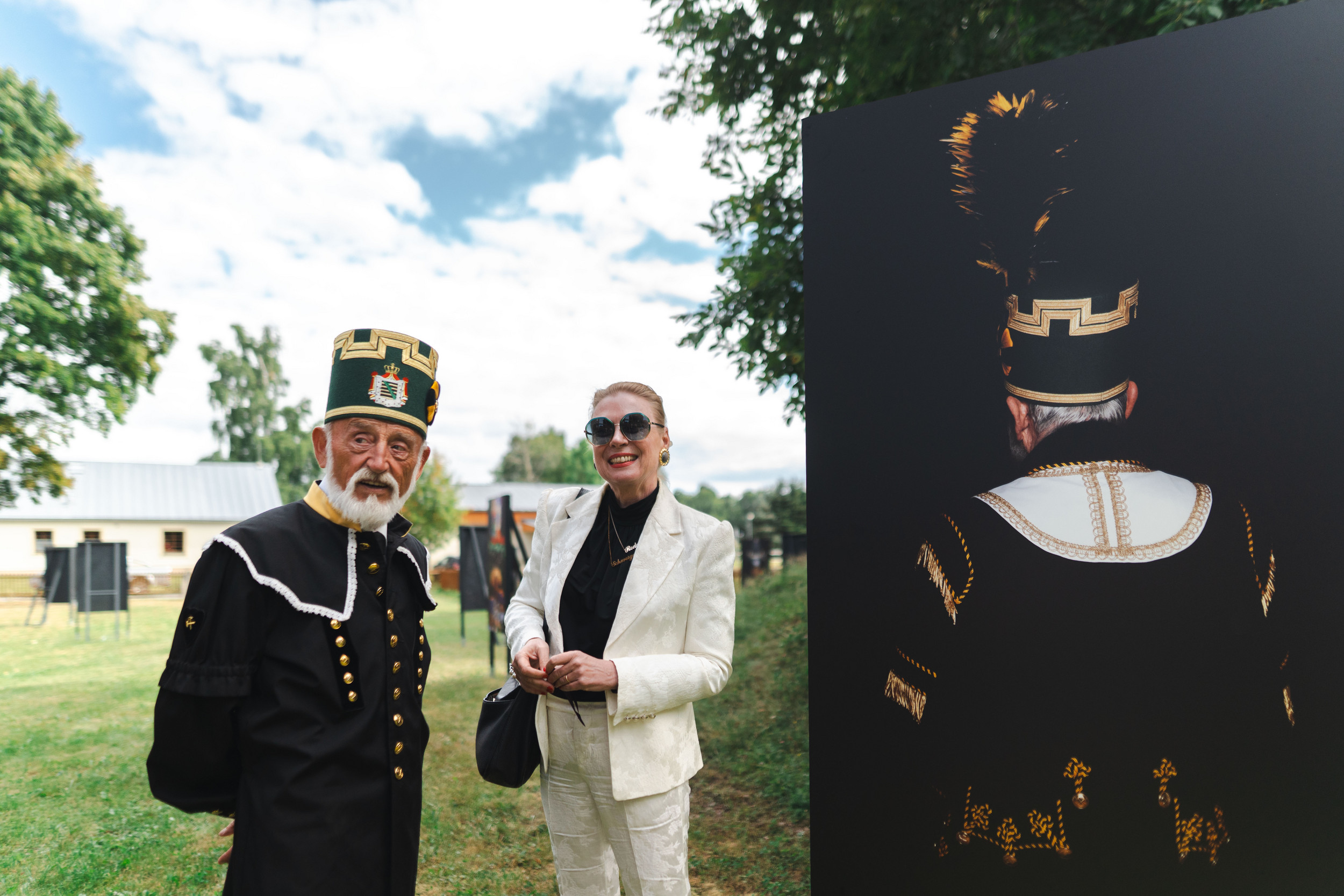
Corina Gertz photographs people all over the world in traditional dress. She deals with the threat to cultural heritage posed by globalisation. Her focus is on the seemingly quieter side of the portrait, the back views. The individual remains hidden, only the clothing carries information. At the same time, the front of the clothing is representative, conveying status and habitus, while the back is more intimate, personal and unnoticed.
In 2023, Alexander Ochs invited the artist to photograph members of mining fraternities and miners' organisations in the Ore Mountains in the same way. During a trip lasting several days, she visited Annaberg-Buchholz, Ehrenfriedersdorf, Freiberg, Marienberg, Oelsnitz/Erzgebirge, Schneeberg and Schwarzenberg, where she captured miners in front of the lens of her camera. These are now juxtaposed with motifs from China, Cuba, Kenya, France, Spain and Turkmenistan.
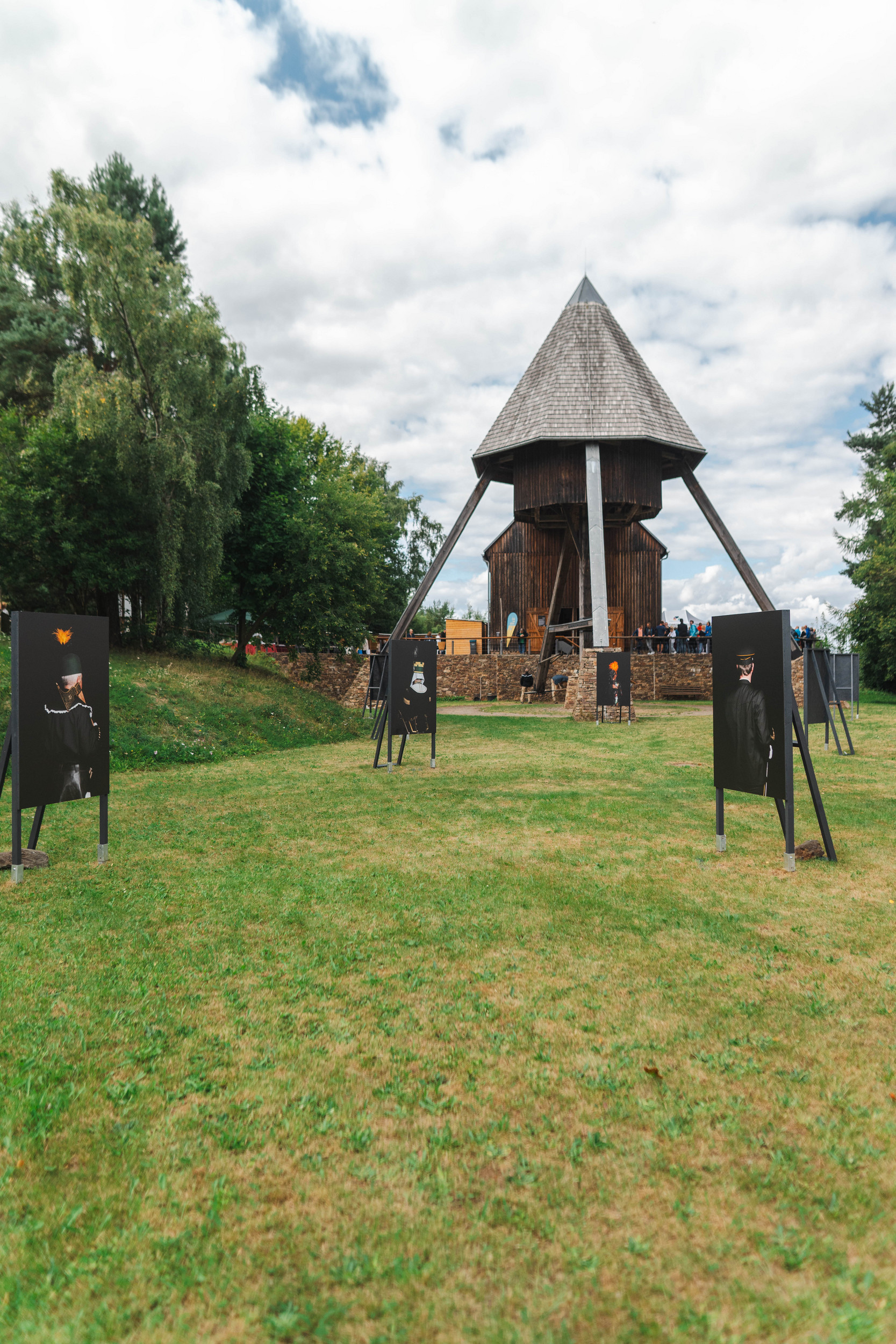
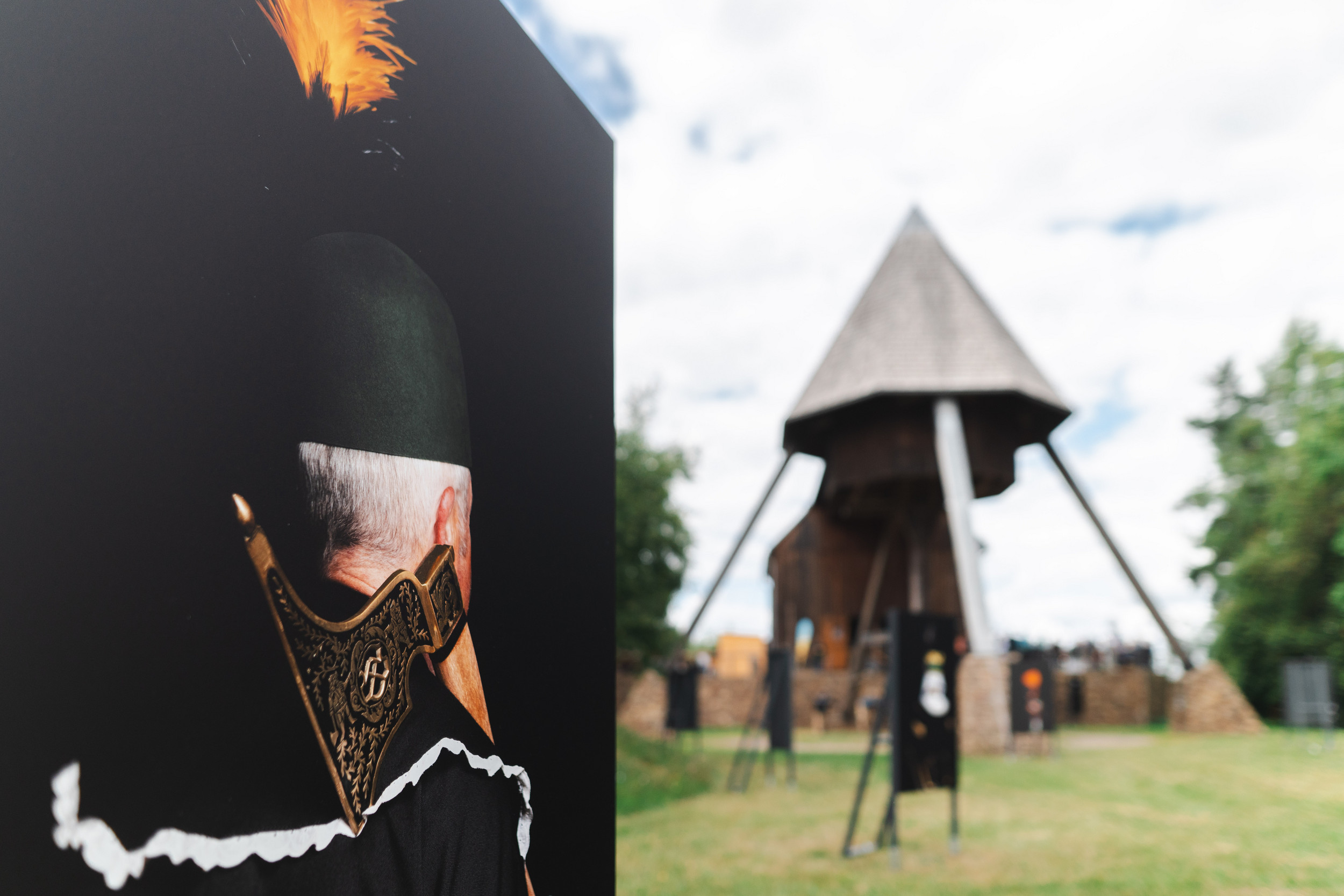
An exhibition has been created on the site of the historic horse-drawn pithead at the Rudolfschacht in Marienberg that turns the historic mine into a personal encounter. At the same time, it opens up the view by visualising the attention that is paid worldwide to the cultivation of culture and tradition. 20 larger-than-life "averted" portraits are located in the outdoor area, eight in the rooms of the shaft house and the cutting bench, and can be visited there until 2 November 2025 during the museum's opening hours.
Marienberg
Rudolphschacht (Lautaer Hauptstraße 12, 09496 Marienberg, Lauta)
Outdoor exhibition: Photographs, printed on aluminium Dibond • from spring to autumn • 1 May to 1 November 2026

Marienberg - the first ideal town of the Renaissance north of the Alps
in 1519, a man named Clemens Schiffel found the first silver in the Schlettenbach valley. Mining triggered an enormous influx of people, so that the Saxon Duke Henry the Pious decided to found another free mining town here. Between 1460 and 1560, 31 towns were founded or declared free mining towns, 16 of them on the Saxon side and 15 on the Bohemian side.
When Marienberg was built from 1521, the principles of the Renaissance for an ideal town were realised for the first time north of the Alps: a square central square and a right-angled arrangement of streets and houses. The planning of Marienberg according to the functional and geometric ideals of the Renaissance can be traced back to Ulrich Rüwlein von Calw (1465-1523). He is thus in line with artists such as Leonardo da Vinci and Albrecht Dürer, who also designed ideal town plans.
From mountain town to boomtown
Marienberg developed into a regional economic centre: there is evidence of 1,000 mines in the Marienberg mining district in 1555. The expansion of the town, education and culture followed the mining boom: Mining office (1525), Latin school (1530), construction of the town wall (from 1541), over 500 town houses and construction of the late Gothic hall church of St Mary (from 1558). Its architectural style follows the great models of St Annen in Annaberg-Buchholz and St Wolfgang in Schneeberg.
The entire square town centre can still be experienced today and is part of the UNESCO World Heritage Site Erzgebirge/Krušnohoří Mining Region. The market square with the town hall and town houses, the mining office, the prince's house, the Red Tower and Zschopau Gate of the town walls as well as the late Gothic hall church of St Mary's have all been preserved. A tour of the towers of the town hall or St Mary's is an impressive lesson in architectural geometry.
→ More information is available at the future Marienberg World Heritage Visitor Centre
→ Read more about Marienberg's historic old town centre
Technical monument: horse-drawn pithead on the Rudolph shaft
This technical facility in the Lauta district of Marienberg was particularly important for the mining industry. Horses ran in circles in these round buildings and used their muscle power to drive the reels, to which ropes or chains were attached and lowered. Vessels were attached to them to convey water or ore.
In 2006, the technical monument " Pferdegöpel am Rudolphschacht " was restored and a visitor centre was set up to provide information about how it worked. From 24 August to 2 November 2025, the exhibition "The Averted Portrait" by Corina Gertz was also on display here.
Altars to kneel at: St. Marien in Marienberg
The main altar in St Mary's Church in Marienberg immediately attracts everyone's attention with its rich ornamentation. The wooden pillar structure and the scrollwork decoration in the colourful Baroque style date back to 1617 and were created by Andreas Helmert. The altarpieces were painted by Kilian Fabricius, electoral court painter in Dresden. The figures of Moses and St John stand above the main field of the altar. They probably date from the 16th century by an unknown master.
The church's other furnishings include sacred works of art such as the late Gothic carved altar from a Freiberg workshop (16th century), a small carved altar with St Anne and St Barbara the Miner (16th century) as well as paintings, crucifixes, epitaphs and relief carvings (17th and 18th centuries).
Other planned ideal cities in Italy, Germany and the USA
Ideal city layouts from the Renaissance period are mainly known from northern Italian cities such as Ferrara, Mantua and Sabbioneta. All three are UNESCO World Heritage Sites. The "square city" of Mannheim, whose layout dates back to the 17th century, and the New York district of Manhattan, which was reorganised according to geometric principles in the 19th century, were built later.
Ore mining landscapes: silver, tin, cobalt, uranium, iron
Silver, tin, cobalt, uranium and iron represent the five ore mining landscapes that characterise the UNESCO World Heritage Site of the Ore Mountains/Krušnohoří Mining Region. Each provides visitors with insights into mining and processing in individual eras and illustrates the significance from a global perspective.
The humanist and physician, surveyor and city builder: Ulrich Rüwlein von Calw (1465-1523)
Ulrich Rüwlein came from Calw in Baden. The son of a miller, he went to the University of Leipzig to study philosophy, mathematics and medicine. He followed the "Berggeschrey", the lure of silver mining, to the Ore Mountains and entered the service of the Saxon dukes George and Henry. According to an old chronicle, Rüwlein is also said to have been involved in the planning of the mining town of Annaberg.
in 1497, he was appointed to the post of town doctor in the mining town of Freiberg. Here he also worked as a surveyor, master builder and mining expert, tinkering with compass and angle measuring instruments. In 1505, he published the first scientific treatise on mining in the German-speaking world: "Eyn wohlgeordnet und nützlich büchlein, wie man bergwerk suchen und finden soll".
His career continued to rise: in 1508, Freiberg granted him citizenship, in 1509 he became a councillor and from 1514 to 1519 he served as mayor. The region owes him the founding of the first humanist grammar school in the Duchy of Saxony (1515). He left the city in a dispute and returned to Leipzig as a professor of medicine in 1519.
In the last years of his life, Duke Henry the Pious, whose monument stands on the Marienberg market square, commissioned Rüwlein to design a building plan for the new mountain town of Marienberg. With his ideal square ground plan in the Renaissance style, Ulrich Rüwlein wrote himself into the topography and cultural memory of the region.
The inventor and mastermind: Friedrich Wilhelm Heinrich von Trebra (1740-1819)
Friedrich Wilhelm Heinrich von Trebra came from a Saxon-Thuringian noble family. He was enrolled as the first student at the newly founded Freiberg Mining Academy in 1765. After completing his studies in geology and mineralogy, he was appointed master miner in Marienberg in 1767. As an official of his sovereign Friedrich August III, he supervised the mining law and all mining activities in the Marienberg mining district. In the years that followed, he rose to the position of Deputy Mining Captain at the Freiberg Mining Office.
On the one hand, von Treba became nationally known through his friendly relationship with Johann Wolfgang von Goethe. At the time, Goethe was responsible for the administration of the mining industry in Ilmenau, Thuringia. The two were in regular personal contact, which included the exchange of collected minerals and rock samples. He also recruited Dutch mining companies, which invested in mines in Freiberg and Marienberg, among other places.
Important innovations can be traced back to von Trebra's expertise: the introduction of the Hungarian Hunt as a means of transport in the mine, the water column machine for generating hydropower as a successor technology to the water wheel and the improvement of geoscience for exploring ore deposits.
Von Trebra was socially and culturally committed with the introduction of health insurance for miners and the obligation to wear standardised work clothing. in 1769, the black miner's habit, which can still be seen today at traditional mining parades, was presented to the public for the first time. From 1806 onwards, he pushed ahead with his idea of establishing mining magazines throughout Saxony. These granaries were used to store grain in order to prevent crop failures.
Marienberg mine magazine: Museum of the Saxon-Bohemian Ore Mountains and German-Czech cultural centre
in 1806-1809, Friedrich Wilhelm Heinrich von Trebra took the initiative to build the Marienberg mining magazine as a granary. The storehouse, which was once used to prevent famine, is now a listed building. The massive, multi-storey stone building has been home to the Saxon-Bohemian Ore Mountains Museum since 2006. The transnational exhibition on the everyday life of miners and Erzgebirge folk culture in German and Czech is unique in the region.
Other exhibition areas include the history of the town of Marienberg and the history of the mining magazine. A particularly important focus is the exhibition "Germans and Czechs - Biography of a Neighbourhood". It comprehensively documents the political history of the 20th century, which has left its - sometimes painful - traces in the border regions to this day.
→ Read more about the Marienberg mountain magazine
Did you know that? Reform pedagogue Friedrich Fröbel (1782-1852) worked in Marienberg
Friedrich Wilhelm August Fröbel was a pioneer of creative early childhood education. Play education was at the centre of his concept. For him, play was not just a pastime, but the most important learning and educational tool. in 1840, he established the foundation of the "General German Kindergarten" in Blankenburg/Thuringia.
Child-friendly toys, movement and intellectual games as well as musical education were part of the educational programme, which was to be implemented by specially trained kindergarten teachers. In 1847, the 3rd Fröbel kindergarten in Germany opened in Marienberg.
Today, Fröbel's concept is recognised worldwide. In Germany alone, over 200 Fröbel Group childcare centres work according to his principles.
Innovation and a sense of tradition, openness and immigration have always ensured the survival of the Erzgebirge mining region. All of this bears witness to many transformation processes that reach far back into history and in some cases continue to this day. The region has always been on the move. People came and went with the economic ups and downs, reinvented themselves culturally and further developed crafts and technology. This is still the case today.
The last Habit tailor in Saxony: Markus Seiler
Markus Seiler runs his bespoke tailoring business (Trachten-Seiler) in the centre of the mountain town of Marienberg. Founded as a family business in 1977, the first things that catch the eye when entering the shop are country house dresses, leather waistcoats, loden and felt hats. And then a plain black jacket. It initially stands out from the other items of clothing, but is a familiar sight here in the region: the Freiberg mountain coat, also known as the Berghabit.
A Berghabit is worn in the Ore Mountains on festive or official occasions: on Miners' Day in Schneeberg or for mining parades at Christmas. The fittings and jewellery show the miner's origin, rank and function. Markus Seiler spends a good week sewing the puffer jacket, waistcoat, ass leather, knee breeches, knee leather and gaiters, attaching thirty buttons with mallet and iron and several metres of braided and velvet ribbon, fringes and cords.
The form, colour and manufacture are precisely regulated in the regulations for "Traditional costumes of miners and smelters in Royal Saxony" (1831). It is still the standard for preserving tradition today. However, the Berghabit is not only worn by members of the numerous mining brotherhoods, miners' and smelters' associations, but also by professors and students of the Freiberg Mining Academy, mayors and the Saxon Minister President Michael Kretschmer.
International mindset: Scherdel Marienberg GmbH
More than 30 years ago, Federnwerke Marienberg GmbH was taken over by the SCHERDEL Group from Marktredwitz/Bavaria. After years of continuous expansion of the product portfolio, SCHERDEL in Marienberg has developed into a global supplier of specialised technical springs. Its customer list includes global automotive manufacturers, for example. With over 1,000 employees, Scherdel is one of the largest companies in the Ore Mountains.
The employees also come from all over the world: Afghanistan, Japan, Ukraine, the Czech Republic - to name just a few nations. However great the differences in cultures, languages and personal histories may be here, the Scherdel team manages to integrate people in a unique way so that they feel at home here in the Erzgebirge. Openness and the will to get to know each other and have a common goal are crucial. In this way, initial language barriers can be quickly overcome. Read more: "Halfway around the world in one conversation" (Author: Carsten Schulz-Nötzold)
Villa Baldauf: Centre for art and culture
The brothers Carl Ludwig and Carl Theobald Baldauf founded the button and metal goods factory Gebrüder Baldauf in Marienberg in 1910. Their products, which were sold internationally, earned the company a good reputation worldwide. The factory also included an Art Nouveau villa with extensive grounds.
Since 2009, the Baldauf Villa has been a centre for art and culture. The centre is operated by the kul(T)our-betrieb of the Erzgebirgskreis. The rich calendar of events and exhibitions offers cultural events and concerts, art presentations and traditional Erzgebirge arts and crafts.
Leisure tip: Aqua Marien - Saxony's largest water world
The Aqua Marien water world is the largest adventure pool in the Free State of Saxony. Guests can easily spend the whole day here and enjoy a wide range of activities: Wave pool and swimming lanes, children's and adventure area, attractive sauna landscape and exquisite wellness programme.